By Katty Biglari
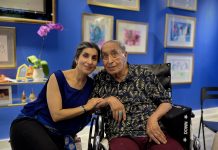
Masoumeh Seyhoun started the renowned Seyhoun gallery in her family home on Tehran’s Shah Avenue back in 1966. It went on to be the longest-running art gallery in Iran. Now, her son Nader and his wife Marjan Aleyasin have set up a successful offshoot in Washington, D.C.
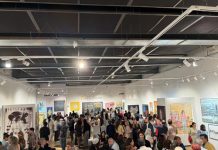
Gallery 1912 — opened by the couple in 2018 on the ground floor of their Georgetown home — continues the Seyhoun family’s mission: promoting established and emerging Iranian artists through times of turmoil, war, recession, and uncertainty. At the DC gallery’s openings, art enthusiasts socialize, buy works, and feel a connection to Iran.
Nader Seyhoun and Marjan Aleyasin recently joined Kayhan Life for a conversation about their experiences in the gallery world — both in the U.S. and in Iran — and their love of art.


Nader, you moved from Iran to the United States, then opened your gallery in DC. How has your vision as a gallerist changed?
Being in Washington, D.C. has broadened my perspective significantly. My vision has become more global, focusing on creating connections between Iranian artists and the international art scene, while maintaining the integrity and identity of their work.
Marjan, how do you divide up your responsibilities at Gallery 1912?
We operate very much as a collaborative team.
I lead the gallery’s outreach and visibility, managing our presence on social media, building relationships with collectors, identifying and bringing new artists to the gallery, and driving sales.
Nader focuses primarily on curating the exhibitions—working closely with artists, developing the conceptual framework of each show, and ensuring the overall artistic direction of the gallery.
This division allows us to balance the creative and business aspects of the gallery effectively.
How did you both decide on the name of your gallery?
The name ‘1912 Gallery’ comes directly from our address on 35th Street. We wanted a name that was simple, neutral, and not directly tied to the Seyhoun legacy, as the DC gallery has a distinct identity and focus. Our program is centered primarily on artists from the diaspora, and we offer a fresh platform with its own direction and curatorial vision.
Nader, when and why did you decide to join forces with your mother, Masoumeh Seyhoun, at her gallery in Tehran?
I grew up immersed in the world of art through my parents, Houshang and Masoumeh Seyhoun, and the gallery was always a central part of my life. Joining my mother, who had been managing the gallery since 1966, was both a natural progression and a conscious decision to continue and expand what she had built.
In 1992, after more than two decades away, I returned to Iran from France. I felt a deep sense of responsibility to support Iranian artists and to help sustain a space that had already become a cultural landmark.
Your father was a renowned architect. How did he influence you?
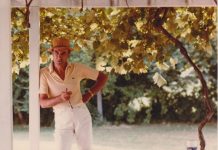
My father was one of Iran’s most celebrated architects, a man whose vision helped shape the cultural and architectural identity of the nation. His influence on me was profound.
Growing up, I watched him approach every project with an unwavering commitment to both form and function. He often spoke about the balance between performance and beauty, the idea that something must work well, but must also carry aesthetic and emotional weight. For him, great architecture was never purely utilitarian, nor merely decorative. It was the harmony between the two that made architecture truly meaningful.
That philosophy has never left me. In running a gallery, I have always tried to maintain that same balance, creating a space that is structurally sound in how it operates, while remaining deeply engaging and emotionally resonant on an artistic level. Just as my father believed that a building should move the people who inhabit it, I believe that a gallery should move the people who walk through it.
What year did the gallery become known as the Nader Seyhoun Gallery?
The gallery’s name changed to Nader Seyhoun Gallery in the early 1980s, at the onset of the Iranian Revolution. As is common during times of political upheaval, my mother was asked by the new government to change the name of the gallery, due to issues concerning my father at the time. She chose to rename it after her son, marking a new chapter, while preserving the legacy and identity she had worked so hard to build.
Did your mother continue to have input in the exhibitions and artist selections?
Yes, absolutely. My mother never stepped away from the gallery. Even in her most difficult moments of poor health, she was always present. Her love for her work and her devotion to the artists truly kept her going. Her insight and experience remained invaluable; she had an exceptional eye and a deep understanding of artists, and her guidance continued to shape the gallery.
At the same time, I was introducing new ideas and fresh directions to the program. For example, I organized the first street art exhibition ever held in a gallery in Iran, right there at the Seyhoun Gallery. Before that, this genre was virtually unknown to Iranian audiences. The response was remarkable.
How did the 1979 revolution impact the gallery, the artists, and the business?
In the immediate years after the Revolution, Iran’s artistic landscape underwent a profound transformation. Institutions were redefined, public expression was scrutinized, and many artists found themselves navigating newly imposed ideological boundaries. Some left the country and contributed to forming a vibrant Iranian diaspora art scene. Others stayed, adapting their visual language to survive and create within the evolving framework of cultural policy.
In the 1980s, which were marked by war and economic hardship, art was often framed within narratives of martyrdom, resistance, and religious symbolism. Yet even within those confines, artists found ways to embed metaphor, allegory, and deeply personal reflection. Persian visual culture, rich with centuries of poetic symbolism, became a subtle vehicle through which contemporary anxieties and aspirations could be expressed.
Interestingly, it was during this period, in the midst of the devastating war with Iraq, that the gallery experienced some of its highest attendance figures. People were desperate for an escape from the grief and heaviness of everyday life and turned to art as a refuge. They were eager to visit the few galleries that remained open and active. Seyhoun Art Gallery was always among them. There was something deeply moving about seeing people seek beauty and meaning in the midst of such hardship.
How did the art scene evolve after that?
The 1990s and early 2000s brought a relative sense of opening, and by around the turn of the millennium, Iran experienced a true renaissance in the visual arts. Painting, sculpture, photography, and installation art all flourished, and a new generation of artists emerged with bold, innovative voices that captured both local and international attention.
Galleries multiplied, art fairs emerged, and Iranian artists began gaining unprecedented international visibility. Tehran developed into a remarkably dynamic gallery scene, and auction houses began to spotlight Iranian modern masters alongside contemporary voices.
Perhaps one of the most heartwarming developments of this era was that going to galleries became a beloved cultural pastime. Fridays, when most galleries in Tehran traditionally hold their openings, became a cherished weekly ritual, particularly among art lovers and the younger generation. Gallery hopping on Fridays turned into a vibrant social and cultural tradition, with crowds moving from one opening to the next, discovering new artists, engaging with fresh ideas, and embracing art as an integral part of their lives. It was a beautiful and deeply encouraging sign that Iranian society’s hunger for art and culture was not only alive, but also thriving.
How did your exhibitions evolve over the years, before you left Iran?
Over time, exhibitions became more diverse and conceptually driven. While remaining rooted in Iranian modernism, we increasingly embraced contemporary practices and welcomed younger generations of artists, creating a dialogue between tradition and innovation.
We also expanded by opening a second branch, Seyhoun Art Gallery 2, which proved to be very successful. The second branch was larger in size and had high ceilings, allowing us to display very large-scale works, and opening the door to a new range of exhibitions featuring artists working on a grander scale. In 2016, we celebrated a landmark milestone, the gallery’s 50th anniversary — with events organized across both branches.
Why did you leave Iran?
Leaving Iran was not an easy decision. It was one that weighed heavily on us and was driven by a combination of personal, professional, and practical considerations.
On a personal level, we wanted our children to pursue higher education in the United States, a country with some of the world’s most exceptional universities, and offer them opportunities and experiences that would shape their future.
Professionally, after decades of dedicated work in Tehran, I felt a growing desire to expand my horizons and bring Iranian art to a broader international audience. I wanted to create new opportunities for the artists I had worked with and believed in for so many years, to give their work the global visibility it deserved. The art world is boundless, and I felt that the time had come to engage with it on a larger scale.
It was not a departure from my mission, but rather an evolution of it, carrying the legacy of Seyhoun Gallery forward into a new chapter, in a new part of the world.
How do you pick the artists that you represent?
Selecting artists is one of the most important and personal aspects of what I do. The decision requires both instinct and experience, built over decades of engaging with art and artists across different cultures and contexts.
First and foremost, I look for authenticity, originality, and a strong, consistent vision. Technical skill alone is never enough. What truly draws me to an artist is whether they have something meaningful and genuine to say — a distinct voice that is entirely their own. I also look for commitment and dedication to their practice over time, because great art is rarely the result of a single inspired moment; it is the product of years of discipline, exploration, and perseverance.
Selecting the right artist is not only about the work itself. It is equally about understanding the environment and the audience. Each country has its own cultural sensibilities, aesthetic preferences, and level of familiarity with different art forms. And a city can have its own distinct taste and art culture. What resonates deeply with audiences in Los Angeles may not have the same impact in Washington, New York, Paris, or Tehran. It is crucial to be attuned to these differences and make thoughtful, informed decisions.
Over the years, I have learned that representing an artist is a relationship built on mutual trust and shared vision. It is not simply a commercial transaction: It is a long-term commitment to nurturing a career, championing a body of work, and finding the right audience for it, wherever in the world that audience may be.
What was the first exhibition at 1912 Gallery?
Washington, D.C. is a city unlike any other, a global political capital where the conversation is dominated by diplomacy, policy, and power. While this gives the city a unique symbolic significance, it also presents a distinct challenge for the art world.
In the DMV area, most people are deeply immersed in politics and government, and gallery culture is not yet as deeply rooted or widely embraced as in cities such as New York or Los Angeles. Familiarizing audiences with the idea of visiting galleries and engaging with art on a regular basis is an ongoing effort, one that requires creativity, outreach, and patience.
With that context in mind, our inaugural exhibition at 1912 Gallery was a group show featuring a carefully curated selection of younger, yet already established, Iranian contemporary artists. We wanted to introduce Washington audiences to the richness, depth, and resilience of contemporary Iranian art, and to challenge any preconceived notions.
We wanted to demonstrate that while the post-Revolution era has been defined by volatility for Iranian artists, it has been equally defined by remarkable adaptability. Iranian artists have continued to create, to reinterpret tradition, and to speak, sometimes softly, sometimes boldly, through form, color, and material. They have found ways to express themselves under the most challenging of circumstances, and their work carries the weight and beauty of that experience.
In the end, perhaps the most striking feature of Iran’s artistic landscape since the Revolution is not its fragility, but its resilience. And it is precisely this resilience that 1912 Gallery was founded to honor and amplify, a testament to a culture that, despite uncertainty, continues to imagine, create, and endure.
What is your next exhibition?
Our upcoming exhibition presents a curated selection of contemporary works that explore identity, memory, and cultural dialogue, with both established and emerging voices. The works delve into themes of identity and memory.
At 1912 Gallery, every exhibition is a conversation, between the artist and the audience, between the past and the present, between where we come from and where we are going.