By Katty Biglari
The Iranian photographer Siavosh Ejlali — who lives and works in Karaj, Iran — is one of the winners of this year’s Sony World Photography Awards, a prestigious set of prizes that spotlight stories of our time.
Ejlali’s winning image “Lost Hope,” a tribute to Iranian women, was chosen out of more than 430,000 images submitted by photographers in more than 200 countries to the Open competition (which requires no entry fee). It was one of 10 category winners, and garnered the top prize in the “Creative” category.
Ejlali was also, in parallel, one of 10 photographers shortlisted for the Open Photographer of the Year award, which was given out earlier this month.
The photographer recently spoke to Kayhan Life in an interview.
Describe your entry “Lost Hope”, and what you wanted to convey through the image.
My photograph “Lost Hope” is a symbolic image reflecting social and psychological pressures, as well as the emotional weight, imposed on Iranian women in recent years. The black plastic covering most of the face represents dark thoughts and the imposition of beliefs and dominant narratives that restrict identity and personal freedom. The red balloon falling toward the ground suggests a fragile hope gradually slipping away.
The urban background points to contemporary Iranian society, the very space where women have raised their voices and stood for visibility, dignity, and proportional rights. The red tone of her clothing and lips refer to the heavy price women have paid along this path.
Ultimately, this image becomes the portrait of a generation that sees the possibility of improvement, change, and hope as increasingly minimal and distant. There is a sense of quiet stillness, as if the subject was standing in place, watching time pass and life unfold rather than shaping it.
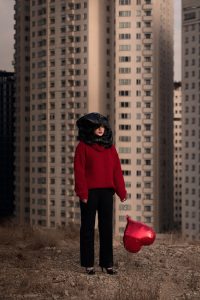
Copyright: © Siavosh Ejlali, Iran, Islamic Republic Of, Winner, Open Competition, Creative, Sony World Photography Awards 2026
When did your interest in photography begin? What was your first camera, and how did you get a hold of it?
My interest in photography began during my teenage years. I was maybe in middle school when my parents gifted me an analog Zenith camera, similar to the Zenith 122. Metering was quite complicated for me at the time, and I had to rely on a printed exposure chart to set the camera manually. I remember photographing landscapes, family members, and flowers in our yard.
During those years, I became acquainted with the veteran photographer Nasrollah Kasraian through a family friend, and we had the honor of hosting him in our home. He gave me three books: one featuring his photographs of Mount Damavand, another of Iran’s nomadic tribes, and “The Complete Photographer” by Andreas Feininger, which he had translated into Persian. I was deeply inspired by these photography books, but I was overwhelmed by the technical complexity of Feininger’s concepts — and stayed away from photography for a couple of years.
This was before my university studies, when the digital camera emerged in Iran, between 2005 and 2007.
A few years later, I received a semi-professional bridge camera as a birthday gift from my family. To my dismay, the backpack containing the camera was stolen from the trunk of my car, and I faced yet another disruption.
I purchased a professional DSLR, a Canon EOS 600D (also known as the Kiss X5), in 2010 with my savings and the support of my family. This marked the true beginning of my journey in photography. I upgraded to Nikon D750 in 2016, and with considerable effort, I recently acquired a mirrorless Nikon Z6 II.
In hindsight, the theft of the bridge camera had an undeniable influence on my photography career. The void heightened my interest in the discipline, and the purchase of a professional camera forced me to learn photography systematically. I started attending classes and workshops and devoured specialized books.
What was the first big achievement of your career?
It was probably the Kamal-ol-Molk Gold Medal at the 4th Khayyam International Photography Festival in 2017. It happened to be the first public presentation of my work.
It has been a challenge to participate in group shows, let alone have a solo exhibition. The reason is that most of my images do not pass the multiple layers of permits and approvals. For example, a couple of years ago, I had to submit 14 images for the censor to maybe approve one for a group show. The photos adhered to dress code requirements, but there was an issue with the content. I still remember the censor’s exact words: “Photos that are entirely about Azadi Square will be rejected.”
I dream of having a solo exhibition inside or outside Iran.
Which of your awards has had an impact on your career as a professional photographer?
Three of the awards had considerable impact. I won my first significant cash prize shortly after the Khayyam Festival; I was awarded $1000 at the Arbel Festival in Turkey. In 2022, making the shortlist in the Portrait category of Sony Photography Awards was important in terms of credibility.
In 2024, the publication of an article about my work in Art Market Magazine was more of a spiritual achievement than a prize for me. The article analyzed my photographic journey in addressing the role of a new generation of Iranian women in social movements.
You initially photographed members of your family. How do you select your subjects?
Sometime in the second half of the year 2019, the main focus of my work shifted to the young generation of Iranian women. I initially relied on friends and acquaintances, then started photographing non-professional and occasionally professional models. The photos of the latter group turned out more realistic and more to my liking.
Over the years, my focus has shifted, and I pick my subjects based on their mindset, perspective, and lifestyle rather than physical appearance. My preferred platform for communication is Instagram.
The model for the photo “Lost Hope” was Anis, a student in the Masters program in Industrial Design at Tehran University. She was an intelligent young woman with a deep understanding of current issues, and a suitable choice for executing my project.
How did the “Woman Life Freedom” movement impact your work? How did it change your outlook?
My work on the contemporary condition of women in Iran was evolving alongside broader societal changes. I was actively intent on capturing the shifts in a staged and concept-driven manner. I was influenced by the inescapable transformations in society, and worked hard to translate it into imagery.
How is the situation for photographers in Iran today, and what are the challenges? Can you travel easily and take pictures?
The situation for photographers in Iran today is a mixture of opportunity and limitation. Perhaps the most significant concern is the economic challenge. The cost of photographic equipment is tied to the dollar, whereas income, if a photographer is fortunate to have one, is earned in the local currency. This pressure is particularly heavy on fine art photographers, who often lack a stable commercial market.
In addition to economic concerns, there are also limitations and sensitivities as to the publication of photographs. Image and subject matter are expected to remain within specific frameworks to avoid legal consequences. Compared to previous years, the atmosphere has somewhat softened, yet we still occasionally witness the temporary suspension of social media pages of fellow photographers.
Photography in public places can also involve certain restrictions, depending on the subject and context. Nevertheless, photographers usually find ways to adapt and continue working within the existing conditions. Overall, Iranian photographers have learned to operate within this environment…with flexibility, creativity, and an awareness of contextual sensitivities.
In a way, these circumstances have encouraged a more metaphorical and multilayered visual language.
You have a Masters degree in innovation management from Amirkabir University of Technology. Are you working in that field, or teaching and engaging in photography?
I completed both my middle and high school education at the National Organization for Development of Exceptional Talents (Sampad) in Karaj. In 2009, I was admitted as part of the first group of students to the Masters program in Innovation and Technology Management at Amirkabir University of Technology (Tehran Polytechnic).
I work in the field of technology management, while pursuing photography seriously alongside my academic and professional career. Most of my photography work is done on weekends and holidays.
For the past seven years, I have also managed a Telegram channel with more than 4,600 professional members dedicated to international photography festivals and competitions. On this platform, open calls are organized, and selected works are reviewed and analyzed by experienced critics in terms of their technical and artistic merit. The critiques are compiled and published as a PDF booklet. So far, three editions have been released, and the fourth one is currently in preparation.
I also teach. I conduct courses in lighting and portrait photography and retouching, and workshops focused on staged photography, idea development and innovation.
The support of my family throughout this journey has been extremely important.
What is the role of a photographer in today’s world, when social media are inundated with images?
In today’s world, where social media platforms are saturated with images, the role of a professional photographer goes beyond merely producing a beautiful picture. In my view, a photographer can have impact only after achieving technical mastery within a specific genre or field. If we analyze a photograph in terms of form and content, or idea and execution, then quality, skill, and the ability to create a professional and well-crafted image are paramount.
Photography can become a platform for social impact, where art functions not merely as an aesthetic product, but as a means of raising awareness, fostering sensitivity, and elevating society’s perspective. This is my belief, having exercised this rewarding profession for the past 12 years.
Is there anything you would like to add?
I would like to thank Kayhan Life and teachers and colleagues who have supported me along the way: Ali Salman, Yasser Delbaz, Nassar Matraghi, Mohamadreza Rezania, Ramyar Manouchehrzadeh, and Azadeh Akhlaghi.