|
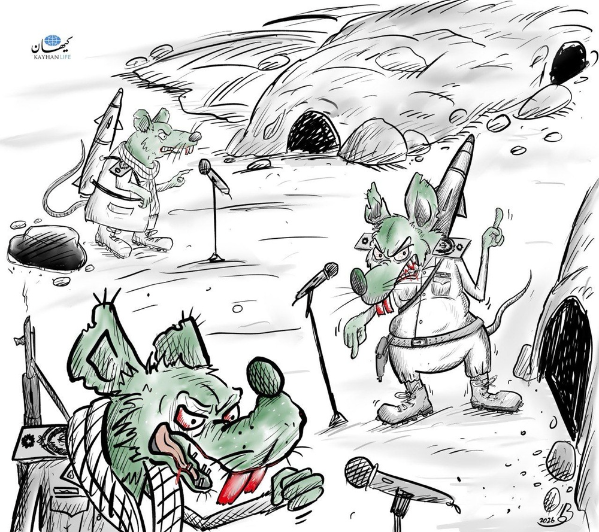
Bravado from the Burrows
By Behnam Mohammadi
Mojtaba Khamenei has not appeared publicly since the war began. In the absence of a visible Supreme Leader, the regime offered proof of life by the appointments of six battle-hardened commanders and their media-coordinated warnings against Iranians seeking regime change, U.S. and Israeli officials, and Arab states bordering the Persian Gulf. The regime’s loudest threats may also betray its deepest fear: an uprising fueled by Iran’s economic collapse.
Welcome to the Kayhan Life Week in Review
As the Islamic Republic attacked commercial shipping in the Strait of Hormuz and demanded concessions to reopen the waterway, the United Arab Emirates accused Tehran of “acts of piracy,” and regional powers formed a mutual-defense pact concerning Tehran’s aggression. U.S. forces disabled a vessel suspected of breaching the blockade, and maritime traffic fell to a fraction of prewar levels. Washington also targeted the regime’s sanctions-evasion networks. Tehran sought sanctions relief and compensation; President Donald Trump countered by demanding reparations for victims of the regime’s wars, attacks and suppression of protests. Inside Iran, triple-digit food inflation, currency collapse, unemployment and poverty exposed the regime’s profound fragility. Award-winning neuroscientist and human rights defender told Kayhan Life that the Islamic Republic was facing the gravest crisis in its history and exploiting the U.S.-Israeli war to intensify domestic repression. The urgent situation led the European Union and 32 countries to condemn the regime’s use of capital punishment to silence dissent. In a stark contrast, a photojournalist’s 15-year sentence inside Iran stood against the international celebration of Iranian talent.
►Diplomacy swung between threats and bargaining. President Donald Trump said his options were to let the Islamic Republic collapse economically or strike it “really, really hard.” Tehran conditioned reopening the Strait of Hormuz on compensation, sanctions relief, and an end to military threats, while Trump countered with demands of his own.
U.S. Warns Iran It Will Step Up Economic Pressure
Trump Says Islamic Republic Options Are Let Tehran Fail Economically or ‘Hit Them Really Hard’
Iran Ties Hormuz Reopening to U.S. Concessions on Several Demands
Trump Demands Islamic Republic Pay Compensation for Deaths as Hormuz Deal Hopes Fade
►The struggle over Hormuz intensified. The UAE accused the Islamic Republic of striking three vessels, while traffic through the strategic waterway fell from a prewar average of 130 to 140 ships a day to just six. U.S. forces separately disabled a cargo ship that allegedly ignored warnings against breaching the blockade on Iranian ports.
U.S. Can Keep Naval Blockade on Iranian Ports “Indefinitely,” Pentagon Chief Says
Iran, U.S. Make Competing Claims Over Control of Strait of Hormuz
UAE Says Iran Attacked ADNOC Vessels in Strait of Hormuz; No Injuries
Persian Gulf Shipping Traffic via Strait of Hormuz Falls to Six Vessels
►Turkey, Pakistan, and Saudi Arabia moved to reinforce their defenses by forming an alliance resembling NATO’s mutual-defense system, widely viewed as a deterrent to the Islamic Republic. Separately, a reported assassination threat from Tehran prompted Trump to leave Turkey aboard a secret military flight.
Turkey, Pakistan, Saudi Arabia Defence Pact Technically Same as NATO’s Article 5, Minister Says
Trump Took Secret Flight Out of Turkey Due to Islamic Republic Threat, The Washington Post Reports
►Washington also pursued the financial networks sustaining the Iranian regime. The Treasury sanctioned Dubai-based crypto exchange Shelbit and its founder, Iran-based Aban Tether, alleging that they processed millions of dollars for the IRGC and other sanctioned entities through a broader multibillion-dollar sanctions-evasion network.
US Sanctions Dubai Crypto Exchange for Aiding Iran’s IRGC, Following a Reuters Report
►Within the theocratic state, power shifted further toward unelected security institutions. Former IRGC commander Mohsen Rezaei, who previously suggested capturing 1,000 Americans and demanding billions of dollars for each to solve Iran’s economic problems, became secretary of the Supreme National Security Council, attaining his most powerful executive position despite repeated presidential defeats and an Argentine warrant over his alleged role in the 1994 AMIA bombing.
Mohsen Rezaei Appointed as Secretary of Iran’s Top Security Body
►The IRGC’s claims of strength were sharply at odds with daily life in Iran. Economists warned that triple-digit food inflation, a currency that has lost much of its value, widespread unemployment, and declining incomes were driving millions deeper into poverty. Since 2018, food prices have multiplied more than 34-fold.
Iranians Face Triple-Digit Food Inflation, Rampant Poverty, Economists Warn
►Fearing unrest, the Iranian regime intensified its crackdown. Professor Amiri-Moghadam who is the director of Iran Human Rights based in Norway told Kayhan Life about the disturbing shift in executions: in 2023–25, over 90 percent of executions involved drug or murder charges and just 3–5 percent security offenses. In the first seven months of 2026, 227 of 444 verified executions were for murder, including those who were executed on security-related charges.
The EU and 32 other countries, including France, the UK and Canada, condemned “in the strongest terms’ the Islamic Republic’s ongoing executions.
Iran Executions: Interview with Key Human Rights Activist Amiri-Moghaddam
EU, 26 Countries Condemn Iran’s Executions of Protesters
Iranian Photojournalist Faces 15 Years in Prison Over Images, Reporting
►Beyond the week’s conflict and repression, Iranian achievements received international recognition. Belgium’s King Philippe granted sociologist Firouzeh Nahavandi the title of Baroness for her academic accomplishments. In the United States, award-winning artist Rashin Kheiriyeh exhibited paintings inspired by Ferdowsi’s Shahnameh in Washington and Los Angeles.
Professor Firouzeh Nahavandi Is Granted Title of Baroness by Belgium’s King Philippe
Award-Winning Artist, Illustrator Rashin Kheiriyeh Exhibits in LA, DC
|