By Kayhan Life Staff
The Iranian economy is in a critical state: triple-digit food inflation, a collapsing currency and mass unemployment have pushed millions more people below the poverty line.
That’s the shocking picture laid out by economists and researchers in recent reports published in the Iranian media.
Trump Says U.S. Is ‘Low-Keying It’ With Iran, Stresses Economic Pain, According to Axios Interview
In an Aug. 9 article published in the Iranian newspaper Donya-e Eghtesad, the economist Massoud Nili compiled economic statistics and indicators illustrating how the structural crisis in the Islamic Republic has placed the economy under pressure from all sides.
The article notes that the exchange rate has soared 50-fold since the beginning of 2018. Over comparable periods in the past, it increased fourfold.
This 50-fold increase did not occur in a consistent manner, but over seven major currency crises which, like powerful earthquakes, shook Iran’s economy and left extensive damage in their wake.
Prices have increased 19-fold over the period, compared to other periods in the recent past, when they surged 3.5 to 3.8 times. Food prices have surged even more sharply, multiplying more than 34 times between 2018 and the present, compared with approximately fourfold increases during similar periods in the past.
Gross domestic product (GDP), which would normally increase roughly 1.5 times over eight-year periods, has shown very little growth since 2018. Over the same period, per-capita net national income has declined by approximately 12 percent.
Statistics also show that between 2018 and 2024, approximately 16 million more people were reported to be living below the poverty line. This increase has no precedent in earlier periods in the recent past.
Nili added that, in terms of employment, while approximately 5 million people have been added to the working-age population since 2019, net employment has increased by only 400,000. In those seven years, while an average of more than 700,000 people were added to the working-age population each year, only about 57,000 new jobs were created annually.
As a result, the economically inactive population has reached an unusually high level of between 39.5 million and 40 million people in recent quarters. Out of a working-age population of approximately 66.5 million, around 40 million people do not participate in the labor market, and an estimated 2.5 million others are unemployed.
Of the 66.5 million people who constitute Iran’s working-age population today, approximately 42 to 42.5 million people make no contribution to the economy, and only around 24 to 24.5 million are employed, including those working part-time. Particularly significant is the fact that young people aged 20 to 29 make up the majority of the economically inactive and unemployed population.
Referring to the unemployment rate — which escalated still further in the spring of 2026 — and to widespread poverty across various segments of society, Nili warned: “The strategic mistake is to regard these indicators merely as numbers and forget that they are not numbers at all; they are lives.”
“The lives of those who are sick today — whether they can gain access to medicine and treatment and recover, or whether their lives are left to a fate that we have determined. The lives of young people who could find jobs and build other lives for themselves, yet who may instead be driven toward the abyss of hopelessness, addiction, and crime,” he noted.
The cost-of-living crisis has also been highlighted in other reports and studies.
The Iranian Labor News Agency (ILNA), citing inflation statistics for July from the Statistical Center of Iran (SCI), reported that households must now pay, on average, 87.9 percent more to purchase the same basket of goods and services they bought in July of last year.
While the pace of price increases has slowed somewhat, the cost of goods and services has risen significantly compared with last year.
“The continuation of triple-digit inflation in food products, the significant gap between wages and living costs, and concerns about the emergence of new price shocks, particularly in the fuel market, are clear signs that the pressure of living costs on households remains in place — a reality that cannot in any way be denied,” ILNA said.
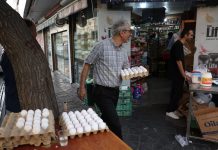
Albert Boghosian, a professor of economics at the University of Tehran, told ILNA: “The details of the statistics from the SCI show that the main burden of inflation remains concentrated on food products. Year-on-year inflation for the food and beverages group reached 128.1 percent in July. Although this rate was slightly lower than the 133.9 percent recorded in June, it still indicates that households are paying more than twice as much to purchase the same food basket as they did in July of last year.”
“At the same time, the gap between the income and expenses of working-class households remains deep. According to official estimates, the minimum cost-of-living basket for workers was estimated at around 45 million tomans (around $245) in March of last year, while the minimum wage for 2026 was set at 16.625 million tomans (approximately $100), eventually reaching approximately 22 million tomans (almost $118) with wage-related benefits,” Boghosian explained.
“Today, however, independent calculations indicate that the minimum cost-of-living basket is around 70 million tomans (nearly $374). Therefore, a worker earning the minimum wage faces a monthly shortfall of more than 40 million tomans (around $241) to cover the minimum cost of living — a gap that has made the continuing erosion of purchasing power one of the most important consequences of persistent inflation,” he added.
He also warned about the potential implementation of President Massoud Pezeshkian’s plans to raise gasoline prices under such circumstances, saying: “An increase in gasoline prices does not merely raise transportation costs. Because of inflationary expectations, it can also lead to higher prices across a wide range of goods, particularly food products, placing additional pressure on household budgets.”