By Nazanine Nouri
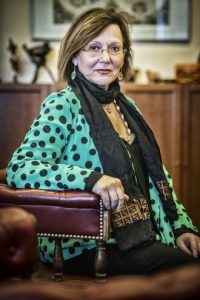
The Belgian-Iranian sociologist Firouzeh Nahavandi, Professor Emerita of Sociology at Belgium’s ULB University (Université Libre de Bruxelles), has been granted the title of Baroness by King Philippe of Belgium.
The title was conferred on the occasion of the Belgian National Day honors on July 21st in recognition of her distinguished academic career and her contributions to the study of the Muslim world, international development, and the status of women.

It was a surprise announcement which the Royal Palace made over the telephone a few days earlier, Nahavandi explained. In a July 21 interview with the Belgian channel RTBF, Nahavandi said she viewed this honor as recognizing a lifetime of academic work.
“I have conducted research, taught and written extensively, and I continue to do so,” she said. “This is recognition of the transmission of knowledge. For me, that is the most important aspect of everything I’ve done.”
Nahavandi is the author of several books on the Iranian Revolution and on the women of Iran (published in French).
She is also a frequent commentator in the French-speaking media on Iranian politics, the Middle East, Islam, women’s rights and international development.
In a June interview with the Qualita news outlet, she offered insights into what the war with the U.S. and Israel represented for the Islamic Republic.
“This war is also a question of survival for the regime, especially because domestically, the regime has not managed to control the population — despite the fact that the repression is very severe, that people are hanged every day, that arrests are continuing, and that a student rebellion is beginning to take shape,” she said. “The regime is unable to control the situation domestically. So it is determined not to lose face internationally.”
Nahavandi is the daughter of the late Iranian economist, academic and statesman, Houshang Nahavandi (1932-2025), who served as Minister of Development and Housing (1965-1968); President of Pahlavi University (1968-1971) and of the University of Tehran (1971-1976); Chief of Staff of Empress Farah Pahlavi (1976-1978); and Minister of Higher Education and Science (1978).
Born in Paris in 1955, Professor Nahavandi completed her secondary education at the French Lycée in Tehran before earning a PhD in social sciences from the Université Libre de Bruxelles. She spent most of her academic career as a professor at the ULB, where she founded and directed the Center for International Cooperation and Development Studies (CECID) from 1989 to 2021. She is also a member of Belgium’s Royal Academy of Overseas Sciences.
Nahavandi first became known for her research on the causes and dynamics of the 1979 Iranian Revolution with her 1988 book “Aux sources de la Révolution Iranienne.” She later expanded her scholarship to development theory and the sociopolitical evolution of Muslim-majority societies. More recently, much of her work has focused on the status of women in non-Arab Muslim countries including Iran, Afghanistan and Turkey. Her most recent publications include: “Être Femme en Iran: Quelle Émancipation?” (2023); “Les Visages de la Réislamisation” (2023); and “Femmes Iraniennes: Évolution ou Révolution?” (2025).