By Katty Biglari
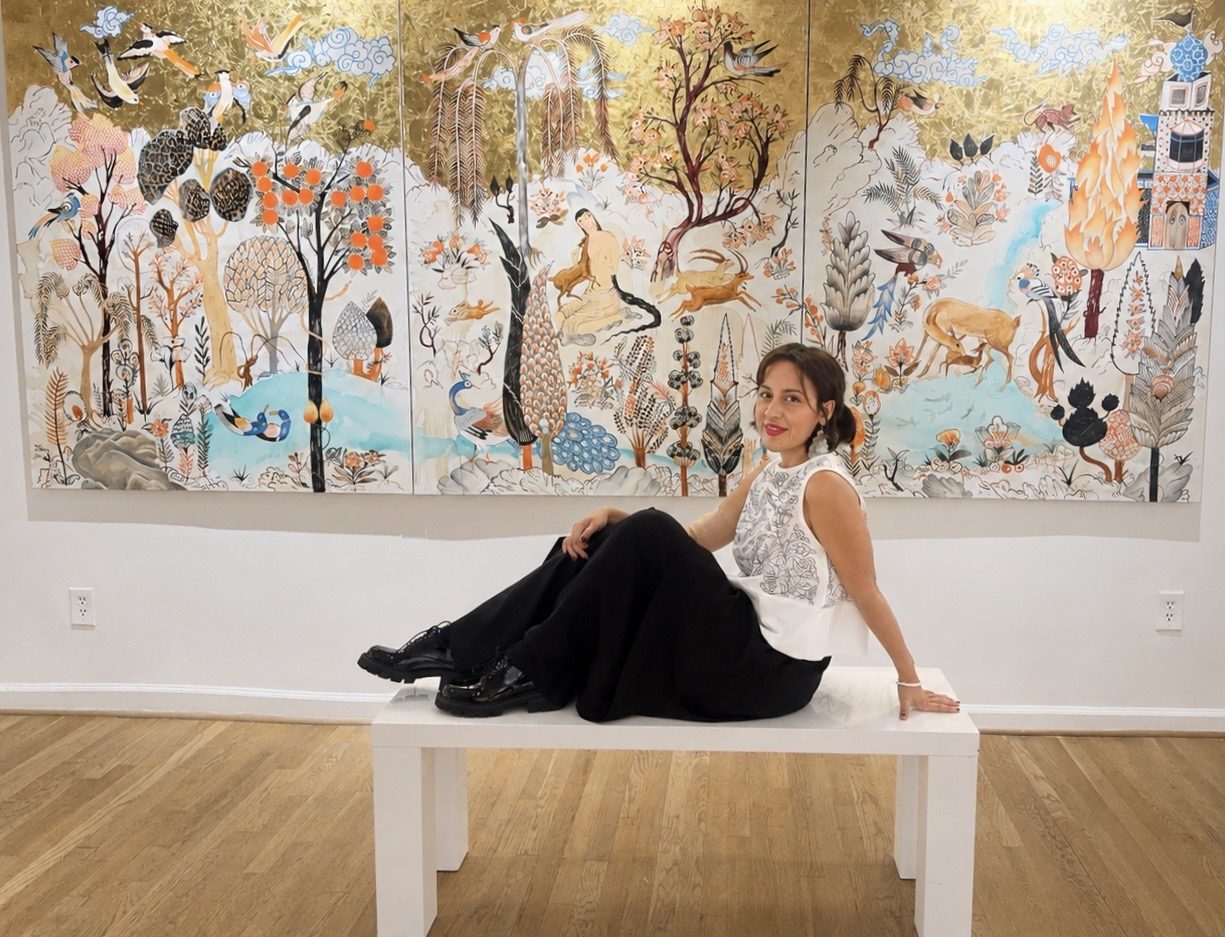
Rashin Kheiriyeh is an awardwinning artist and author who has written and illustrated 100 children’s books and who moved to the United States in 2011. This summer, she has been exhibiting paintings inspired by the Shahnameh (the Book of Kings, the 10th-century epic poem by the Persian poet Ferdowsi) at the Hillyer Gallery in Washington, DC, where she resides. They are also on display in a group show at the Advocartsy Gallery in Los Angeles.
Rashin studied at Al-Zahra University in Tehran, where she received her Masters of Fine Arts in graphic design and illustration. She won the Best Book of the Year award (granted by the Tehran Book Council) in 2005 and 2006, and in 2007, was one of 30 emerging contemporary Iranian artists selected for a traveling exhibition promoting cultural exchange in the United States.
The following is a recent Kayhan Life interview with Rashin.
You are inspired by classical Persian narratives, and strive to reconcile the distinct histories and narratives contained in the Persian and Western traditions. How did you approach your new Shahnameh series?
I grew up with the Shahnameh in Iran. It is an incredibly important book for Iranians and for anyone who loves Persian culture, history, and literature. I believe that through this masterpiece, Ferdowsi played an essential role in preserving Persian language, history, mythology, and cultural traditions for generations to come.
For me, the Shahnameh is both an ancient literary masterpiece and a living source of inspiration. The Shahnameh is full of fascinating stories, complex characters, love, tragedy, courage, conflict, and transformation. As an artist, I love storytelling, but I want to tell these stories in my own visual way
I am also interested in bringing my Persian cultural background into conversation with the Western artistic traditions that I have encountered while living and working in the United States. I hope to give this epic a new life through my own imagination.
How are the two exhibits in DC and LA connected, in terms of theme and execution?
The two exhibitions in DC and LA are connected through their themes and visual language. Both explore my relationship with Persian literature, mythology, memory, and storytelling, particularly the Shahnameh, but through a contemporary and personal perspective.
The paintings exhibited at Hillyer Gallery in Washington, DC will travel to the Advocartsy Gallery in Los Angeles, where they will be exhibited for a new audience in the near future.
The Shahnameh is full of fascinating stories, complex characters, love, tragedy, courage, conflict, and transformation. As an artist, I love storytelling, but I want to tell these stories in my own visual way. How were elements of different styles, such as Persian miniature and Surrealism, incorporated in the imagery.
I combine elements of Persian miniature painting with Surrealism to create my own visual language. In Persian miniatures, I draw inspiration from the flattened perspective, decorative patterns, simplified forms, and poetic relationship between figures, nature, and space.
Surrealism allows me to unleash my imagination, creating a world where anything can happen, even when it doesn’t follow the logic of reality. Figures can float, scale can change, and unexpected creatures or objects can appear.
This is how I approach illustrating literature. I am not interested in a word-by-word or literal interpretation of the text. Instead, I respond to the emotions, symbols, and deeper meanings within the story and translate them into my own visual world. The literature becomes a starting point for imagination rather than a set of instructions for what the image should look like.
Why do the stylized female figures with long black hair appear as nudes in your paintings?
The female figures are nude because I wanted them to feel timeless and pure. The nudity is not sexual; it represents the figure in her most essential and vulnerable state — without clothing that would place her in a particular time, social class, or historical period.
The long black hair connects her more specifically to my Persian visual language. For me, the combination creates a figure who feels both ancient and contemporary, vulnerable yet strong, and able to exist beyond a particular time or place.


The story of Rudabeh trying to drown herself and being rescued by the ship’s crew is not from the Shahnameh. Is it a reimagined story, or a metaphor?
Yes, it is a reimagining rather than a literal scene from the Shahnameh. The ship and the journey have deep symbolic meaning in classical Persian literature, including the Shahnameh. They can represent fate, transformation, and passage from one stage of life to another.
Rudabeh and Zal faced strong opposition to their love and marriage, and overcoming those obstacles was not easy. In my interpretation, the journey reflects that struggle and the transformation they had to go through.
The dragon in the ocean represents danger in a surreal and symbolic way. It gives a physical form to the fears, obstacles, and uncertainty surrounding their journey. Rudabeh’s rescue, therefore, is not meant as a historical event from the Shahnameh, but as a metaphor for surviving those dangers and moving toward a new life.
You are recognized for illustrating children’s books, including Welcome Uncle Nowruz, published in 2026. What was the first children’s book you published? How does your personal journey inspire your stories?
My first published children’s book was Peyvand-e Do Darya (پیوند دو دریا), which means The Union of Two Seas. It was published in Iran by Kanoon, the Institute for the Intellectual Development of Children and Young Adults in 2000. The book was a religious narrative about the marriage of Imam Ali and Fatemeh.
My personal journey has always been closely connected to my work. I grew up in Iran surrounded by Persian literature, poetry, mythology, art, and traditions. From my very first book, storytelling and cultural narratives have been an important part of my artistic practice.
Moving to the United States gave me a different perspective. Living between two cultures has influenced the way I think about identity, memory, belonging, and storytelling.
Many of my stories begin with something personal: a childhood memory, a Persian tradition, a piece of literature, or an experience of living between cultures. So, literature, narratives, and storytelling have always played a major role in the creation of my artwork.
You have illustrated books for other authors. How does that compare to illustrating your own stories?
When I illustrate a book written by another author, I first try to understand the heart of their story and connect with it emotionally. I respect the author’s words, but I also look for what I can bring to the story visually.
When I illustrate my own stories, the process is different because the words and images often develop together. I have more freedom to think visually from the very beginning, and sometimes an image can even change the direction of the writing. I can decide what needs to be said with words and what can be left entirely to the pictures.
In both cases, I see myself as a visual storyteller and enjoy either way.

What projects are you excited to explore next?
I am excited to continue exploring Persian literature, mythology, and classical narratives, especially the Shahnameh. There are so many fascinating stories and characters that I haven’t explored yet.
I am also interested in creating soothing, contemplative spaces through my paintings, almost like a Zen garden: a place you wish you could enter, spend time in, and feel peaceful. I want the viewer not only to look at the painting, but to imagine being inside its world.
My idea is to bring a piece of the Persian garden into our daily lives, not simply as something belonging to Iran’s past, but as a living and evolving culture.