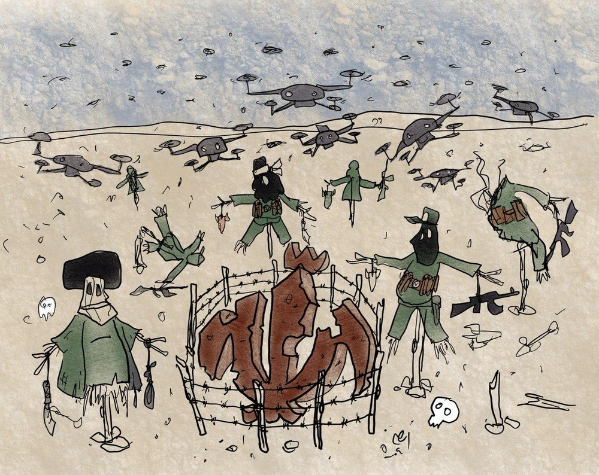
Artist: Ahmad Barakizadeh
The Scarecrow Republic
Across the Middle East and extending to Africa, the Islamic Republic’s vast network of influence is showing signs of decay. The ideological project that once fueled militancy now resembles a deserted field — its old symbols of resistance standing like scarecrows.
In Iraq, the government is being pressed by the U.S. to dismantle militias backed by Tehran. Washington is also targeting individuals who have diverted millions from Tehran to Hezbollah.
In southern Lebanon, Israel has intensified strikes on Hezbollah positions to prevent rearmament, as the Lebanese Army takes a rare step toward disarming the group. Israeli operations have also extended to the clerical state’s drone supply chains in Africa, while Egyptian mediators in Rafah urge weary Hamas fighters to surrender their weapons in exchange for safe passage.
At the center of this surreal wasteland lies the heart of the old struggle. It once beat with promises of liberation and paradise; now it sits, fenced and rusting.
Even in Iran, the revolutionary defiance has given way to contempt for the theocracy. The old, repetitive slogans strain the eardrums of the one-time warriors, who are kept awake at night by the hungry rumble of their empty stomachs.
The scarecrows still stand, relics of an empire built on defiance. Their heads are sacks, not of ideas, but of sand.
Welcome to the Kayhan Life Week in Review
►There was more embarrassment for the Islamic Republic of Iran this week, as its corrupt and brutal treatment of ordinary Iranians was exposed at the same time as questions were raised about its increased reliance on Russia, more sanctions were imposed on Iran’s banking sector, and several countries revealed the extent of the regime’s malign activities on their soil.
In his report, Ahmad Rafat of Kayhan Life delves into the complex relationship between the Islamic Republic and Russia, exploring why it is undermining the theocratic state’s unity of purpose. Critics warn that Tehran is becoming a pawn in Russia’s geopolitical games — used merely as leverage in Moscow’s dealings with the United States, Europe, or regional powers. They argue that restoring relations with the West should be Tehran’s priority. The Russophile figures insist that Russia, the clerical state’s strategic partner, will never abandon the theocratic state in its confrontation with the West.
►That confrontation continued this week, with new sanctions imposed by the UK. It targeted Ali Ansari, the founder of Ayandeh Bank, which was stripped of its license by the Islamic Republic of Iran’s Central Bank last month due to allegations of corruption and mismanagement over several years. Ansari stands accused of “facilitating and supporting the hostile activities” of the Islamic Republic, and its Islamic Revolutionary Guard Corps (IRGC), which oversees most of Iran’s financial sector.
Roshanak Astaraki of Kayhan-London explains how Ayandeh Bank exemplifies the phenomenon within the Islamic Republic, where public wealth is siphoned off through complex networks of money laundering and patronage, enabling figures such as Ansari to amass enormous fortunes.
►The widening gulf between privilege and poverty has deepened social unrest, prompting the regime to respond with brute force. This was highlighted by the death of a Monarchist activist Omid Sarlak, who set fire to a picture of Ayatollah Ali Khamenei, and posted the act on social media. In the accompanying social media post, Sarlak from Aligudarz in Lorestan, wrote: “How long humiliation? How long has poverty been? It’s time to take the plunge, youth.” Twelve hours later, Sarlak’s bruised and lifeless body was found in his car.
The authorities claimed the death was a suicide, while relatives and activists accused the state of killing him for his act of dissent. The day after Sarlak was laid to rest, Seyyed Ahmad Khatami, a member of the Assembly of Experts, announced that any act of defiance against Khamenei would be punishable by death.
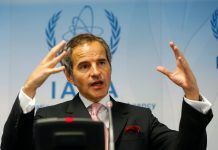
►Internationally, the Islamic Republic sought to offer tokens of appeasement, including allowing the international atomic watchdog limited access to its nuclear facilities. That effort was criticized by International Atomic Energy Agency chief Rafael Grossi, who told the FT that while the IAEA has carried out about a dozen inspections in Iran since hostilities with Israel in June, it had not been given access to nuclear facilities such as Fordow, Natanz, and Isfahan, which the United States bombed.
►Meanwhile, the extent of the Islamic Republic’s attempts at infiltrating what it calls hostile states was brought to light by the Australian Security Intelligence Organization, which said the IRGC had been behind two anti-Semitic attacks in August in the country. Its director-general of security, Mike Burgess, said the attack was part of a global campaign by the Islamic Republic to stoke anti-semitism around the world. Iran and Israel are long-time foes vying for power in the Middle East.
►A similar alarm was raised in France by the “France 2050” think tank, which accused Tehran of spying on the Iranian diaspora and infiltrating several universities to stoke unrest. The think tank aims to convince French lawmakers to launch an inquiry into the extent of this infiltration.
►Also in France, President Emmanuel Macron said that the Islamic Republic of Iran had freed two French nationals, Cécile Kohler and her partner, Jacques Paris, who had been detained for more than three years. Their release coincided with the arrest of student Mahdieh Esfandiari over anti-Israel social media posts she produced. The Islamic Republic has been accused in recent years by international human rights bodies and states of “hostage diplomacy,” arbitrarily detaining dual and foreign nationals for leverage in diplomatic talks.
►On the human rights front, Natasha Phillips of Kayhan-Life reports that the United Nations condemned the Islamic Republic’s persistent abuses in a report by the Independent United Nations Fact-Finding Mission (IFFM). The mission found that men in the Islamic Republic were murdering female relatives with no repercussions for their crimes. The UN commissioned experts said the Islamic Republic had failed to hold those responsible to account.
►In a positive development, women and girls in Iran attended a soccer match in the Iranian city of Mashhad to watch the Hazfi Cup. Females have historically been banned from attending soccer matches in the Islamic Republic for various reasons, including preventing them from seeing men’s bare legs. When female attendance has been allowed, it has often been in limited numbers and with the provision of the poorest seats in the stadium. The FIFA President Gianni Infantino welcomed the news and called their attendance an “encouraging development”.
►Finally, the Iranian global community bade a heartfelt farewell to Kambiz Atabay, former President of the Asian and Iranian Football Federations and former advisor to Mohammad Reza Shah Pahlavi, who passed away on Monday.
A Sandhurst-trained officer, Atabay served as President of the Iranian Football Federation (1972–1978) and later as the Asian Football Confederation — the first and only Iranian to hold that position. Under his tenure, Iran entered its golden era, winning three consecutive Asian Cup titles, the 1976 Asian Games gold, and securing the nation’s first-ever World Cup appearance in 1978. He also built the Takht Jamshid League, Asia’s first professional football league. He set new standards for coaching, refereeing, and media coverage. Atabay’s vision of organization and professionalism shaped Iranian sport for generations. Atabay served as an advisor to Empress Farah Pahlavi after the 1979 revolution until his death.
Kayhan Life’s Curated News Picks
-
Iran Confirms Receiving Messages on Possible Resumption of Nuclear Talks
- Benjamin Netanyahu Warns Iran-Backed Groups in Lebanon and Yemen
- Australian Parliament Passes Terror Listing Tweaks as Labor Targets Iran’s IRGC
- ‘Brothers Posed as BARC Scientists’: How Delhi Police Cracked ‘Nuclear Espionage Ring’ with Iran and Pakistan Links
- “Action Is the Springboard of Hope”: Trailblazer for Women’s Rights in Iran Celebrated at Georgetown
Updates from Kayhan Life’s Social Media:
Treat of the Week
Tahdig Hack – Persian Macaroni with Potato Tahdig

The Kayhan Life Team wishes you a good weekend.