By Elwely Elwelly
Additional Reporting by: Kayhan Life Staff
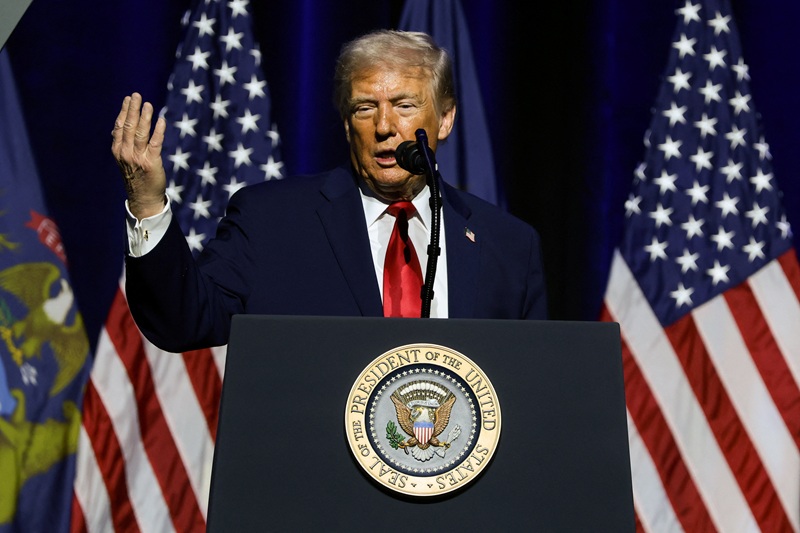
DUBAI, Jan 13 (Reuters) U.S. President Donald Trump urged Iranians to continue protesting and said unspecified help was forthcoming as Iran’s clerical leadership intensified a nationwide crackdown on the most serious unrest it has faced in years, deepening an international standoff with potentially far-reaching consequences for the Middle East.
“Iranian Patriots, KEEP PROTESTING – TAKE OVER YOUR INSTITUTIONS!!! … HELP IS ON ITS WAY,” Trump said in a post on Truth Social, adding that he had canceled all meetings with Iranian officials until what he described as the “senseless killing” of protesters stopped.
The unrest, triggered by collapsing living standards, chronic unemployment, and inflation, has posed the gravest internal challenge to Iran’s ruling establishment in at least three years. It has unfolded amid mounting external pressure following Israeli and U.S. strikes last year that further strained Tehran’s relations with Western powers.
Iran International, a London-based Persian-language broadcaster, said its editorial board had concluded that at least 12,000 people were killed over two nights in early January, calling the episode the deadliest mass killing in Iran’s contemporary history.

The outlet said it reviewed information through what it described as a rigorous, multi-stage process, drawing on sources close to Iran’s Supreme National Security Council and presidential office, accounts from within the Islamic Revolutionary Guard Corps, testimony from eyewitnesses and families, field reports, medical data, and information from doctors and nurses. The broadcaster said the killings occurred largely on Jan. 8 and Jan. 9.
Trump Says Nations Doing Business With Iran Face 25% Tariff on US Trade
An Iranian official said earlier that about 2,000 people were killed during the protests, marking the first time authorities acknowledged a death toll of that magnitude from the crackdown following roughly two weeks of nationwide unrest. Speaking to Reuters on condition of anonymity, the official blamed what he described as terrorists for the deaths of both protesters and security personnel but did not provide a breakdown.
On Jan. 12, the U.S. State Department issued a new security alert warning American citizens that departures from Iran were becoming increasingly difficult and that direct assistance from Washington should not be expected. The alert, circulated through the Virtual Embassy Tehran, stated that several land border crossings remained open at that time. But it cautioned that conditions were fluid and could change without notice. Americans were advised to attempt departure only if they believed it was safe to do so.
The alert warned that security forces expanded their presence across the country, according to multiple reports, enforcing road closures, disrupting public transportation, and sharply restricting access to mobile networks, landlines,s and the national internet. The communications shutdowns complicated travel, limited the flow of information, and isolated many cities from the outside world.
Trump later announced a 25 percent tariff on imports from any country doing business with Iran, a major oil producer already under extensive U.S. sanctions. He also said additional military action remained among the options he was considering in response to the crackdown, declaring earlier this month that the United States was “locked and loaded.”
Tehran did not immediately respond publicly to the tariff announcement. China, Iran’s largest oil customer, swiftly criticized the move. Iran exports much of its crude to China, with Turkey, Iraq, the United Arab Emirates, and India also among its key trading partners.
Russia condemned what it described as “subversive external interference” in Iran’s internal affairs, saying U.S. threats of new military strikes were “categorically unacceptable.” The Russian Foreign Ministry warned that those who planned to use unrest “as a pretext for repeating the aggression against Iran committed in June 2025” should be aware of the “disastrous consequences” for the Middle East and global security.
Despite the scale of the protests and Iran’s deepening economic distress after years of sanctions and isolation, there were no clear signs of fractures within the security elite that has sustained the clerical system since the 1979 Islamic Revolution.
Still, uncertainty over Iran’s political future reverberated beyond the region. German Chancellor Friedrich Merz said he believed the government was nearing collapse. “I assume that we are now witnessing the final days and weeks of this regime,” he said, adding that if it had to rely on violence to retain power, “it is effectively at its end.” He did not say whether his assessment was based on intelligence or other information.
Iranian Foreign Minister Abbas Araqchi rejected Merz’s remarks, accusing Germany of double standards and saying the chancellor had “obliterated any shred of credibility.”