By Kayhan Life Staff
Sweden’s closely fought election has opened the way for a change of government, putting the future of its Iran policy before a new parliament as Stockholm and Tehran exchange diplomatic expulsions.
Social Democratic leader Magdalena Andersson was tasked on Sept. 18 with exploring a government after preliminary results from the Sept. 13 election gave the left-wing opposition bloc a parliamentary majority. Prime Minister Ulf Kristersson submitted his resignation to the Speaker of Parliament on Sept. 17. Parliament could formally propose a candidate for prime minister as early as Sept. 29.
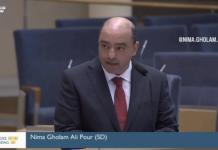
For Nima Gholam Ali Pour, an Iranian-born Sweden Democrats lawmaker, the campaign included an appeal to voters concerned about democracy and human rights in Iran. Speaking to Kayhan Life before the election, he argued that his party and the Christian Democrats had been stronger advocates on those issues than their rivals, and pledged continued support for democratic change.
Sweden’s Security Situation, Including Iran Threat, Could Get Worse, Swedish Security Police Says
The interview comes amid renewed diplomatic tensions. Sweden said on Sept. 16 that it had ordered an Iranian embassy official to leave over activities incompatible with the Vienna Convention on Diplomatic Relations, without specifying those activities. Tehran expelled a Swedish diplomat the following day, calling Sweden’s action unjustified.
Gholam Ali Pour entered parliament in 2022 representing Malmö, and was one of three lawmakers who signed the invitation that brought Crown Prince Reza Pahlavi to the Swedish parliament in April. The visit drew criticism in Sweden and objections from Tehran.
He was born in Iran in 1981. His family was forced to flee the country after his mother was accused of sheltering left-wing activists opposed to the Islamic Republic. They were admitted to Sweden as refugees in 1987. He later trained as a teacher and earned a master’s degree in international migration and ethnic relations.
His message to Iranian activists was direct: provide lawmakers with evidence and workable proposals, and resolve the divisions that make parliamentary engagement harder. “We need organizations that have the expertise to give policy suggestions about Iran to the politicians,” he said.
Closing the Islamic Republic’s embassy was already a familiar demand, he said. What else should Sweden do, and how should it support those seeking democratic change?
He argued that rivalries among Iranian groups allowed opponents of dialogue to question whom Sweden should approach.
“They have to stop fighting and start having a discussion of what they want for the Iranian people,” he said.
Swedish security authorities’ accusations that the Iranian regime uses criminal networks to carry out violence in Sweden give that debate a domestic urgency, alongside concerns about repression inside Iran.