By Kayhan Life Staff
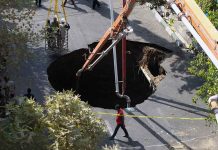
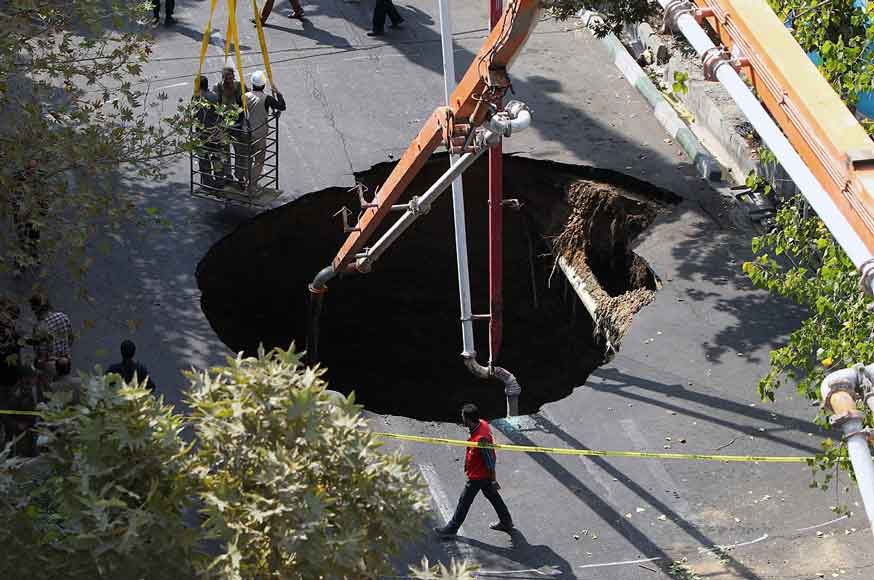
Land subsidence — the gradual sinking or lowering of the Earth’s surface — is spreading at alarming rates across Iran, with Isfahan among the world’s worst-affected cities, according to a recent survey. The main cause of the crisis: groundwater extraction for agriculture.
Data from the Geological Survey and Mineral Exploration of Iran (GSI) shows that land subsidence in 2024-25 was roughly 10 times what it was in 2016-17, and that many areas once considered isolated patches were now merging.
Meanwhile, a new study published in Nature Cities — a London-based online monthly — ranked Isfahan among the world’s worst-affected cities, with an average rate of land subsidence of roughly 11 millimeters per year. Rates are higher in some Indonesian cities, reaching 33 millimeters per year in Medan and 22 millimeters in Bandung.
According to domestic figures, subsidence in Isfahan has exceeded the warning threshold, with its so-called “danger zone” extending as far as the city’s international airport. More than 3.3 million people live in the high-risk area.
Mansour Shishehforoush, director general of the Crisis Management Department for Isfahan Province, recently announced that 29 of the province’s 35 plains have been affected. The plains of Isfahan, Borkhar, Mahyar, Ardestan, Falavarjan, Golpayegan and Shahreza are among those experiencing the highest rates of subsidence.
All but one of Iran’s provinces — Gilan in the north — is affected.
A 2025 study published in the U.S.-based, peer-reviewed Journal of Geophysical Research: Solid Earth analyzed satellite data from 2014 to 2022 and identified 106 areas affected by subsidence across Iran. Their combined surface area exceeded 31,400 square kilometers — meaning that roughly 1.9 percent of the country’s territory was sinking at a rate of more than 10 millimeters per year.
The study found that seven of Iran’s 10 most populous cities are located in subsidence-affected areas: Tehran, Mashhad (northeast), Isfahan, Karaj (north), Shiraz (south), Qom (north-central) and Urmia (northwest).
Both the area affected by subsidence and the rate at which it is spreading have increased in the last past four years. According to officials at the Ministry of Roads and Urban Development, the affected area exceeded 90,000 square kilometers in 2025-26, encompassing more than 200 cities.
Another study, published in 2024 in the U.S. peer-reviewed journal Science Advances, drew on satellite imagery from 2014 to 2020. It found that about 56,000 square kilometers of Iran, or 3.5 percent of the country, were affected by subsidence. In some 3,000 square kilometers of these areas, the ground was sinking at more than 10 centimeters per year.
Groundwater extraction for agriculture is the main driver of subsidence. Studies show that about 77 percent of land experiencing subsidence of more than 10 millimeters per year is used for farming. Researchers have also found that much of the compaction of Iran’s aquifer layers is irreversible, meaning that the ground will not necessarily return to its original level even if water resources recover.
Tejarat News, a Tehran-based online news outlet, reported on Nov. 1 that subsidence is no longer merely an environmental crisis. By threatening farmland, making buildings and transport networks vulnerable, and increasing infrastructure maintenance costs, it has become a source of mounting economic damage.
“In areas such as Rafsanjan (southeast), where agriculture and orchard farming depend heavily on groundwater, subsidence should be assessed, alongside the depletion of water reserves, as a long-term economic risk,” said the report.
“Aquifer compaction is not limited to the ground surface sinking; if the compaction of the ground layers is irreversible, part of the natural water storage capacity is also lost forever,” the report added. “The consequence of such a situation could be reduced agricultural resilience during droughts and higher costs of adapting to water scarcity.”
Tejarat News also noted: “The economic cost of subsidence in agriculture is not just the value of crops lost in a single season; it also includes the cost of securing water, equipment depreciation, increased production risk, and the possible reduction of the land’s usable capacity in the coming years.”
Elsewhere, the report stressed that one of the most significant economic consequences of subsidence is the threat that it poses to transport networks. Roads, railway lines and metro routes are valuable assets, and disruptions to them can affect passenger travel, freight movement and economic activity across entire regions.
Because roads and railways are typically used for decades, failing to account for subsidence risks can increase their life-cycle costs. In other words, decisions about infrastructure development and maintenance that overlook declining groundwater levels may cause initial cost estimates to differ significantly from actual operating and maintenance expenses.
The report concluded that the crisis’s economic cost extends far beyond abandoned buildings and road repairs. The loss of groundwater storage capacity, rising water supply costs for agriculture, threats to real estate assets, increased infrastructure maintenance requirements, and greater investment uncertainty are collectively placing direct and indirect pressure on Iran’s economy.