By Kayhan Life Staff
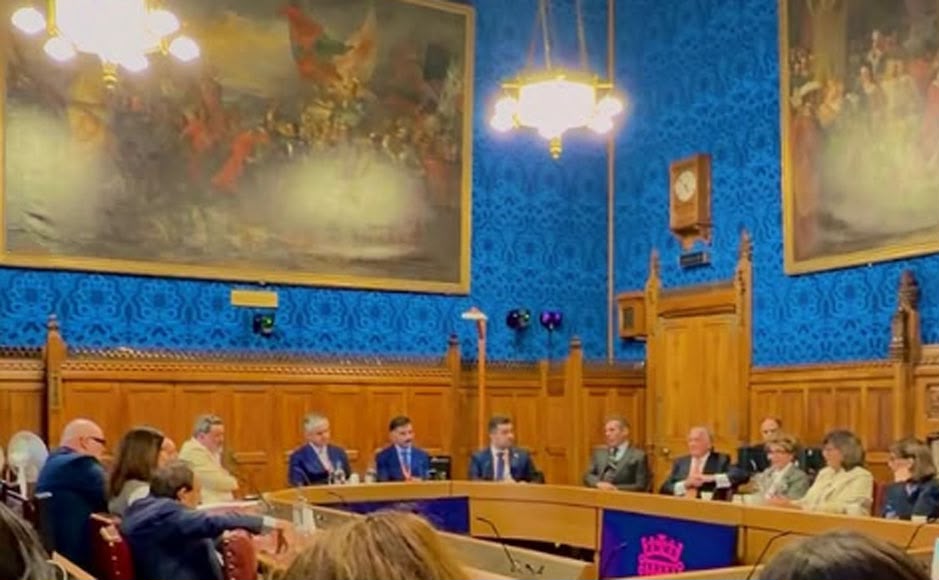
Members of Britain’s House of Lords backed calls for stricter supervision of charities controlled by foreign organizations at a meeting held inside the UK Parliament on Oct. 21. Campaigners pressed ministers to complement the Islamic Revolutionary Guard Corps’ designation as a national security threat with safeguards for the charitable sector.
The proposals are to strengthen the trustee disqualification regime and introduce measures to prevent charities from acting on behalf of designated bodies. Supporters say they will be effective at cutting off the institutional networks that the Iranian regime is alleged to use to exert influence and threaten its opponents in the UK.

Hosted by Lord Walney and organized by Lotus Advocacy (a British non-profit focused on democracy and human rights), the Oct. 21 event brought together peers, members of the Iranian diaspora and policy experts.
“We must push to ensure these reforms work effectively and prevent the Iranian regime from exploiting the goodwill and vital work of British charities,” Walney said.
A Lotus Advocacy spokesperson urged ministers to use the government’s existing reform process: “Parliament has already judged the IRGC a threat to this country. Our charity law should say the same.”

Roger Macmillan, a former security director at the Persian-language broadcaster Iran International, said the Iranian regime used charities, community organizations and immigration routes to maintain influence and pressure dissidents.
“Tehran does not need to send more people to Britain when it can already import its own media and influence networks while exploiting our charitable system,” he said.
“Young people are targeted, the Jewish community are targeted and Iranian families who fled the regime are watched, threatened and coerced here,” he added. “That is a national security problem, and we should treat it as such.”
British political commentator Matt Goodwin argued that hostile states, including the Islamic Republic, were exploiting divisions within British society, increasing polarization and undermining social cohesion. He called for stronger measures against extremism, citing Australia as a model.

Goodwin called for sanctions against Press TV, Tasnim and Fars, which he described as propaganda outlets, and for a much wider sanctions regime against the Iranian regime along the lines of the one imposed on Russia.
“As we did when Russia carried out an attack on our soil, we should expel Iranian diplomats, including its ambassador,” he said.
Haleh Blake, a British-Iranian activist and co-founder of United4Mahsa —- named after Mahsa Amini, the 22-year-old woman who died in police custody in Tehran in 2022 for improperly wearing the compulsory veil — described intimidation affecting activists abroad and relatives in Iran, including the publication of personal information online, imprisonment and pressure on family members.

“We must close financial loopholes and strengthen legal powers to prevent British charities from being exploited by the regime,” she said.
Blake said diaspora communities wanted to work with the counterterrorism police.
In July 2026 the National Security Act 2023 designated the IRGC as a national security threat to Britain. However, designation is not proscription, and considerable gaps remain between national security legislation and charity law.
While some terrorism convictions automatically disqualify someone from being a charity trustee or senior manager, offenses relating to designated bodies are not currently grounds for automatic disqualification.
Furthermore, designation alone does not give the Charity Commission additional powers to intervene when a charity is controlled by, or acts on behalf of, a designated organization.
The IRGC is separate from the regular armed forces and has a wide range of military, intelligence, and economic responsibilities within the Islamic Republic. Its Quds Force carries out overseas operations. The “designation” protocol attributes criminal offenses for support, assistance, and material benefits, and gives authorities the power to disrupt those working with designated entities.

Lotus Advocacy’s first proposal would extend automatic disqualification to convictions under sections 17A–17C of the National Security Act, covering support for, assistance to, and material benefits from designated bodies. Trustees are responsible for a charity’s governance, finances and charitable purposes.
The consultation closes on Dec. 23 and concerns the Charity Commission for England and Wales. Scotland and Northern Ireland have separate charity regulators.
Lotus Advocacy called for the regulator to have the power to initiate formal investigations, suspend or remove trustees, appoint a temporary manager, and protect the charity’s funds and property. Where appropriate, the regulator could also remove the charity from the register. Some of these powers already exist but the proposal would provide the regulator with a clearer legal basis to use them in relation to charities associated with organisations designated under national security law.
The organizers said any new powers would need clear evidence, appropriate safeguards against abuse, and allow appeals by the charities concerned. This would in turn help to protect legitimate charitable and religious activity and the right to form and join organisations.
The proposals would allow authorities to address both individual wrongdoing and the organizations behind it. The aim is to stop charities from simply replacing trustees while keeping control of their assets and retaining public trust. Success would depend on proving who controls a charity, sharing information across agencies and ensuring regulators have the resources to act.
Registered charities can access tax benefits and the credibility that comes with that status from donors, public bodies, and the local community. Campaigners have argued that when a charity falls under the control of a foreign government, that government can use those very benefits to extend its influence.
The campaign builds on Walney’s March report, “Undue Influence,” which found that organizations linked to the Islamic Republic had used Britain’s charity system. Walney, a member of the House of Lords and former government adviser on political violence, argued that regulators focused on how charities were run without looking closely enough at their ties to hostile governments.
He described a “compliance trap” in which procedural changes or a change of trustee would have little or no effect on the organization’s affiliations.
The Islamic Center of England says it is not politically directed or controlled by the Iranian state and that it does not promote extremism, violence or hatred. The other organizations which the report examined have also denied allegations of state alignment or wrongdoing.
The Charity Commission opened a formal investigation into the Islamic Center of England in November 2022, appointed a temporary manager in 2023 and ordered changes to its management and oversight in May 2025. It said it removed a rule requiring one trustee to be the supreme leader’s official religious representative in Britain.
The commission said the change addressed conflicts of interest and concerns about the charity’s independence. It also found misconduct or mismanagement.
When announcing the consultation, the Government said the Commission’s Terrorism, Extremism and Threats from Foreign States team shared information with police and other agencies on 656 occasions during 2025–26. It also issued seven orders prohibiting individuals from holding leadership roles in charities and 29 formal warnings. These figures reflect the team’s total work, not just cases involving alleged links to the Iranian regime.
The issue is whether regulators are acting swiftly and effectively enough and whether greater powers should be used to deal with both the organisations and the people who run them.
Lotus Advocacy is seeking support in both Houses of Parliament for a joint letter to ministers, formal written questions to the government and changes to the law.