By Andrew Mills and Ariba Shahid
Oct 26 (Reuters) – Top officials from the Mecca Pact countries Saudi Arabia, Turkey and Pakistan are set to meet Iranian officials in Tehran on Monday to discuss regional coordination, two people with knowledge of the matter said.
Saudi Arabia will be represented by Defence Minister Prince Khalid bin Salman, and Pakistan by army chief Field Marshal Asim Munir, the people said, speaking on the condition of anonymity.
The Turkish head of intelligence will also join, one of the people said.
The deputy secretary of Iran‘s top security body, Ali Bagheri Kani, told state TV that Saudi Defence Minister Prince Khalid, Pakistan’s Munir and Turkish intelligence chief Ibrahim Kalin would visit Tehran for consultations with Iran’s Supreme National Security Council on regional security.
Iran Says Saudi Arabia, Houthis Have Not Answered Mediation Offer
The Saudi government media office, Pakistan’s military media wing and Turkey’s Foreign Ministry did not immediately respond to requests for comment.
The planned talks would be the first high-level contact between Iran and all members of the three-nation bloc since Saudi Arabia came under escalating attacks from Yemen’s Iran-aligned Houthis.
Munir visited Tehran last week, where he met Iranian President Masoud Pezeshkian and other senior officials. During the visit, Iranian officials told him there would be no talks with Washington until Tehran’s demands were met, according to Iranian media.
Pakistan has been a key intermediary between the United States and Iran. Earlier mediation efforts helped produce an interim peace agreement in June, but the deal quickly unravelled as fighting between Iran and the United States resumed weeks later.
Saudi Arabia intercepted another wave of missiles and drones on Sunday as fighting with the Houthis continued unabated.
ANALYSIS—How Are Yemen’s Houthis Attacking Saudi Arabia So Effectively?
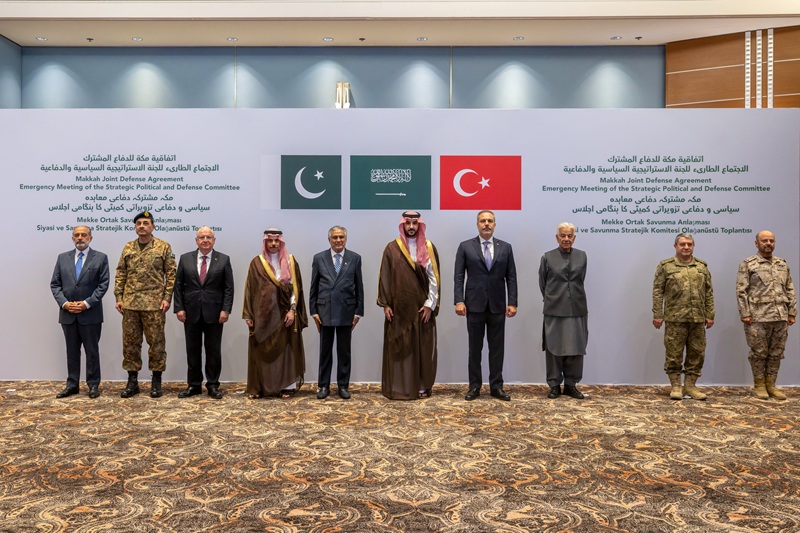
Ministers from the Mecca Pact countries held an emergency meeting in Riyadh earlier this month and agreed to ensure the “rapid deployment” of military forces and capabilities in Saudi Arabia.
The Houthi attacks have become an increasingly destabilising element in the US-Israeli offensive against Iran, turning US ally Saudi Arabia into a pressure point in the wider war.
Turkey, Pakistan and Saudi Arabia signed the Mecca Joint Defence Agreement in August, under which an armed attack on one member is considered an attack on all.
The agreement’s first article says the parties shall use “all necessary means” to eliminate threats to one another’s territorial integrity, sovereignty or internationally recognised borders, according to a text seen by Reuters.
Efforts by Turkey’s parliament to ratify the agreement began last week and are still underway, while Pakistan approved the pact last week.
(Reporting by Andrew Mills and Ariba Shahid; Additional reporting by Tuvan Gumrukcu; Writing by Yomna Ehab and Eman Abouhassira; Editing by Christopher Cushing, Saad Sayeed and Tom Hogue)
#Iran, #MeccaPact, #Diplomacy, #RegionalTalks, #IranianOfficials