A New Wave of Protests in Iran Is Likely, Warns Tehran-Based Anthropologist
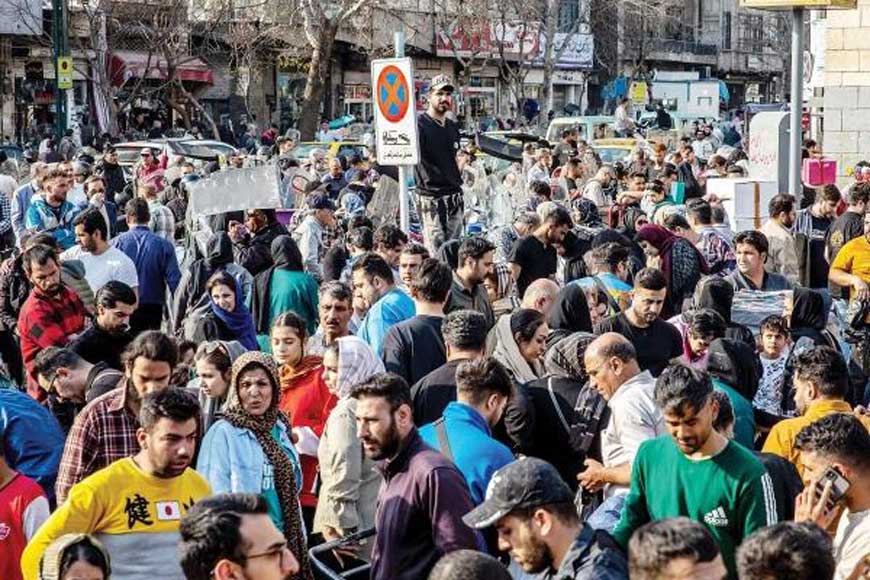
Life in Iran is a daily struggle for survival amid runaway inflation and the constant fear of arrest and imprisonment: That is the upshot of Kayhan Life’s recent conversations with Iranians living inside the country who spoke on condition of anonymity.
Nine months since the start of nationwide protests which resulted in the massacre of tens of thousands, and at a time when the U.S.-Iran war drags on with no end in sight, citizens of Iran are facing an excruciating battle to survive and put food on their table.
Survey results showed that the desire to emigrate among Iranians has declined by around 8 percent — indicating, not that people wish to stay in Iran, but rather that they have reached high levels of despair.
A housewife living in Mehrshahr, Karaj, northwest of Tehran, told Kayhan Life: “Since they raised the price of gasoline, there have been more officers on the streets. Every night, armed Basij (militia) members patrol the streets. Several officers and motorcycle units are stationed outside every mosque.”
“They have deployed a motorcycle unit with two or three officers every 200 meters. These scenes frighten people. The motorcycle units stand by the roadside, holding large guns. Every time I pass them, my whole body trembles with fear.”
A 20-year-old man who worked in Tehran as a Snapp (Iran’s largest ride-hailing service) driver said: “My girlfriend is constantly telling me, ‘Let’s leave this place.’ My mother also wants us to leave because we have no future here. No matter how hard we work, we get nothing out of it.”
“Earlier today, I was at my mother’s house, and we were talking about getting engaged. I chose a very simple engagement ring and matching band that cost 170 million tomans ($742). I calculated that I would have to earn six months of a government salary to buy a simple ring.”
EXCLUSIVE—How a Billion-Dollar Sanctions Dodge Kept Chinese Goods Flowing to Iran
A 46-year-old woman living in Mohammadshahr, Karaj, whose family’s only source of income is her husband’s salary of 32 million toman ($140), which barely covers their living expenses, said: “My parents live in Meshkin Dasht, Karaj. Their water bill used to be 50,000 tomans ($0.22), and sometimes even 20,000 ($0.09) or 30,000 ($0.13).”
“But this month, their bill was 670,000 tomans ($3), even though they used very little water because they believe wasting water is a sin. They have raised the price of everything — from water and electricity to gas.”
A young woman living in Shahriar, in Tehran Province, whose relative’s son was killed during the December-January massacre, fought back tears as she said: “The Basij set up checkpoints every night from 6 p.m. and remain on the streets until 11 p.m. or midnight. They wave flags and chant slogans, as if they have accomplished some great feat!”
“With all these Basij and IRGC (Islamic Revolutionary Guards Corps) motorcycle officers roaming the streets, how could ordinary people possibly dare to go outside? It is as if they have taken control of the streets. My elderly mother-in-law once said that whenever she passed them, she felt as if she was about to have a heart attack.”
“My father, who is a retired IRGC member, has cut off contact with us because I participated in the December protests and because my husband and I support Crown Prince Reza Pahlavi. I have been forced to see my mother secretly and only from time to time.”
The young woman added: “I had previously seen reports saying that there were also foreign nationals among these officers, but I had never seen it with my own eyes. Today, I went to the fruit shop of a middle-aged Afghan man who lives at the end of our street. He has a cucumber field and fruit orchard around Shahriar.”
“I went to his shop today to buy cucumbers for making pickles. While I was looking through the cucumbers, a man came in and began greeting and chatting with the Afghan shopkeeper. Then he asked, ‘Where is your son?’ The man replied in a strong Afghan accent, ‘My son is at work.’ The other man gave him a sarcastic smile and said, ‘Yes, I saw your son wearing body armor, carrying a gun, with a radio in his pocket, blocking the streets on Ba’ath Street.’”
“The Afghan man’s eyes widened in astonishment, and as he tried to compose himself, he said, ‘No, you must have seen someone else!’ The man replied, ‘I saw your son myself. He told me they paid him 60 million tomans ($262) a month!’ Just imagine where they found this Afghan man — to stand in the streets with a gun and stop people’s cars.”
When she reached this part of her story, she sighed and said: “Our upstairs neighbor, who works for the municipality, said last night that they had not paid him for two months and had given him vouchers instead of his salary.”
“My husband’s colleague, who works as a tea and cleaning attendant at a company in Karaj, said that because he had no money for transportation, he went to the company to cover his commuting expenses, emptied the charity box near his home, and took the money. May God spare even a desert wolf from having to live like this,” she said.
A young woman living in Karaj who works in marketing said she had been forced to resign because of the rise in gasoline prices: “I am a sales representative, and I use my own car to visit companies and shops. My assigned area is Nazarabad in Alborz Province.”
“I have to drive 60 kilometers each way for visits. Today, when I went to fill up, gasoline cost 10,000 tomans ($0.04) per liter, and I paid 150,000 tomans ($0.65). I realized it simply was not worth driving all the way to Nazarabad and back. I called the company, resigned, and now I have to look for another job.”
A middle-aged man living in Tehran who works for Snapp said: “Every day, I leave home at five in the morning to work for Snapp. Today, when I turned on the app, I saw that the fares had dropped dramatically. It was simply not worth starting the car, driving somewhere, and coming back.”
“A few nights ago, I had a passenger around Khorasan Square. The passenger, who lives in that area, said they held marches and gatherings there every night. It does not even look like a square anymore; they have turned it into something resembling Bain al-Haramayn! My passenger, a young laborer, said he worked at Saipa (an Iranian automaker headquartered in Tehran).”
Bain al-Haramayn was a 378-meter-long open pedestrian plaza located between the Imam Husayn Shrine and the Al-Abbas Shrine in the city of Karbala, Iraq.
“He had been told he only needed to come to work two days a week. During the trip, the young worker opened up to me and said, ‘Things at Saipa were really bad. Because of the parts manufacturers’ outstanding claims, they were paying employees’ salaries weekly,’” the driver added.
“When we were children, my mother would make a pot of abgoosht (an Iranian stew) once a week, and we would eagerly sit down together and enjoy it. Now, maybe once a month, if we are lucky enough to see abgoosht on our table!”
A 46-year-old resident of Mashhad, the capital of Khorasan Razavi Province in northeastern Iran, who works in a home-based manufacturing business, said: “During the 12-day war, my husband, our two sons, and I moved to one of the neighborhoods in southern Mashhad. I repeatedly noticed little boys scavenging plastic from rubbish bins back then. Since the war, the number of these children has increased.”
“They go around with carts, their heads buried in garbage bins. It feels as though time has stopped in this city, and the situation of Mashhad’s waste pickers and beggars is no different from what it was 30 years ago. I have seen many small boys under the age of seven in different parts of the city searching through garbage bins for plastic to sell.”
“Things have reached the point where oil-change shops and similar places are full of elementary and middle-school children, because schools have been closed since late December and many children have started working to help support their families.”
A housewife whose husband drives a Nissan pickup truck for a cake and pastry company in Tehran said: “My husband is paid per delivery, meaning he transports goods for each order. However, for several months, people’s orders for cakes and pastries have declined, and my husband is working barely two days a week.”
“We have no insurance, no future, and I am always afraid. Until two years ago, when I still prayed, I would ask God not to make me dependent on anyone or leave me bedridden.”
“God forbid that an elderly or disabled person should end up in this situation here. Our neighbor’s father-in-law was a construction worker. A few years ago, he fell from a building and never worked again. The owner of a heavy-vehicle garage in Shahriar arranged two shacks inside his garage for him, his wife, and their children, and they lived there for seven years. Eventually, with the help of several drivers, they found them a rental home in Yaft Abad for a very small amount of money.”
A 54-year-old woman living in Shiraz, the capital of Fars Province, said: “When I got married, my husband’s salary was 40,000 tomans ($0.17). Some 22 years ago, he bought a long necklace for my wedding day for 60,000 tomans ($0.26). Now his salary has risen to 25 million tomans ($110), but every day we regret that we cannot arrange a marriage proposal for our son, who has been in a relationship with his girlfriend for two years.”
“We cannot even afford to hold a simple engagement ceremony for him. If I spend absolutely nothing else, perhaps I can buy a very small pair of earrings. The price of one gram of gold has now surpassed 24 million tomans ($105). Buying gold has become a dream for many families!”
She herself does not own a mobile phone and sends her messages using her son’s phone. She said: “They have made owning a phone a dream for many people. No one is more despicable than the people who have done this. On Saturdays, Mondays, and Wednesdays, they cut off the electricity at exactly 12 o’clock.”
“We live on the second floor, and when the electricity goes out, our water pump stops working too, so the water gets cut off as well. Our apartment has two bedrooms but only one window. When the electricity goes out, our home becomes pitch-dark, and when the water is cut off at the same time, we are completely unable to function.”