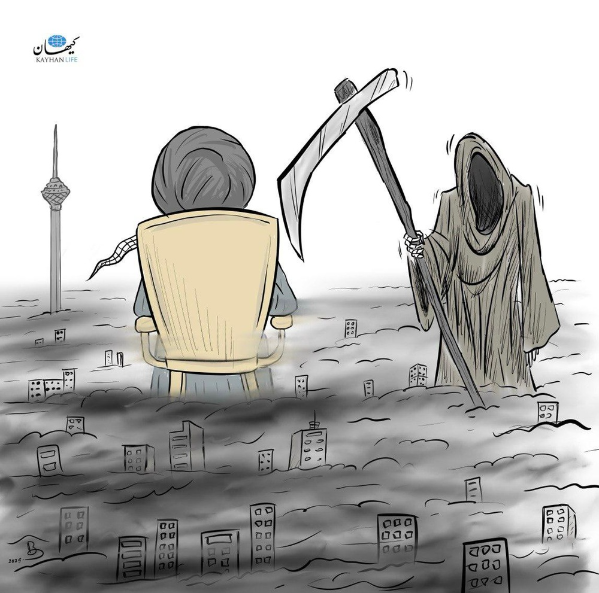
Artist: Behnam Mohammadi
Death Roams Iran’s Streets, the Islamic Republic Barely Blinks
Air pollution has tightened its grip on Iran’s cities with the lethality of the Grim Reaper. This is a public-health emergency claiming tens of thousands of lives every year.
According to the Ministry of Health, nearly 59,000 Iranians died in 2024 from exposure to toxic air. The ministry’s investigations reveal that 96 percent of Iran’s urban population is exposed to particulate matter concentrations exceeding the World Health Organization’s guideline levels.
The tragedy, however, is not merely the scale of death. It is that much of it is preventable. Iran passed a Clean Air Act in 2017, assigning clear responsibilities to ministries, municipalities, and regulators. Yet the law remains largely unimplemented. Committees convene, statements are issued, but pollution continues unchecked.
The economic toll is staggering. The health ministry estimated that the financial damage caused by pollution-related deaths in the last Persian calendar year was approximately $17.2 billion, with an annual average of $2.6 billion in Tehran, which amounts to around $300 per resident, or $1,200 for a family of four.
Families pay the price directly—through illness, lost income, and the rising costs of healthcare—while the government suppresses the release of updated hospital statistics.
This is not simply the result of geography or climate. It stems from policy failures, including an aging vehicle fleet that has more than doubled in size over the past decade, poor-quality fuel, unregulated industries, and weak enforcement. Meanwhile, the burden falls heaviest on the poor, the young, and the elderly—those least equipped to protect themselves.
Iran’s air crisis will not resolve itself. It requires political will, transparent governance, and, at the very least, real enforcement of laws already on the books. While the regime barely blinks, the public continues to pay the price, one breath at a time.
Welcome to the Kayhan Life Week in Review
►This week, while Iran’s deepening environmental crisis heightened public anxiety inside the country, the Islamic Republic faced renewed pressure over its nuclear cooperation, expanded U.S. sanctions, and fresh allegations of foreign plots. Abroad, the sturdy spirit of Iranian political influence and civil society activism offered a stark contrast to the challenges unfolding at home.
Iran’s water crisis dominated the week’s developments, as officials warned of the worst shortages in decades. Years of government mismanagement, inefficient agricultural practices, and declining rainfall have pushed the country to a breaking point. While authorities blamed Iranians for excessive consumption, hydrologists countered that structural failures by the state are the primary cause.
►Against this backdrop of mounting domestic strain, the Islamic Republic faced renewed scrutiny from the United Nations’ nuclear watchdog. Rafael Grossi, director general of the International Atomic Energy Agency, warned that the Islamic Republic must “seriously improve” its cooperation with the agency to avoid further escalation with Western governments.
►As diplomatic tensions escalated over the nuclear issue, Washington intensified its Maximum Pressure campaign. The U.S. imposed new sanctions on individuals and entities tied to the Iranian regime’s ballistic missile and drone programs.
►The US also accused Tehran of funneling approximately $1 billion to Hezbollah this year. The Lebanese militant group is designated as a terrorist organization by numerous Western and Persian Gulf states. The US also sanctioned two individuals it accused of using money exchanges to move funds to Hezbollah.
►And once again there was an allegation of an assassination plot linked to the theocratic state. A U.S. official said that an attempt to assassinate Israel’s ambassador to Mexico had been foiled.
►The Iranian regime’s reach was also evident in neighboring Iraq, ahead of parliamentary elections. Qais Al-Khazali, a leader of the Asa’ib Ahl al-Haq movement who has been designated as a global terrorist by the United States, is an ally of the clerical state. He has sought to soften his image in a quest to become one of Iraq’s top politicians. Many Iraqis are bracing for an election they fear will change little, with elites, including pro-Iranian militias, not delivering much since the 2003 U.S.-led invasion.
►Despite escalating political tensions, the Iranian nation’s enduring resilience left a mark at international gatherings. In Washington, D.C., Iran’s first and only Minister for Women’s Affairs, Mahnaz Afkhami, was honored at a Georgetown University symposium. Ambassador Melanne Verveer, the United States’ first Ambassador for Global Women’s Issues under President Barack Obama, lauded Afkhami’s lifelong insistence that women’s leadership strengthens society as a whole. Afkhami—who served from 1975 to 1978 before going into exile—reflected on her early efforts to build global networks for women’s rights amid a period of optimism and modernization.
►At the One Young World summit, actress and political activist Nazanin Boniadi and former political prisoner Nazanin Zaghari-Ratcliffe drew renewed attention to the Islamic Republic’s widespread use of executions and political detentions. A prerecorded message from imprisoned Nobel laureate Narges Mohammadi underscored the human cost of dissent, describing solitary confinement and the toll on her children.
In a symbolic departure from past practice, the Iranian Olympian Kasra Mehdipournejad carried the pre-revolutionary Lion and Sun flag in the summit’s opening procession at the insistence of Boniadi and Mehdipournejad—an act of solidarity with those risking their lives to oppose the regime.
Kayhan Life’s Curated News Picks
Updates from Kayhan Life’s Social Media:
-
POST: 74 Bodies Found in Dry Bed of Karaj Dam Raise Questions
-
VIDEO: Photographer and Author Maryam Eisler will be Exhibiting in “Second Lives” in London
-
VIDEO: Two Soldiers Raise Lion and Sun Flag in Tehran Metro in Unprecedented Act
-
VIDEO: Promo for Arash Sobhani’s New Music Video, “Engineering Memories”
Treat of the Week
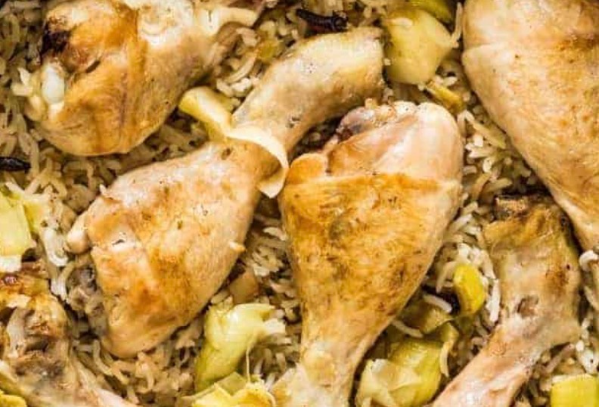
Persian Leek Rice with Chicken
The Kayhan Life Team wishes you a good weekend.