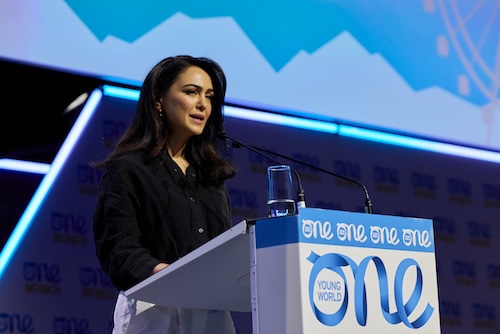
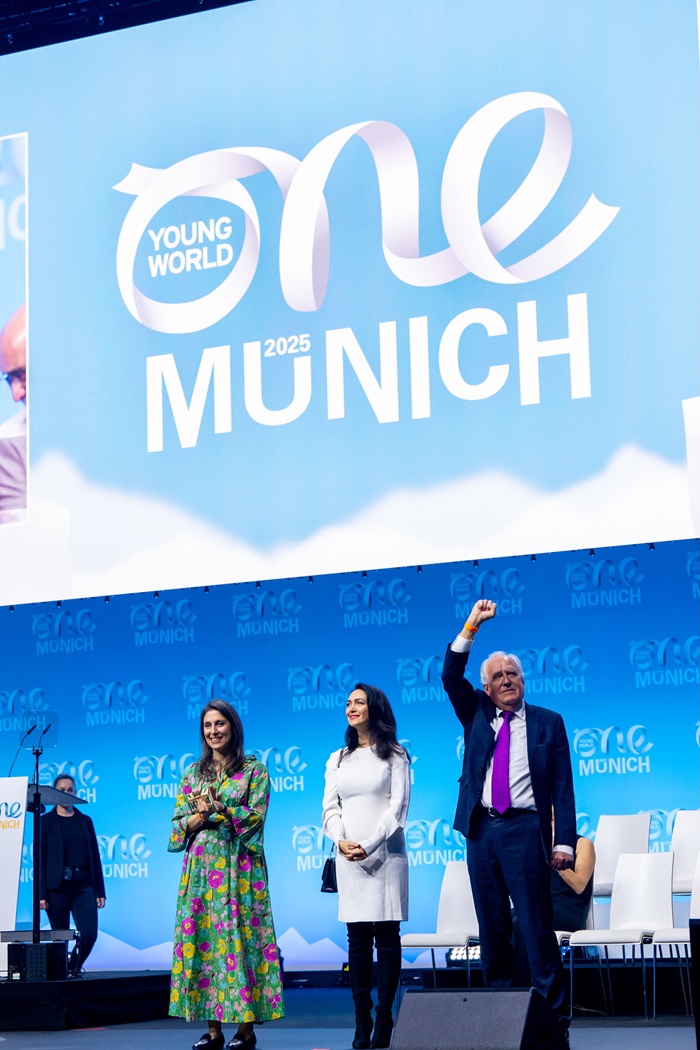
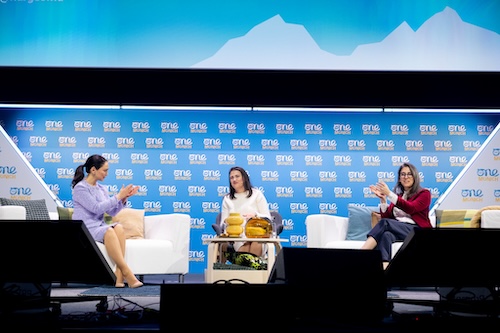
The British-Iranian actress and activist Nazanin Boniadi and the former political prisoner Nazanin Zaghari-Ratcliffe, discussed the plight of political prisoners in Iran during the One Young World Summit in Munich on Nov. 4.
London-based One Young World is a non-governmental organization launched to empower young leaders around the world and to provide them with support to address global issues through ethical solutions. The organization’s annual summit took place this year from Nov. 3 to Nov. 6 and included speakers such as musician Bob Geldof and Nobel Peace Prize-winning journalist Maria Ressa.
Zaghari-Ratcliffe, a British-Iranian author and human rights activist, was freed from detention in Iran in 2022 following an agreement between Iran and Britain to release her and the detained dual national Anoosheh Ashoori. Zaghari-Ratcliffe and Ashoori’s releases coincided with the settlement of a long-standing debt of 400 million pounds ($522 million) owed by the UK to Iran which was paid on the same day.
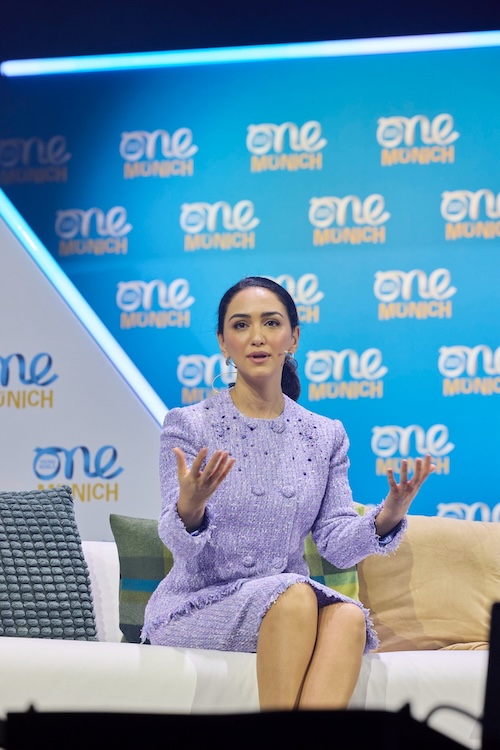
Boniadi is a British-Iranian actress and activist. She has been a member of the Council on Foreign Relations since 2018, an Ambassador for Amnesty International UK since 2020, and a board member for the Abdorrahman Boroumand Center for Human Rights in Iran since 2023. Boniadi’s activism focuses on women’s rights and issues which affect young people.
“I participated in the One Young World conference because it’s the world’s most impactful forum for young leaders,” Boniadi told Kayhan Life. “This global platform gathers exceptional young adults from nearly every country and sector to accelerate social impact, foster cross-cultural understanding, and drive progress on the world’s most pressing issues.”
“Being invited back as a returning counselor is not just an honor—it’s a testament to the belief that courage is contagious,” she added.
The summit opens with a ceremony each year in which flags of the represented countries are displayed. Boniadi, and Iranian Taekwondo Olympian Kasra Mehdipournejad who was the Iran flagbearer for the ceremony, felt strongly that the Islamic Republic of Iran’s flag should not be used and that Iran’s pre-revolutionary Lion and Sun flag should be carried during the procession.
“I explained to the organizers that the Islamic Republic’s flag had only existed for 46 years. I told them it would send a powerful message of solidarity with Iranians risking their lives if the Lion and Sun flag was included instead,” Boniadi said. “I also made it clear that I could not participate in the ceremony if the regime’s flag was used.”
“Our collective insistence made this historic moment possible, and I’m deeply grateful to One Young World for taking a stand and setting a precedent for justice and human dignity,” Boniadi said. “Notably, when Kasra waved the Lion and Sun flag across that stage, ‘Iran’ was announced instead of ‘the Islamic Republic of Iran.’”
During the conference — chaired by author and managing director of One Young World Ella Robertson McKay — Boniadi and Zaghari-Ratcliffe discussed the prolific use of executions and detentions by Iranian officials to intimidate and silence critics of the government. They also talked about Zaghari-Ratcliffe’s experience in Iran’s notorious Evin Prison, and the impact on detainees of an Israeli missile attack in June on the prison which left at least 71 people dead. The prison is home to many of Iran’s political prisoners and is the workplace for several judges known for handing down draconian sentences.
“With the theme of ‘freedom’ in mind, I felt it very timely to talk about the attack on Evin prison by Israeli forces during the 12-day war between Iran and Israel,” Zaghari-Ratcliffe said in an interview with Kayhan Life. “We discussed the confusion and mixtures of feelings, but how those prisoners who were already vulnerable and denied their freedom were suddenly exposed to new dangers, and how much was covered up.”
“Attacking a prison would mean that there is a lot of back and forth, people being mislocated, people disappearing, lack of access to medical care,” Zaghari-Ratcliffe said during the panel discussion. “Documents go missing, and people get relocated to other places. They are ill treated, and have less access to their basic human rights, including clean water.”
“They would lose their whole life. Some of these women have been living in prison for years and built their own life in prison, and all of a sudden you lose your life, your belongings, your everything, and you’re relocated to an unknown place,” Zaghari-Ratcliffe added.
As part of the panel discussion, a pre-recorded video message by Nobel Peace Prize winner and human rights activist Narges Mohammadi in Persian with English subtitles was played. She discussed the effects of solitary confinement and the toll of her imprisonment on her children.
Mohammadi is the Vice President of the Defenders of Human Rights Center (DHRC) alongside fellow Nobel Peace Prize Laureate and former judge Shirin Ebadi. Mohammadi has been imprisoned by the Iranian government several times for her peaceful activism and was awarded the Nobel Peace Prize “for her fight against the oppression of women in Iran and her fight to promote human rights and freedom for all.”
Speaking about her experience of solitary confinement Mohammadi said: “Sometimes it drags so slowly you ask endlessly why night hasn’t come. You wonder what time even is.”
“Visits never felt enough. Hugging your child in the morning isn’t enough until night. You want to hold them again and again,” Mohammadi added. “Every act of defiance, persistence and resistance, meant greater and greater suffering for my children.”
“Was that resistance worth it? I won’t dwell on my personal feelings,” Mohammadi said in her message.”I believe every person’s prison experience is unique. Each story must be heard to help humanity move farther from violence. I hope one day we will know true peace, with no violence against anyone.”
Describing her interactions with young leaders at the conference, Zaghari-Ratcliffe said: “I remember one young woman from Kenya who talked about her despair and attempting to commit suicide, and the work she does now with survivors of abuse.”
“She told me also that she had seen my story on TV as a teenager, and discussed it with her mum, and had then campaigned for my freedom and shared my story in her own community. And now she was meeting me – we both burst into tears,” Zaghari-Ratcliffe said. “I told her it showed how each of us never knows our power, or the power of our campaigning for justice to come.”