The United States’s “Economic D-Day” — also known as Operation Economic Outcast, a campaign designed to maximize sanctions pressure on the Islamic Republic of Iran and deepen its economic isolation — could prove to be the missing link in the U.S. campaign to bring down the regime.
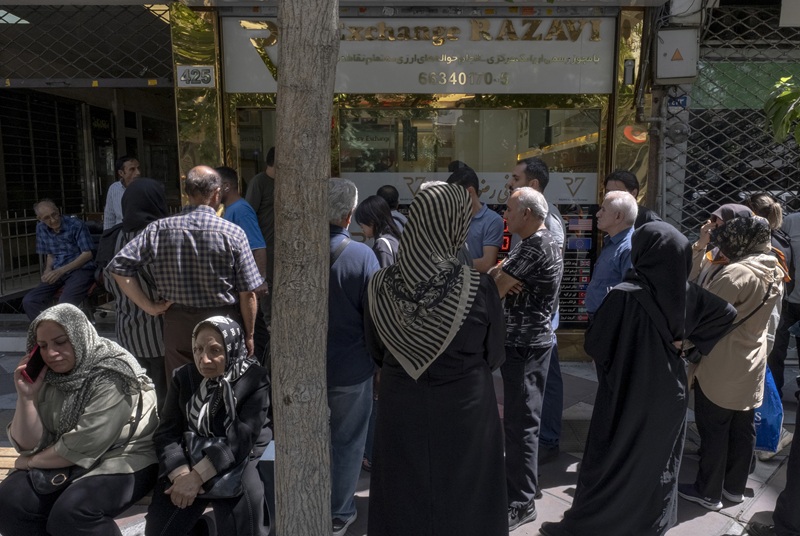
Even before the campaign was officially launched, the Iranian currency fell to its lowest-ever level of nearly 2,060,000 rials per U.S. dollar. Persistent efforts by the Central Bank of the Islamic Republic of Iran (CBI) failed to lift it to 2,000,000 rials per dollar.
Although the dollar functions as a thermometer of Iran’s economy, and its unprecedented surge highlights the powerful impact of the U.S.’s economic campaign against the regime, other factors have also become strikingly apparent: a decline in Iran’s oil exports to China and rising prices across various markets, including the automobile market, in less than a week.
The new economic pressures are operating on three key fronts:
- A reduction in Iranian exports, particularly oil, coupled with rising transaction costs, as sanctioned Iranian oil requires higher brokerage fees and steeper discounts;
- Greater difficulty in repatriating foreign currency;
- Higher costs for importing intermediate and essential goods.
The consequences of these three pressures include a rising exchange rate, accelerating inflation and price increases, a deepening recession, higher unemployment, and a further erosion of household purchasing power.
Some observers have compared this approach to the sanctions imposed in previous years and argue that the Islamic Republic will once again find ways to survive under sanctions.
Yet this new round of sanctions is unfolding under entirely different circumstances.
Today, the Islamic Republic is dealing with war and its psychological and economic repercussions. Its governing structure has become deeply fragmented and destabilized following the elimination of large numbers of senior, mid-level, and even lower-ranking officials.
Sanctions have strangled Iran’s economy for nearly two decades, while for almost half a century the country’s economic structure has suffered the astronomical — and at times irreparable — cost of government incompetence and corruption. It has been severely weakened.
At the same time, the Islamic Republic has deployed virtually all the resources at its disposal to build networks and mechanisms for circumventing previous sanctions. It now faces a new wave of constraints, making it increasingly difficult to build new networks to evade sanctions.
US Eyes Airlines, Digital Assets as Iran-Related Targets, Bessent Says
The war and the intensification of U.S. economic pressure have accelerated the crises generated by the policies and performance of the Islamic Republic, leaving Iran’s economy in the most fragile condition ever known in its modern history.
Meanwhile, the severe economic shocks of recent months have demonstrated that what was for years promoted under the misleading and unprofessional label of a “resistance economy” — a concept introduced by Iran’s former Supreme Leader, Ayatollah Ali Khamenei, and intended to shield the country from sanctions and foreign pressure — was little more than empty rhetoric.
Fundamentally, there is no such thing as “resistance” in an economy: the laws governing economic activity in human societies ultimately impose themselves on governments.
In other words, the Islamic Republic — even under wartime conditions, with shrinking financial resources, mounting pressure on foreign trade, and the erosion of people’s ability to make a living — cannot pin its hopes on notions of “resilience” and “resistance.”
The most serious threat posed by the latest U.S. economic pressure on the regime will emerge when the effects of the “Economic D-Day” campaign extend beyond economic indicators and begin to directly affect people’s lives and daily circumstances. For those already living with poverty and deprivation, which permeate nearly every aspect of life, there is little capacity to withstand any additional economic hardship.
Under such conditions, public anger and discontent are likely to be directed at a government which, for more than half a century, has pursued confrontation and warmongering, precipitating Iran’s decline in virtually every sphere.
The “Economic D-Day” operation will impose costs and consequences on the Islamic Republic that extend far beyond sanctions and the economy itself. It will leave the regime facing a stark choice: surrender or collapse.