
By Kayhan Life Staff
The Islamic Republic of Iran is stepping up its campaign of repression against the population, and using Shia proxy forces from Iraq, Lebanon, Afghanistan, Pakistan, and Turkey to enforce it.
The government appears to be intent on demonstrating that, even in the case of a prolonged conflict and further damage to the country, it can stay in power and avert collapse by maintaining the effectiveness of its repressive machinery.
Analysts say that this strategy serves two primary aims: to reassure the regime’s supporters that the “resistance” remains active, and to offset weaknesses among its own forces on the ground.
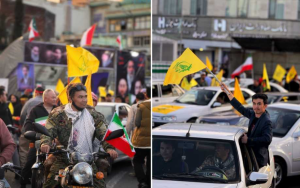
Uniformed units from Iraq’s Popular Mobilization Forces (PMF), fighters linked to Hezbollah-affiliated groups in Lebanon, and a contingent of roughly 100 to 150 Turkish Shia reportedly entered Iranian territory in late March, ostensibly to deliver humanitarian and relief assistance.
Even before the arrival of these mercenary elements from Iraq, Lebanon, and Turkey, members of the Fatemiyoun Brigade—composed largely of Shia Afghan fighters—along with Afghan youths (some of them reportedly underage) had already been mobilized by local Basij militia units for deployment in urban areas.
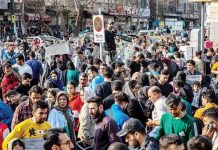
These groups, when combined with regime supporters, perform a dual function. They contribute to the visible presence of crowds at nightly gatherings and in motorbike and car convoys. They are also deployed at checkpoints at various locations across the country.
Reza Tamizkar, a former member of the Police Command of the Islamic Republic of Iran (FARAJA) who now lives in Germany and is a regime opponent, told Kayhan Life: “Although imported mercenaries directly reinforce the machinery of repression, the government has created activities that serve as a cover for their operations. For instance, Iraqi and Afghan forces, as well as those arriving from Turkey, are stationed near checkpoints under the guise of moukebs — charitable hospitality tents.”
“In reality, these tents serve as local support bases for Basij forces, the Islamic Revolutionary Guard Corps (IRGC), and police personnel,” he said.
“Part of their role is to provide food, tea, and sweets, while simultaneously supporting the motorcycle patrol units operating alongside them,” Tamzikar added. “Given the extensive destruction of Basij militia and IRGC facilities and the damage to many police stations, the government — relying on its supporters, including women and foreign recruits — uses these tents to coordinate the distribution of food to security forces deployed on the streets.”
Tamizkar also shared an image with Kayhan Life that showed pro-regime women distributing dinner to members of the repressive forces.
Local restaurants, backed by regime supporters, reportedly prepare larger quantities of food for lunch and dinner so it can be distributed to security personnel in multiple locations.
State-run media appears to be making little effort to conceal the security rationale behind the presence of foreign forces in Iran.

On April 12, the website Nour News, affiliated with Iran’s Supreme National Security Council, reported that a convoy of 80 individuals from Turkey entered the country via the Bazargan border crossing in the northwest “to pledge allegiance to Mojtaba Khamenei” — the new Supreme Leader, whose father Ali Khamenei was killed in a Feb. 28 Israeli attack — and to “support the Axis of Resistance.”
Brigadier General Ahmadreza Radan, commander of FARAJA, has said: “The impact of people’s presence in the streets is no less significant than that of missile launcher operators.”
In a formal declaration, the Islamic Propaganda Coordination Council said that “under the present wartime conditions against the U.S.-led coalition and the Zionist regime, the Islamic Republic of Iran has adopted a three-tiered strategy that may be described as a ‘battle on three fronts’: the first front (the field) involves military and hardware-based combat; the second front (the street) centers on public presence and support both domestically and internationally; and the third front (diplomacy) consists of negotiations and diplomatic engagement at the global level.”