By Kayhan Life Staff
Senior House of Lords members from a wide range of political parties are asking the U.K. government to speak directly with the U.K.-based “Stage of Freedom,” an Iranian diaspora group led by women. They warn that Iran is at a key moment of nationwide mobilization that could transform the country’s political future.
In a letter dated Jan. 28, 30 peers have asked the government to engage with Stage of Freedom, a diaspora group led by Iranian women. The signatories come from Conservative, Labour, Liberal Democrat, and crossbench backgrounds, and include Lord Walney, Lord Brady of Altrincham, Lord Polak, Baroness Eaton, Baroness Deech, Lord Harrington, and Baroness Ludford. Their letter describes the group’s testimony as a “moving account of the suffering of the Iranian people” and has urged ministers to meet the activists “to hear from these brave individuals directly.”
The peers’ request comes after Stage of Freedom sent a letter on Jan. 19 to the Prime Minister, the Foreign Secretary, and members of both Houses. The letter said Iran is now in “a decisive phase of a national revolution aimed at ending the Islamic Republic and enabling a democratic transition.”
The group framed the current unrest as a continuation of the ‘Woman, Life, Freedom’ uprising sparked by the death of Mahsa Amini in 2022, which exposed the regime’s resort to systematic repression and led to international condemnation.
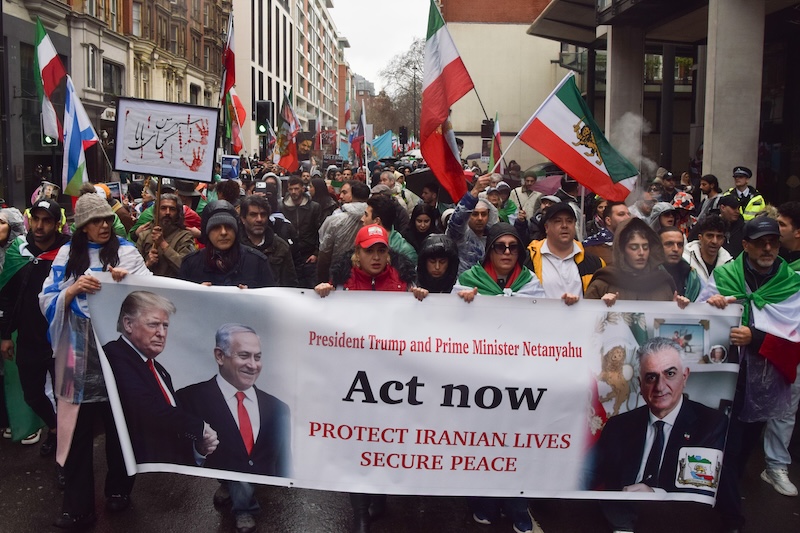
The Stage of Freedom’s statement identified Prince Reza Pahlavi, the exiled crown prince, as a key figure uniting people inside Iran.
“One clear political reality emerging from Iran’s current national revolution,” the group wrote, “is that the only name consistently and audibly called on the streets from within Iran has been that of Crown Prince Reza Pahlavi.”
The group noted that the largest demonstrations and strikes followed his public call on Jan. 8 for coordinated nationwide protest, and said this was evidence of his “credibility and capacity to mobilise broad segments of Iranian society.”
The letter said Pahlavi’s name had been heard in cities and communities with different ethnic and political backgrounds. The group emphasized that support for Pahlavi was not based on ideology but on “respect for the will expressed by the people inside Iran.” They described him as someone who could bring together republicans, constitutional monarchists, ethnic groups, and left-leaning groups during a time of change.
The group stressed that Pahlavi wished to help Iran move toward democracy in an orderly way, with a free and fair referendum to decide the country’s future. They also mentioned his transition plan, the Iran Prosperity Project, which aims to prevent government collapse, internal conflict, and legal problems after the Islamic Republic ends. The plan includes preparing for a constituent assembly and a nationwide referendum on Iran’s future government.
According to Stage of Freedom, the United Kingdom’s stance now “matters” both symbolically and strategically. They argued that statements from democratic governments made repression more costly and showed that human rights abuses would not be ignored. They also said that the Iranian public paid close attention to what democratic parliaments decided.