By Kayhan Life Staff
Prince Reza Pahlavi drew parallels between the deadly drone attacks led against Ukrainian cities and the repression of protesters in Tehran at the Black Sea Security Forum on May 30.
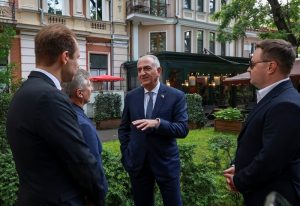
“There is something fitting about delivering these remarks here, in Odesa, a city that has looked into the face of foreign aggression and refused to blink,” he said, adding that Ukraine understood “what it means to defend not just territory, but liberty.”
He argued that Ukraine’s war, Iran’s democratic uprising, and the crisis in the Strait of Hormuz were all episodes in a wider battle against the Moscow-Tehran axis. He called for a transatlantic strategy against what he described as an authoritarian alliance linking Moscow and Tehran.
His remarks came as Washington and Tehran edged toward a possible 60-day ceasefire extension. Currently in the Persian Gulf, Tehran is exercising control over the Strait of Hormuz, threatening shipping and disrupting energy flows.
Pahlavi argued that a free Iran would transform Hormuz from an instrument of coercion into a route for commerce and cooperation.
“The Strait of Hormuz is not used to hold the world economy hostage, but to support international commerce and cooperation,” he said, describing what would change after the fall of the Islamic Republic.
The Black Sea Security Forum was launched in 2024 by Ukrainian parliamentarians and is led by Ukrainian member of parliament Oleksii Goncharenko. This year’s event drew more than 1,200 participants from Ukraine, Europe, and the United States to discuss security challenges in the Black Sea region and beyond. Its partners and supporters have included the American Enterprise Institute, RAND Europe, the Konrad Adenauer Foundation, and Lord Ashcroft, the British lawmaker.
OPINION: Let Iranians Decide Their Own Future Through the Ballot Box
At the heart of Pahlavi’s remarks was Iran’s Sun and Lion Revolution, which began on Dec. 28, 2025 and spread nationwide — to areas once considered regime strongholds, including religious neighborhoods, districts housing government and security officials, and communities located near Islamic Revolutionary Guard Corps facilities.
He told the Odessa audience that more than 40,000 Iranians were killed during the unrest, describing them as “unarmed men and women who took to the streets in January, demanding nothing more than the right to choose their own future.”
“My country has been struck from every direction: by the regime from within, and by the consequences of the regime’s own recklessness, from without,” he said. “And yet the Islamic Republic still stands.”
He said the same regime that supplied drones to Moscow had used surveillance technology against Iranian protesters during internet blackouts imposed to prevent the outside world from witnessing the crackdown. “The ‘Shahed’ drone does not distinguish between a residential block in Kharkiv, a protest square in Tehran, or commercial offices in Dubai,” he added. “It serves the same masters and advances the same agenda: the destruction of any sovereign people’s right to determine their own future.”
Pahlavi described Tehran and Moscow as “co-architects of chaos” and warned that they used delaying tactics, made maximalist demands, and engaged in blame-shifting to exhaust democratic adversaries.
“Every agreement has bought time for the regime, not for the people or the free world,” he said. “Every sanction relief funded the Revolutionary Guards, proxy armies, and drone factories whose products now circle this city, not schools or hospitals.”
Pointing out that “Iran sits at the intersection of the Caspian, the Persian Gulf, and Central Asia,” he emphasized that, “a democratic Iran anchored in the free world does not merely remove a threat. It creates a peace dividend of historic proportions; for Europe, for the Black Sea region, for the Middle East, and the rest of the world.”
Pahlavi set out his five-part strategy: maximum pressure on the Islamic Republic, maximum support for the Iranian people, maximum defections from within the regime, maximum mobilization of Iranians, and the Iran Prosperity Project.
He described the Iran Prosperity Project as a transition framework developed with Iranian experts, jurists, and civil society figures. Its three phases — emergency, establishment, and normalization — are meant to assure that when the regime falls, Iran does not plunge into chaos but moves toward order, accountability, economic recovery, and diplomatic normalization.
“We do not need nation-building,” Pahlavi said. “We are ready to build back our own nation.”
He urged Ukraine’s allies to see the Iranian democratic movement as part of the same security architecture that underpins support for Kyiv.
“Ukraine and Iran are fighting different battles on different soils,” Pahlavi said. “But we are fighting the same war.”
He closed with a direct challenge to policymakers: “Do not negotiate with the axis of chaos: Confront it. Do not manage the Islamic Republic: End it. Do not wait for a better moment: This is the moment.”
To see a video of Prince Reza Pahlavi’s full remarks