By Kayhan Life Staff
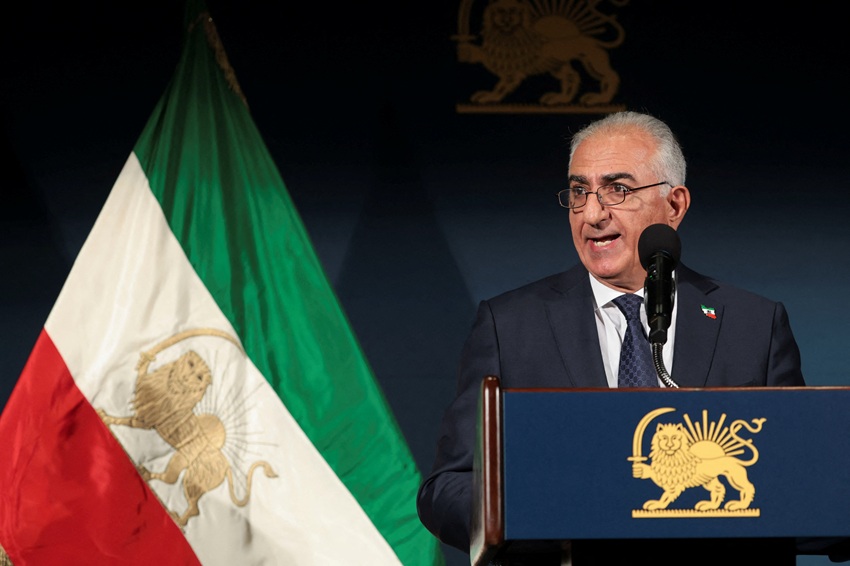
Prince Reza Pahlavi called for international support to liberate Iran from the Islamic Republic, “a foreign occupying force responsible for mass atrocities,” including the killing of more than 12,000 protesters in 48 hours.
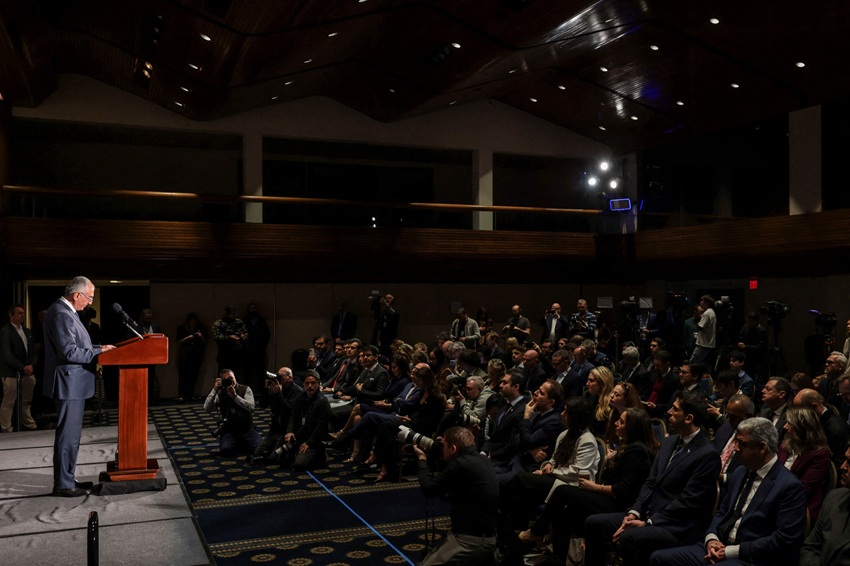
Speaking at a press conference in Washington, D.C., amid one of the deadliest periods in the country’s modern history, the exiled crown Prince said that Iran was confronting “foreign occupation wearing clerical robes.”
Pahlavi urged immediate global action to halt what he characterized as a mass slaughter of civilians. “One murder every 14 seconds,” he said. According to Iran International Persian television channel based in London, government forces have collected bodies in dump trucks, refused to return them to families without payment for the bullets that killed them—a charge activists have previously raised—and buried the unclaimed dead in unmarked mass graves.
“These are war crimes,” he said. “This is not repression. This is an occupation.”
Pahlavi framed the Islamic Republic, now in its 47th year, as a “hostile force” ruling against the will of Iranians. He alleged that Tehran has deployed Hezbollah fighters, Iraqi militias, and other foreign paramilitaries to suppress nationwide demonstrations, comparing the violence to the actions of Saddam Hussein and Bashar al-Assad. “The battle in Iran today is not between reform and revolution,” he said. “It is between occupation and liberation.”
A Six-Point Call to Action
Pahlavi presented an international action plan built around six pillars: degrading the regime’s repressive capacity, imposing maximum economic pressure, breaking the information blockade, holding the regime legally accountable, securing the release of political prisoners, and preparing for a democratic transition.
He called on governments to target Islamic Revolutionary Guard Corps (IRGC) leadership, command structures, and infrastructure—“the instruments of state terror,” as he put it. He urged the blocking of regime-linked assets worldwide and the dismantling of Iran’s so-called “ghost tanker” fleet, which Western officials say allows Tehran to sell oil covertly in violation of international sanctions.
The Prince appealed for international support to restore Iranians’ access to the internet by deploying Starlink, alongside other secure communications networks and cyber operations. “The regime fears the truth more than anything,” he said. “Break the blackout.”
He also pressed for the expulsion of Iranian diplomats, which several countries have avoided for fear of escalation. He also called for coordinated legal action against officials implicated in alleged crimes against humanity.
Finally, he urged democratic nations to commit now to recognizing a transitional Iranian government “when the moment comes,” arguing that such clarity would help hasten defections from within the security apparatus.
“These steps are not interference,” he said. “They are expressions of solidarity with a nation fighting for its freedom.”
“I Will Return to Iran”
Responding to critics who note he has spent his adult life abroad, Pahlavi insisted that his connection to Iranians has remained unbroken. “The bond between the Iranian people and me is not new. It’s been with me since birth, and it cannot be broken,” he said. He recalled volunteering as a fighter pilot during the Iran-Iraq War, when Saddam Hussein’s forces invaded Iran in 1980—a claim he has made in previous interviews, though he never served in combat. “Even in exile, I pledged my life to the service of the Iranian nation. I will return to Iran.”
The Prince cast himself as a unifying figure capable of bridging divides that have long fractured the Iranian opposition. “The public and members of the military see me as the national figure who can unite all opposition forces from every background, ethnicity, republican and monarchist, right, left, and everything in between,” he said. He presented his appeal as less ideological than procedural. He emphasized the aim was to organize an orderly exit from the Islamic Republic rather than to predetermine what comes after.
He argued that millions of Iranians—inside the country and across the diaspora—are already converging around what he described as four nonnegotiable principles: Iran’s territorial integrity; individual liberties and equality of all citizens; separation of religion and state; and the Iranian people’s right to choose, through democratic means, their future system of government.
The question of Iran’s ultimate political form, he said, would be settled only after the collapse of the current system—through a referendum and a constitutional process under international observation—rather than by a single leader, faction, or ideology claiming ownership of the revolution.
He added that a comprehensive transition blueprint—“ready to be implemented immediately”—had been developed by a team of legal, security, and economic experts.
Pahlavi said tens of thousands of members of Iran’s armed forces, police, and security units have already signaled willingness to defect, and that the regime has begun importing foreign proxies to compensate for internal reluctance to continue the crackdown. “This is the beginning of collapse,” he said. “We are seeing the system running out of its own forces.”
He outlined his plan, for a transitional government taking control immediately after the regime falls, followed by the establishment of a temporary parliament and judiciary. A national referendum would determine whether Iran becomes a republic or a constitutional monarchy. A constitutional assembly would then draft a new founding document to be approved in successive referendums until a majority consensus is reached. Only then would a permanent government take office.
“My role is to lead the transition, not dictate Iran’s future system,” he said. “I let historians write history. I’m here to make it.”
International Diplomacy—and Its Limits
The Prince’s appearance drew international media questions about U.S. policy, particularly the role of President Donald J. Trump, who has said “help is on the way” but has declined to commit to military action publicly. Pahlavi said he believes Trump “is a man of his word,” and noted that the President has insisted the future of Iran must be decided by Iranians themselves. “On that, I totally agree,” Pahlavi said. “It is for the Iranian people to decide.”
Asked whether the movement risks depending too heavily on U.S. intervention, Pahlavi replied that any decisive international action—particularly strikes on IRGC assets—would shorten the conflict and save lives, but was not strictly necessary for victory. “If action happens, great,” he said. “If it doesn’t, we will still fight. The difference is cost—and the number of dead.”
Journalists pressed him on European reluctance to take harder measures, including Germany’s hesitation to designate the IRGC a terrorist organization. “I am flabbergasted,” he said. “This regime is on its last leg. Democratic nations must act now.”
He was similarly direct on questions about the threat Iranian operatives pose abroad, including alleged sleeper cells in Europe. He argued that ending the Islamic Republic would eliminate a significant global security risk: “We need to cut off the wealth that funds terrorism once and for all.”
Russia, China, and the Future Regional Order
The Prince said he expects that even governments that have cooperated with Tehran—including Russia—will ultimately reassess their positions as the regime weakens. He emphasized that a democratic Iran would seek constructive relations with its neighbors, including Israel, and with global powers, based on “mutual respect.”
He contrasted that vision with Iran’s current trajectory. “Iran should have been the next South Korea of the Middle East,” he said. “Instead, we have become North Korea—not because we lack resources or talent, but because of corrupt governance.”
He invoked Iran’s ancient history, specifically the reign of Cyrus the Great, as a symbol of the country’s potential to become a stabilizing regional force. He said he envisions a Middle Eastern peace framework akin to the Abraham Accords, expanded to include a free Iran—a concept he called the “Cyrus Accords.”
“This Is Iran’s Moment”
Throughout the speech and extended question-and-answer session, Pahlavi repeatedly framed the crisis as a turning point in Iranian history. He praised the courage of protesters, particularly young Iranians who have led demonstrations despite extreme personal risk.
“You are the immortal guard of Iran,” he said, addressing citizens directly. “Do not allow this regime to create the illusion that life is normal. After all the massacres, there is a sea of blood between us and this regime.”
He added that justice for crimes committed by security forces would be essential, but cautioned that it alone would not heal the nation. “It will open the door to healing and a national rebirth,” he said.
Pahlavi insisted that Iran is “halfway across the river,” with no possibility of turning back. He questioned whether democratic nations would act swiftly to prevent further bloodshed. “There are moments in history where the moral imperative for action is so strong that the weight of inaction becomes unbearable,” he said. “This is one of those moments.”
He closed with a line he has used before: “The people of Iran have risen to reclaim their country. History will honor those who rise with them. “