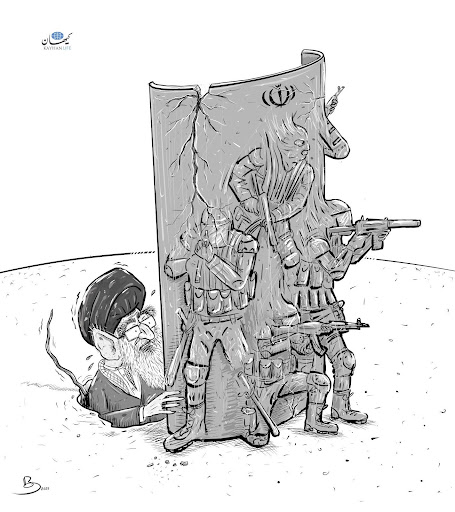
Artist: Behnam Mohammadi
By Kayhan Life Staff
By Thursday, January 1, protests that erupted on Sunday, December 28, had spread to more than 72 cities across Iran, stitching together a geography of dissent that runs from the Zagros Mountains in the west through Tehran and central Iran, across the Caspian north, into Khorasan in the northeast, and down to the southern coast of Hormozgan. The strikes and shuttered bazaars have struck the regime where it is most vulnerable: its economic nervous system.
What began as an outcry over livelihoods has hardened into something far more consequential. Demonstrations are animated by rage at state incompetence, suffocating repression, deep public resentment, and a conviction that the system itself must go. A recent survey by a state-affiliated polling agency found dissatisfaction with the country’s direction at roughly 92 percent, a figure that indicts more than informs.
In response to this unrest, the state has acted as it always does: arrests, bullets by direct gunfire. Human rights groups report at least 10 deaths, dozens of injuries, and more than 100 arrests in the first five days alone. Among the dead is a 15-year-old child.
Meanwhile, projecting an image of control, Tehran insists it faces nothing more than “riots.” But when bazaars closed, its myth of normalcy collapsed, and fear changed sides.
The Iranian people advance unarmed. The clerical state, armed to the teeth, shelters behind plastic shields and live bullets. In that contrast lies the story of a regime losing its claim to authority, and a society discovering its own.