Six Iranian protesters who said they witnessed the brutal crackdown of mass demonstrations in Tehran, Mashhad, Isfahan, and Lahijan on Jan. 8 and 9 have spoken exclusively to Kayhan Life. They have described the crackdown as an organized military assault against unarmed civilians – with heavy weapons, coordinated units, and an intent to kill rather than to disperse the crowds.

“It was as if one foreign country was storming another and drowning its citizens in blood: a large-scale massacre,” said one Tehran resident who took part in the demonstrations. “There was no sign that a police or security force wanted to control or even deter protesters who were citizens of the same country. What they did looked completely like a planned wartime attack, with a high volume of military equipment and a firm determination to eliminate people and pile up bodies.”
The protests began with a strike on Dec. 28 at Alaeddin Passage, a major mobile-phone market in central Tehran, and in a matter of days, turned into the largest anti-government protests in the history of the Islamic Republic — and the 21st century’s bloodiest crackdown against protesters anywhere in the world.
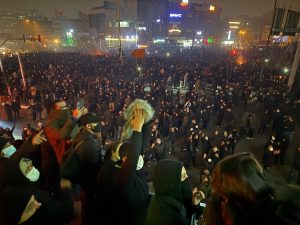
By the 12th day of protests, on Jan. 8, millions poured into the streets after a call from Reza Pahlavi, the exiled son of Iran’s last monarch. Estimates put the turnout in major cities, including Tehran, Isfahan, and Mashhad, as being in the millions. The demonstrations spread to all of Iran’s provinces and about 200 cities, with large urban centers seeing simultaneous gatherings across multiple districts.
Millions Rally Across Iran After New Protest Calls by Prince Reza Pahlavi
At 10 p.m. local time on Jan. 8, the Islamic Republic cut nationwide internet access and launched into a mass killing of protesters. The death toll, according to various media reports, ranges from 12,000 to more than 20,000 — figures that cannot be independently verified, particularly under the continuing communications blackout.
On the 23rd day of protests, nationwide internet access had still not been restored, and contact with people inside Iran remained all but impossible.
A protester identified only as Reza said he had joined the demonstrations in the days leading up to Jan. 8 – but was completely unprepared for what he saw that night in Tehran.
At around 8:30 p.m., as he was preparing to join the demonstrations, Reza was shocked to see the sheer size of the movement.
“I had expected a bigger turnout than on previous nights, but not such an extraordinary outpouring of people,” he said. “Our home is on a main street. As I was getting ready, I heard people chanting ‘Javid Shah’ in unison outside. The sound made it clear that the crowd was staggeringly big. I looked out of the window and saw an unbelievable mass of people. For 15 minutes, a column of demonstrators walked past my window, and still it would not end.”
He said the size and intensity of the gathering exceeded the wave of unrest that followed the disputed reelection of then President Mahmoud Ahmadinejad in 2009.
Reza said footage of the January demonstrations broadcast on channels around the world – which he was able to see on satellite television – did not come close to capturing the scale of the crowds.
Another protester in Tehran, identified as Nima, said the turnout seemed spontaneous and broad-based.
“The crowd was extraordinary,” he said. “Hundreds of thousands of people, with no prior coordination or organization, from every possible background — people out on their own, or with friends and family, or with their children, even — filled the streets within half an hour, between 8 and 8:30 on Jan. 8. It was hard to believe. Everyone was united.”
In Mashhad, Iran’s second-largest city and a center of religious pilgrimage in the country’s northeast, a protester identified as Ali described the city’s major thoroughfare, Vakilabad Boulevard, as being thronged for several kilometers with protesters.
“It was an outpouring of people,” he said. “More than 1 million in one place, in one voice.” He said the crowd’s size initially forced the security forces to pull back.
In Lahijan, a city in Gilan Province near the Caspian Sea with a population of about 110,000, a protester identified as Behrouz also described an overwhelming turnout.
“The end of the march could not be seen,” he said. “From teenagers to elderly men and women, everyone was there — unified and chanting together. Next to me, a woman aged over 70 was shouting slogans with the crowd.”
Behrouz said many people felt the government had lost control. “After an hour, we felt that the city was in the hands of the people,” he said.
According to Kayhan London, authorities later claimed that protesters in Lahijan set fire to a branch of the Ofogh Kourosh retail chain, which Behrouz described as linked to the Islamic Revolutionary Guard Corps (IRGC). Behrouz said he did not see armed protesters, and that residents suspected the authorities themselves to have started the fire.
“I truly did not see armed people,” he said. “People were empty-handed. Reports have since come out claiming that the protesters carried out extensive destruction. I reject that about Lahijan. Even if trash cans were burned, it was a way to create a shield against armed forces shooting at us. No one really wanted to harm people’s property or shops.”
Several interviewees said crowds remained in the streets for two to three hours, then thinned after about 11 p.m. as families left. Reza said the reduced numbers appeared to trigger a coordinated, escalated crackdown.
“All of the security forces were present — police, riot units, the Revolutionary Guard, and armed plainclothes men with blades and firearms — all together,” he said. “They were completely organized and coordinated. I had been in earlier protests, and I can tell you with certainty that this time the government was prepared in advance with a fully coordinated plan to suppress by killing. Their goal was not dispersal. It was killing. They issued a warning, then began shooting.”
He described a pattern in which forces fired into the crowds, then chased fleeing demonstrators into side streets and alleys, attacking smaller groups with guns and batons.
Ali described a similar sequence in Mashhad near the intersection of Vakilabad Boulevard and Haft Tir Boulevard. He said gunfire came from on top of a police building, and riot police, the Revolutionary Guards, and plainclothes security forces then surged towards the people as they scattered. He said he later concluded that some government forces had been embedded in the crowd, directing people into narrower streets where they could be tracked down by the security forces.
He also claimed that reconnaissance drones were used. “When a small group took refuge in an alley, a laser was placed on people, and agents guided by the drones on motorcycles went toward the protesters to suppress them,” he said.
Behrouz said drones were also visible over Lahijan, and said they were both tools of intimidation and a way to track people as they ran down narrow alleys.
In Isfahan, a central Iranian city known for its historic bridges and boulevards, a protester identified as Bahar described what she called “wartime conditions” in the Chaharbagh and Sheikh Seddough areas. She said she was wounded by pellets in her leg and was avoiding hospitals for her own safety.
“In hospitals, they were kidnapping the wounded,” she said. “Not the regular police, but plainclothes security forces from the Intelligence Ministry and the Revolutionary Guard’s intelligence arm searched hospitals room by room, bed by bed, looking for protesters.”
She said relatives treated her at home because the family feared detention.
Bahar said the security forces were shooting at the protesters with guns, while plainclothes men used knives, batons, and pistols. “The scenes were terrifying,” she said, adding that the crackdown had strengthened her resolve to continue resisting.
Nima said security forces in areas of western Tehran – including Sadeghieh, Punak, and Sattar Khan – relied less on tear gas than in past protests, and instead used stun grenades and live fire when the crowds did not disperse. He said armored vehicles were driven into crowds in some areas, and forces pursued demonstrators into alleys “with intent to kill.”
Several interviewees also described the security forces carrying out a rapid cleanup after the violence — to erase evidence.
Bahar said that on the day after the crackdown, family members went to the streets near the Zayandeh River in Isfahan around noon and reported little sign of the previous night’s bloodshed. Behrouz said he drove around Lahijan the next morning and found streets cleared of debris and graffiti.
“All traces of the bloody protests were erased,” he said, “as in movies where zombies attack at night and the city looks normal in the morning.”
As information slowly spread despite the communications blackout, residents began learning about deaths near their homes. Nima said he later found out that a young protester had been killed on a nearby street and that two more people had died a few streets away.
Interviewees described tightened security in several cities after Jan. 8 and Jan. 9, including checkpoints, phone searches, and arrests. Behrouz said Lahijan experienced what he described as de facto martial law from Jan. 9 through Jan. 13, with security forces searching cars and mobile phones. He said arrests escalated after Jan. 13 and authorities appeared to seize CCTV recordings from buildings and shops along protest routes to identify protesters.
Nima said a friend in Zahedan, the capital of Sistan and Baluchestan Province in Iran’s southeast, described ongoing clashes, military deployments, and a heightened security presence even during the daytime. He said some areas of the province saw armed confrontations between protesters and security forces.
Ali described checkpoints across Mashhad and said authorities searched phones for protest photos and videos. He said clashes in other parts of the city, including Tabarsi and Tous, were even more intense than in Vakilabad. He also claimed some security personnel were killed during the unrest, and he described reports of heavy civilian casualties.
The full scale of deaths and injuries remained unclear even to those who said they witnessed the violence.
A hospital worker identified as Shaghayegh, employed at a private hospital in western Tehran, described overflowing emergency rooms and severe pressure from security agencies.
“The wounded and the dead were horrific,” she said. “I did not see anything like this even after the Bam earthquake.” She said injured people arrived in groups, blood covered the emergency room floor, and hospitals struggled with shortages of staff, operating rooms, and blood supplies.
She said security agents shouted at staff and civilians not to film or take photos, and later attempted to inspect hospital employees’ phones. She said fear and coercion led many to delete recordings.
Shaghayegh said she did not personally witness bodies being removed from her hospital, but said colleagues reported that, at another hospital in western Tehran, agents took not only the bodies of the dead but also injured patients — including those in casts or with fresh stitches — while disabling CCTV cameras.
She also said that on Jan. 9, security agencies pressured some hospitals to refuse admission to injured protesters.
Shaghayegh said that between the night of Jan. 9 and Jan. 10, 350 bodies were transferred to the west Tehran branch of the Legal Medicine Organization, Iran’s forensic authority. She said they included people who were turned away by hospitals and later died, as well as people brought directly from the streets.
Reza described additional pressure on families. He said relatives were urged to sign documents stating that a deceased family member had been a Basij militia member in exchange for burial permits and money — an offer he said most families rejected.
Those who refused, he said, were asked for payments ranging from 200 million to 1 billion tomans and were sometimes ordered to bury their dead in locations chosen by authorities, including in Qom, a religious city south of Tehran.
Reza also argued that the protests’ announced timing — gatherings called for the same hour across four consecutive nights — allowed security forces to prepare ambush tactics more easily, including positioning snipers on rooftops and deploying troops to areas analysts judged likely to draw crowds.