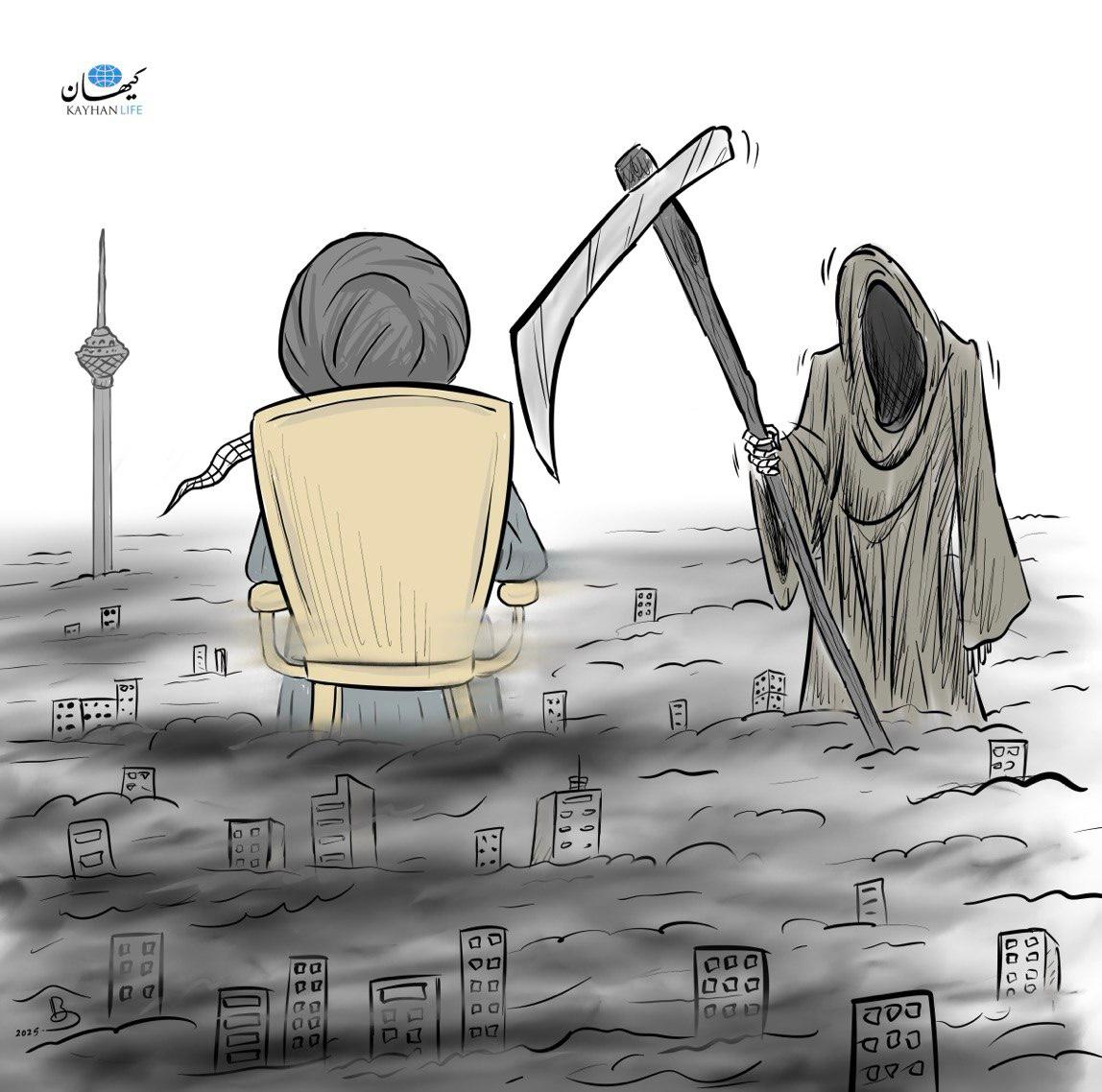
Artist: Behnam Mohammadi
By Kayhan Life Staff
Air pollution has tightened its grip on Iran’s cities with the lethality of the Grim Reaper. This is a public-health emergency claiming tens of thousands of lives every year.
According to the Ministry of Health, nearly 59,000 Iranians died in 2024 from exposure to toxic air. The ministry’s investigations reveal that 96 percent of Iran’s urban population is exposed to particulate matter concentrations exceeding the World Health Organization’s guideline levels.
The tragedy, however, is not merely the scale of death. It is that much of it is preventable. Iran passed a Clean Air Act in 2017, assigning clear responsibilities to ministries, municipalities, and regulators. Yet the law remains largely unimplemented. Committees convene, statements are issued, but pollution continues unchecked.
The economic toll is staggering. The health ministry estimated that the financial damage caused by pollution-related deaths in the last Persian calendar year was approximately $17.2 billion, with an annual average of $2.6 billion in Tehran, which amounts to around $300 per resident, or $1,200 for a family of four.
Families pay the price directly—through illness, lost income, and the rising costs of healthcare—while the government suppresses the release of updated hospital statistics.
This is not simply the result of geography or climate. It stems from policy failures, including an aging vehicle fleet that has more than doubled in size over the past decade, poor-quality fuel, unregulated industries, and weak enforcement. Meanwhile, the burden falls heaviest on the poor, the young, and the elderly—those least equipped to protect themselves.
Iran’s air crisis will not resolve itself. It requires political will, transparent governance, and, at the very least, real enforcement of laws already on the books. While the regime barely blinks, the public continues to pay the price, one breath at a time.