|
The Survival Spectacle
By Behnam Mohammadi
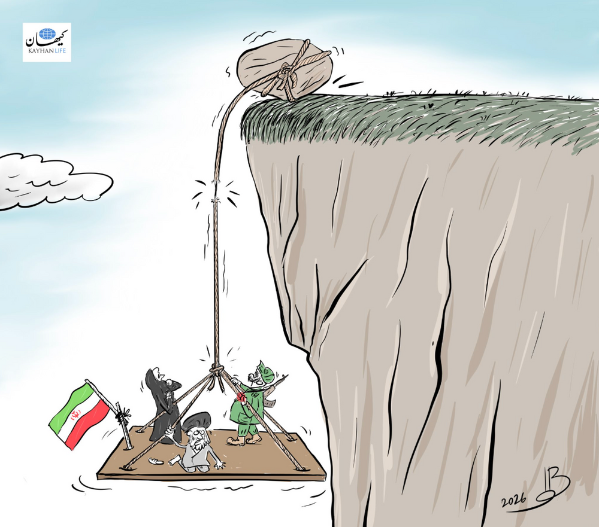
As arrests and executions increase, the Islamic Republic‘s campaign of survival continues: confiscating the property of those it brands as opponents, enforcing a near-total internet blackout, importing loyalists and proxy supporters from the Middle East, Africa, and Europe, and staging choreographed pro-regime rallies, convoys, and spectacles. In its theatre of desperation, what was once forbidden is now useful, and what was once sin is now stagecraft.
Welcome to the Kayhan Life Week in Review
As the Iranian internet blackout nears the 2,000-hour mark, Mojtaba Khamenei, the Islamic Republic’s new supreme leader, has also not been seen or heard from.
U.S.-Israeli strikes have weakened the regime militarily, but the standoff, caught between talks of a possible deal and threats of new strikes, shows Tehran is not strategically defeated.
Tehran’s “hostage diplomacy” has evolved from detaining dual nationals to arresting global energy markets. While Hormuz is Tehran’s visible leverage, its nuclear ambitions remain the leading chokepoint. Ultimately, Iranians continue to pay the price at home.
►Inside Iran, the human cost of the crisis continued to grow for ordinary citizens. Airport workers faced layoffs and months of unpaid wages after nearly three months of suspended operations. Rising prices and stagnant wages forced households to cut back on basics like chicken and dairy.
Iran’s Airport Workers Face Layoffs, Unpaid Wages Amid Economic Collapse
Iranian Households Cut Back on Chicken, Dairy Products As Prices Skyrocket
►The internet blackout has devastated women-led home-based businesses, who make up about 80 percent of the workforce in the sector.
Women-Led Home-Based Businesses Devastated by Internet Blackout in Iran
►Repression continued to breed with Amnesty International reporting that the Islamic Republic executed at least 2,159 people in 2025, helping push the global number of executions to the highest level in 44 years.
Islamic Republic Executed At Least 2,159 People Last Year, Amnesty Reports
Iran Executes Two People Under Security Charges
►The Strait of Hormuz remained the week’s defining symbol. With the Hormuz blockade in its 13th week, major Asian importers have begun making opaque arrangements to move crude oil, chemicals, fertilizer, and liquefied natural gas through the Persian Gulf.
No Deal, No Exit: How U.S.-Iran Standoff Risks Fresh Conflict
SPECIAL REPORT — Iran Is Consolidating Control of Hormuz With Island Checkpoints, Diplomatic Deals — and Sometimes ‘Fees’
Opaque Oil Deals Around Hormuz Test the Petrodollar
Iran’s Newly Created Strait Authority Discloses ‘Controlled Maritime Zone’ at Hormuz
►The war’s civilian toll returned to focus with new comments from a U.S. admiral about the February strike on a girls’ school in Minab. He said the school was on an active Islamic Revolutionary Guards Corps cruise missile base. Iranian officials say more than 175 children and teachers were killed in the strike on the first day of the conflict.
Iran Girls’ School Was Located on Active Cruise Missile Base: US Admiral
►Washington’s messages remained deliberately ambiguous. While the US President said negotiations with the Islamic Republic were in their “final stages,” he warned, once again, new attacks could follow if no agreement emerged. Earlier, he said he paused a planned strike after regional leaders urged him to give talks more time. Has the conflict shifted into a war of attrition?
Trump Says He Paused Attack on Iran as Negotiations Continue
Trump Says US May Need to Hit Iran Again
Trump Says Negotiations With Iran in Final Stages, Warns of Attacks if Deal Fails
Iran Retains at Most ‘Very Moderate’ Strike Capability, US Admiral Says
►The central diplomatic barrier remained Tehran’s pursuit of nuclear weapons.
EXCLUSIVE — Supreme Leader Says Enriched Uranium Must Stay in Iran, Iranian Sources Say
►U.S. President Donald Trump and Chinese President Xi Jinping agreed that the Islamic Republic must not obtain nuclear weapons, even as the conflict widened.
Trump Says He and China’s Xi Agree Iran Cannot Have Nuclear Weapons
►Regional tensions widened. The UAE reported a drone strike that caused a fire at a nuclear power plant, while Saudi Arabia said it had intercepted three drones entering from Iraqi airspace. Pakistan, meanwhile, relayed a new Iranian peace proposal to Washington, though officials suggested the sides were still shifting their demands.
Pakistan Sends New Iranian Peace Proposal to US
UAE and Saudi Arabia Report Drone Incidents as Iran War Deadlock Drags On
►The U.S. Treasury sanctioned an Iranian exchange house and 19 vessels linked to petroleum and petrochemical shipments, while Treasury Secretary Scott Bessent urged allies to disrupt the regime’s financing networks more aggressively. A Reuters investigation also traced how Iran’s largest crypto exchange used blockchain networks tied to major global industry players.
EXCLUSIVE — How Trump’s Crypto Venture and Iran’s Top Exchange Tapped Into the Same Industry Networks
US Imposes New Sanctions on Iranian Exchange House, Shadow Fleet Vessels
Bessent Urges More Disruption to Iran’s Financing, Will Review US Sanctions List
US Treasury, India’s Adani Enterprises Settle Alleged Iran Sanctions Violations
►The Islamic Republic’s reach abroad came under scrutiny, and its free rein was threatened. In Britain, prosecutors said Romanian men acted as proxies for Tehran in the stabbing of journalist Pouria Zeraati. In the United States, prosecutors accused an Iraqi national linked to Kata’ib Hezbollah of helping plan attacks in the U.S. and Europe. Back in the UK, the “Ban IRGC” campaign pressed for the IRGC to be designated a terrorist organization.
Romanians Stabbed Journalist in London at Behest of Iran, UK Court Told
US Accuses Iraqi Man of Helping Iran-Backed Militia’s Plans for Attacks in US, Europe
‘Ban IRGC’ Campaign Urges UK to Identify Revolutionary Guards As A Terrorist Organization
►Concluding with cultural developments, at Cannes, Iranian filmmaker Pegah Ahangarani’s documentary “Rehearsals for a Revolution” used family history, exile, archival material, and political memory to trace modern Iranian history during her lifetime, from the Iran-Iraq War in the 1980s to the deadly January crackdown on Iranian protesters. Asghar Farhadi’s “Parallel Tales,” meanwhile, showed the two-time Oscar winner experimenting with structure from outside Iran, where he has lived since 2023.
Cannes Documentary ‘Rehearsals for a Revolution’ Uses Personal Lens to Chart Iran’s History
Iran’s Asghar Farhadi Bends His Own Cinematic Rules in Cannes Entry ‘Parallel Tales’ |