|
Negotiations Under the Table, War Above It
By Behnam Mohammadi
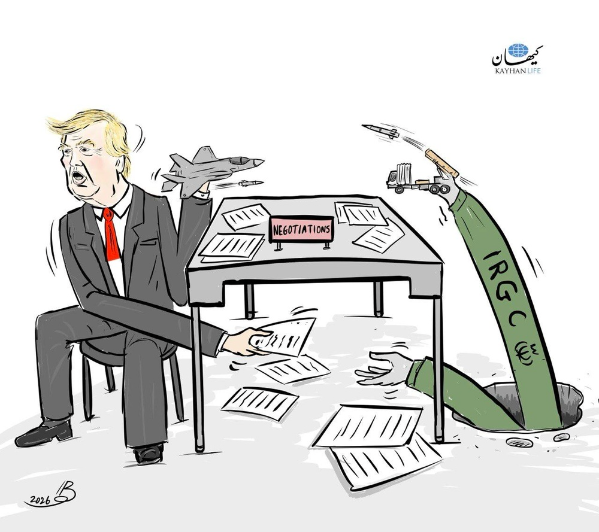
Washington and Tehran bargain in whispers while trading missile strikes. Tehran arms proxies, strikes the region, and crushes Iranians at home, while Washington talks diplomacy as it strikes back.
Welcome to the Kayhan Life Week in Review
Washington pivoted back to a war footing after months of a diplomacy of contradictions. While it had kept the use of force on the table, it had engaged in behind-the-scenes bargaining, continually suggesting a deal with the Islamic Republic was imminent. This week’s strikes, sanctions, asset threats, and fresh IAEA demands over Tehran’s uranium stocks extended to its sponsorship of Hezbollah in Lebanon and its plots in Europe. Iran’s World Cup participation became another arena for political maneuvering over visas, flags, and dissent. And life inside Iran and abroad, showed the human cost of a conflict caused by the Islamic Republic’s governing priorities.
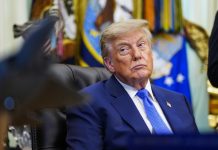
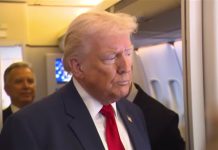
►U.S. President Donald Trump warned that the Islamic Republic would “pay the price” after an exchange of strikes following the downing of a U.S. Apache helicopter. He argued that Tehran had delayed negotiations for too long. U.S. forces said they intercepted Iranian missiles and drones launched toward Kuwait, Bahrain, and the Strait of Hormuz.
Trump says the Islamic Republic will “pay the price”
U.S. strikes near Hormuz after alleged Apache downing
Missiles toward Kuwait and Bahrain widen the Persian Gulf front
►Lebanon remained a key obstacle to any broader settlement. The Islamic Republic reiterated its support for Hezbollah and called for an Israeli withdrawal from southern Lebanon.
Hezbollah keeps Lebanon at the center of the deal
Israel and the Islamic Republic pause strikes — for now
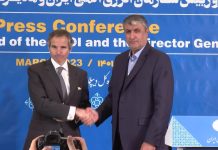
►The nuclear dispute also returned to the forefront after the International Atomic Energy Agency’s Board of Governors adopted a resolution calling on Iran to account for its remaining enriched uranium stocks and permit verification by inspectors.
The U.N. nuclear watchdog demands uranium accounting
►Earlier in the week, President Trump said he would be willing to speak with the Islamic Republic’s new supreme leader, Mojtaba Khamenei, who has not been seen in public since the start of the conflict. He also insisted that frozen Iranian assets would not be released and sanctions would not be eased before a formal agreement is reached. At the same time, U.S. officials were reportedly examining whether Iranian assets could be used to help compensate Persian Gulf states for damage caused during the conflict.
No frozen assets before a deal
Washington eyes Islamic Republic assets for Persian Gulf repairs
►Reflecting growing concern about the freedom of navigation in the Strait of Hormuz, the European Union joined the maritime pressure campaign by imposing sanctions on an Islamic Revolutionary Guard Corps (IRGC) naval command and two individuals.
EU sanctions Islamic Revolutionary Guard Corps Navy over Hormuz
►Washington also announced sanctions on a network accused of disguising Iranian liquefied petroleum gas exports as Omani products in order to evade restrictions. A separate sanctions package targeted individuals and companies in China and Hong Kong that U.S. authorities accused of assisting weapons procurement and financial activities linked to Iran’s military and the IRGC.
U.S. targets liquefied petroleum gas smuggling network
U.S. sanctions China- and Hong Kong-based procurement network
►In London, two Romanian men were convicted over the 2024 stabbing of Iranian-born journalist Pouria Zeraati on behalf of actors linked to the Islamic Republic.
Journalist stabbing conviction in London
►The United States, Britain, and several allied countries issued a joint statement condemning the Islamic Republic’s involvement in plots targeting dissidents, journalists, Jewish communities, and Israeli interests across Europe, North America, and Australia.
Allies condemn “lethal plotting”
►The FIFA World Cup also became entangled in politics. Iran’s national team arrived in Tijuana after weeks of uncertainty over visas and travel arrangements. Days before the tournament, the Islamic Republic’s football federation warned that matches could be halted if unauthorized flags or political slogans were displayed inside stadiums..
Iran’s World Cup team arrives in Tijuana
The regime threatens to halt matches over flags and slogans
►Roya Kashefi reflected on Iran, football, and belonging, asking whether fans can cheer a national team shaped by repression while refusing to surrender the memory, joy, and identity the Islamic Republic has tried to claim.
OPINION: Should We Support the Iran Team at the FIFA Football World Cup?
►Inside Iran, one of the most troubling reports concerned 17-year-old Mani Rahmani, who reportedly died from injuries sustained while in custody after being arrested following anti-regime protests in January.
Seventeen-year-old protester dies after prison injuries
►Environmental pressures also remained acute. Despite improved rainfall and rising dam levels, experts warned that Tehran Province continues to face a severe water shortage.
Tehran Province faces severe water shortage despite rainfall
►In London, a stage adaptation of British-Iranian filmmaker Babak Anvari’s award-winning film “Under the Shadow” opened at the Almeida Theatre. Set during the Iran-Iraq War, the production explores the effects of conflict, state restrictions, and uncertainty on ordinary families in Iran.
Under the Shadow opens on stage in London |