
By Kayhan Life Staff
The province of Tehran started the Iranian New Year with the worst water shortage in all of Iran, with its drinking water and agricultural supply both severely affected. Nearly three months on, the water shortage is still severe — despite a recent rise in water reserves.
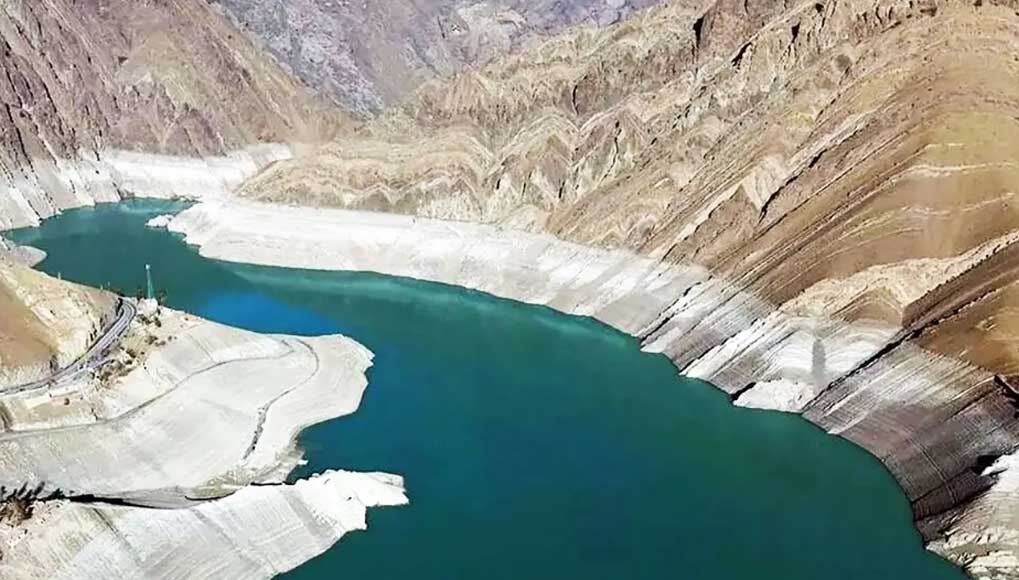
With the increase in rainfall this spring, the reserves of several dams supplying water to the capital, Tehran, including the Amir Kabir Dam (commonly known as the Karaj Dam) — located 63 kilometers northwest of Tehran and 23 kilometers north of Karaj — have risen. Yet experts say the water shortage crisis continues.
Statistics indicate that as of May 16, the Karaj Dam reservoir had reached 106 million cubic meters, equivalent to 59 percent of its total capacity.
Davoud Najafian, managing director of the Alborz Regional Water Authority, said: “Due to increased inflows into the Karaj and Taleghan reservoirs in Alborz Province this year, the volume of water stored in the Karaj Dam has risen to 133 million cubic meters out of a total capacity of 179 million cubic meters. In other words, the dam is now nearly 74 percent full.”
Specialists explain that Iran’s water crisis is not simply the result of a few years of low rainfall. Rather, it stems from a long-term imbalance between the country’s natural environmental capacity and its patterns of economic and population growth.
The Tehran-based Tejarat News website, discussing the roots of the nation’s water shortage, wrote: “Over the past decades, water-intensive activities have expanded significantly. These include water-heavy agriculture, the establishment of high-consumption industries, and the concentration of population in major metropolitan areas such as Tehran. As a result, water demand has outpaced the region’s natural capacity.”
Tejarat News further emphasized that poorly aligned development policies, combined with the overextraction of groundwater, had prevented Tehran’s water crisis from being resolved.
In an interview with Tejarat News, energy expert Mohammad Ebrahim Raisi explained that Tehran’s original water-supply system was designed to provide approximately 70 percent of water from surface sources and 30 percent from groundwater, with groundwater intended as a strategic reserve.
“But the situation has changed,” Raisi said. “Today, more than 60 percent of Tehran’s water comes from groundwater and wells drilled within the city.”
The report also noted that the high concentration of population and economic activity in Tehran places additional pressure on water resources. As the population grows, demand increases for drinking water, municipal services, energy production, and industrial activity. When such growth exceeds the region’s ecological carrying capacity, even years of abundant rainfall only delay the crisis rather than resolve it. According to the report, this pattern has persisted for many years.
Experts also blame decades of government mismanagement under the Islamic Republic.
Ahmadreza Lahijanzadeh, Deputy Head of the Iranian Department of Environment’s Marine Environments and Wetlands Bureau, said recently that the majority of the country’s environmental crises stem from poor water resource management. He noted that only 18 percent of declining water resources were attributed to climate change, while roughly 80 percent stem from human activities and management decisions.
Emphasizing that nature ultimately reacts to misguided policies, Lahijanzadeh said: “Dust storms, land subsidence, and the drying of wetlands are direct consequences of ignoring environmental considerations in managing natural resources.”
Regarding the state of the country’s water resources, he added that the number of water wells had grown from about 15,000 in the early 1970s to nearly one million today, many of them illegal. He argued that this demonstrated serious weaknesses in water governance.
Lahijanzadeh pointed to the Jaz-Murian Wetland (Hamun-e Jaz Murian) basin, which contains roughly 22,000 wells, nearly 11,000 of which are unauthorized. A significant portion of the pressure on regional water resources, he said, stems from these excessive withdrawals.
These developments have left Iran’s major metropolitan areas, including Tehran, facing a severe shortage of drinking water. The crisis is no longer limited to reduced rainfall or declining reservoir levels. Experts now warn that the capital has entered a deeper stage known as “hydrological drought,” a condition in which even periodic rainfall cannot replenish depleted groundwater reserves.
Mehdi Zare, Professor of Engineering Seismology at the International Institute of Earthquake Engineering and Seismology (IIEES) in Tehran, previously warned in an interview with Khabar Online that Tehran’s water system has entered “the most severe phase of hydrological drought.”
According to him, even the relatively favorable precipitation recorded during the 2025 and 2026 water years has failed to restore the region’s aquifers.
Zare explained that in eastern Tehran — particularly across the Houmand-Abasard Plain, a high-altitude intermontane plain — the groundwater table has dropped by 40 to more than 60 meters in some locations. The area has effectively become a “critical and restricted plain,” with its hydrological balance destroyed by thousands of illegal wells and unchecked villa development.
Zare also highlighted conditions in the Lavasan region (11 kilometers northeast of Tehran) and the Latyan Dam watershed (a mountainous catchment in the Alborz Mountains), where widespread hillside construction, the drilling of deep wells for garden villas, and the absence of an integrated sewage network have caused both severe groundwater depletion and nitrate contamination of underground water sources.
Professor Zare further emphasized that the rapid expansion of housing projects and the addition of hundreds of thousands of residents to the geologically constrained areas of Pardis (17 kilometers east of Tehran) and Rudehen (30 kilometers east of Tehran) have dramatically increased the region’s dependence on water from the Lar Dam (in the northern province of Mazandaran) and local groundwater wells.