|
Khamenei’s Heirs Fight Over Power and Plunder
By Behnam Mohammadi
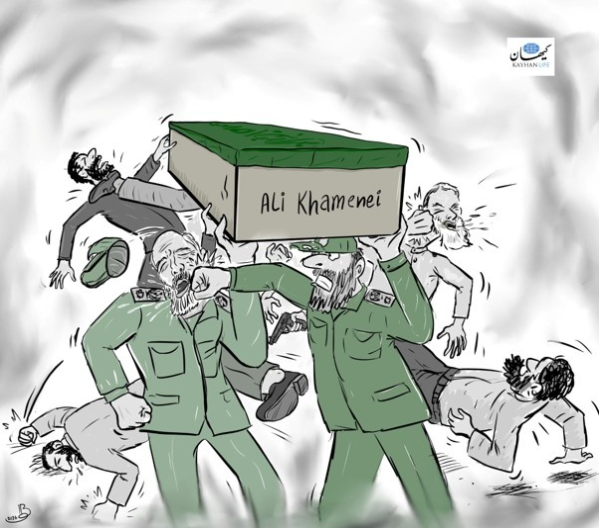
With Ali Khamenei gone and his heir hidden from sight, the Islamic Republic’s remaining commanders are busy dividing the estate, and planning how to eliminate rivals. One faction wants a deal with Washington to ease its survival; the other fears that every concession will expose weakness and invite revolt. Even state television has joined the wake, cutting Ghalibaf mid-sentence. In Tehran’s ruling household, inheritance means missiles, money, and who gets to survive the next collapse.
Welcome to the Kayhan Life Week in Review
This week extended the new normal of a supposed peace deal: Washington and the Islamic Republic sparred publicly over the meaning of their Memorandum of Understanding, while violence continued across the Persian Gulf. Drone attacks by the regime struck tankers and the Persian Gulf‘s Arab states; the U.S. hit back; Tehran claimed retaliation; and talks resumed. Against this backdrop, Prince Reza Pahlavi rejected the U.S.-Iran MOU, saying the Islamic Republic had suffered major blows and that the Iranian people’s struggle to overthrow it would continue. The question remained whether the 60-day negotiations would lead to peace, or merely pause the next round of war. Beyond the battlefield, cyberwarfare opened another front, while Nobel Peace Prize laureate Shirin Ebadi and prominent Iran experts urged an inquiry into an Iranian-American George Washington University professor.
►Iran and the United States concluded a round of indirect talks on Wednesday with no sign they had made headway toward a lasting peace, focusing instead on the Strait of Hormuz traffic and unfreezing Iranian funds — issues supposedly settled in last month’s interim accord.
Tehran indicated key nuclear sites would remain off-limits until a final deal with Washington was reached and sanctions lifted. The head of the International Atomic Energy Agency, Rafael Grossi, reiterated that the accord gives U.N. nuclear inspectors access to all sites in Iran, and it had to happen. Washington said nuclear limits would be addressed later, while the next meeting was postponed until after Ali Khamenei’s funeral on July 9.
US, Iran Talks Conclude in Doha, Focused on Strait of Hormuz
Iran Deal Grants Access to Nuclear Inspectors, IAEA Chief Says
►Last week, the U.S. military attacked Iran on Friday in response to an Iranian drone strike on a cargo ship in the Strait of Hormuz, with each country accusing the other of violating terms of a ceasefire. Tehran launched multiple missiles and drones toward neighboring countries including Bahrain and Kuwait.
US Strikes Iran in Response to Attack on Cargo Ship in Strait of Hormuz
Islamic Regime in Iran Fires Missiles, Drones at Bahrain, Kuwait, US Official Says
►Elsewhere, however, there were signs of progress. Israel and Lebanon signed an agreement to end the fighting between Israel and Tehran-backed Hezbollah. Both sides framed the deal as an initial step that calls for Hezbollah to disarm and Israel to withdraw troops from Lebanon, but it was not clear how it would be enforced. Hezbollah said it would not cooperate, describing it as a surrender to Israel.
Iran Says It Hits US-Linked Targets as Bahrain Reports Drone Attack
Hezbollah Rejects US-Brokered Israel-Lebanon Security Deal as ‘Surrender’
►Vice President JD Vance and Secretary of State Marco Rubio were dispatched on high-profile trips abroad over the past week to defend the MoU. While experts pointed to their differing world views and policies, U.S. officials said the administration was united behind President Donald Trump’s goal of preventing the Islamic Republic from obtaining a nuclear weapon and restoring Lebanese government sovereignty over its territory.
ANALYSIS- Vance, Rubio Strike Different Tone on Iran and Israel
►Overall, lingering questions remain about whether the world may be mistaking a Trump’s pre-election pause for lasting peace. Although Tehran’s economic leverage will likely remain strong through after U.S. midterm elections in November, the risk of renewed confrontation afterward is remains high.
ANALYSIS – The Next Iran War May Come Sooner Than You Think
►Yossi Karadi, Director General of Israel’s National Cyber Directorate, told German newspaper Die Welt that in June 2025 during Israeli military operations against Iran, Israel’s authorities registered around 1,600 hostile cyber incidents. During the same month in 2026, the number had jumped to some 4,800 incidents. The targets included critical infrastructure, institutions, businesses, and the public.
While diplomacy aimed to maintain a fragile ceasefire, cyber conflict reached the legal and criminal realm, as Montenegrin police and the FBI arrested an Iranian-Turkish national wanted by U.S. authorities over alleged hacking attacks and accusations of damage to U.S. infrastructure and universities.
Iran Cyberattacks on Israel Surged in 2026, Israeli Cyber Chief Says
Montenegro Police, FBI Arrest Iranian Wanted by US for Hacking
►Prince Reza Pahlavi rejected the MoU, saying the Islamic Republic had suffered major blows since the start of the war with the U.S. and Israel. In his first Persian-language satellite television appearance since the agreement, he said the Iranian people’s struggle to overthrow the regime would continue, regardless of international support.
Reza Pahlavi Rejects U.S.–Iran MOU, Says Regime Has Suffered Major Blows
►And finally, Nobel Peace Prize laureate Shirin Ebadi and prominent Iran experts urged George Washington University to investigate Professor Sina Azodi. Their letter questioned his suitability for an academic post, accusing him of normalizing the violent suppression of civilian dissent and undermining citizens seeking human and political rights.
Shirin Ebadi, Iran Experts Urge Probe of George Washington University Professor Sina Azodi |