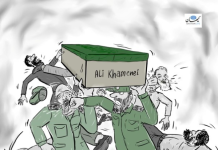
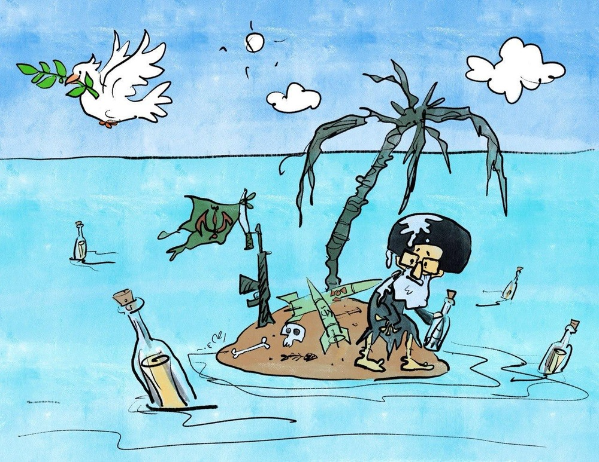
Artist: Ahmad Barakizadeh
Supreme Isolation: The Ayatollah of Nowhere
Two years after the flames of October 7 lit up the region, the Islamic Republic, the self-proclaimed architect of an “Axis of Resistance, finds itself marooned on the shrinking sandbar of its own ideology.
In Sharm el-Sheikh, Hamas and Israel signed a peace deal, precisely one day after the second anniversary of Hamas’s terrorist attack on October 7, 2023. As Israel prepares to pull back and hostages are exchanged, the region seems to be moving on — without the theocratic state that once fancied itself the region’s indispensable disruptor.
The grand “Axis” was meant to project the Islamic Republic’s “strategic depth.” Today, it has morphed into its “pivotal vulnerability.” Hezbollah’s top commanders were killed, and its depots destroyed. Hamas’s political and military leaders were wiped out. The Houthis suffered crippling losses. Bashar al-Assad fled Damascus for Moscow’s protection. Even within the Islamic Republic, the short but devastating 12-day war stripped the regime of key military figures and nuclear personnel — along with its illusion of strategic control.
After four decades of exporting revolution and underwriting proxy warfare, the Iranian regime’s return on investment has been grim: trillions of dollars in nuclear program, missiles, militias, and martyrdom traded for renewed sanctions and deepening isolation.
And so, on his deserted ideological island, sits Ayatollah Khamenei — haggard, isolated, his revolution’s tide long receded. Around him, the waves murmur the same refrain now echoing across the region: the resistance has resisted itself to death.
Welcome to the Kayhan Life Week in Review
A rare glimmer of hope emerged in the Middle East this week, as Israel and Gaza moved toward a long-awaited cease-fire — even as the Islamic Republic of Iran found itself increasingly on the defensive, both internationally and at home. The theocratic state faced renewed sanctions, deepening scrutiny of its proxy networks, and mounting criticism over human rights abuses, signaling a shifting regional balance and a potential recalibration of Western engagement.
The cease-fire, brokered through a U.S.-led diplomatic initiative, marked the first tangible step toward de-escalation since Hamas, the Iran-backed militant group, launched its October 2023 assault on Israel. The agreement calls for a cessation of hostilities, a partial Israeli troop withdrawal, and the release of remaining hostages — a fragile but welcome pause after months of devastating conflict.
Even as diplomacy offered a fleeting moment of relief, the Islamic Republic’s regional activities continued to draw condemnation. In Yemen, the Iran-backed Houthis detained nine United Nations staff members, accusing them of espionage — a move the UN denounced as arbitrary and emblematic of the group’s growing defiance under Iranian patronage.
At the same time, the regime came under renewed financial pressure. Newly reimposed international sanctions targeted the Islamic Republic’s finance, energy, shipping, and software sectors, tightening constraints on an economy already weakened by years of isolation. Reports released this week revealed how the regime has long circumvented such measures through covert trade networks and front companies — tactics Western governments now aim to disrupt through stricter enforcement.
Across the Atlantic, Iran’s exiled Crown Prince Reza Pahlavi urged Western governments to end engagement with the Islamic Republic and instead support the Iranian people’s pursuit of a democratic system. Speaking at the Council on Foreign Relations in New York, Pahlavi outlined a five-point strategy centered on nonviolent resistance, civic mobilization, and institutional reform. He argued that despite decades of repression, Iran’s civil society remains capable of self-governance and that the fall of the Islamic Republic must come from within — not through foreign intervention.
In Europe, diplomatic maneuvering took another turn as the Islamic Republic released 18-year-old French national Lennart Monterlos, detained for nearly a year on espionage charges. His release followed France’s decision to withdraw a case against the regime at the International Court of Justice, where Paris had accused the Islamic Republic of denying consular access to detained citizens. The gesture was viewed as a modest concession amid otherwise fraying relations between Tehran and Western capitals.
Meanwhile, in the United Kingdom, legal and political tensions over the Islamic Republic’s regional influence surfaced in a different form. The Crown Prosecution Service announced plans to appeal a court’s dismissal of terrorism charges against musician Liam Óg Ó hAnnaidh, who allegedly displayed the flag of Hezbollah, the Iran-backed Lebanese militia group, during a concert. The case was thrown out after a judge ruled it had been filed outside the statutory deadline, but prosecutors said they would seek to clarify an important point of law regarding expressions of support for proscribed organizations.
At home, the Islamic Republic faced renewed outrage over its violent suppression of the 2022 uprising, in which hundreds of protesters — including children — were killed and thousands more injured. A joint investigation by the Iran Human Rights Documentation Center and the independent outlet IranWire found that the regime’s security forces deliberately targeted demonstrators’ eyes and heads, causing life-altering injuries. The report also revealed that the Islamic Republic’s forces had obtained Western-made weapons in violation of international embargoes — a stark reminder of both the regime’s reach and the enduring suffering of the Iranian people.
Kayhan Life’s Curated News
- China Has Found a Way to Bypass Iran Oil Sanctions
- Australian Bill Allows for IRGC to Be Listed as a Terrorist Organization
- Death Sentences Were Issued for Three Prisoners of Conscience, Including a Woman
Updates from Kayhan Life’s Social Media
Treat of the Week
Mortadella and Pistachio Sandwich