By Kayhan Life Staff
WASHINGTON, Oct. 3 — Iran’s exiled Crown Prince, Reza Pahlavi, urged Western governments to abandon what he described as decades of appeasement toward Tehran and instead stand with the Iranian people in their campaign to overthrow the Islamic Republic and build a secular democracy.
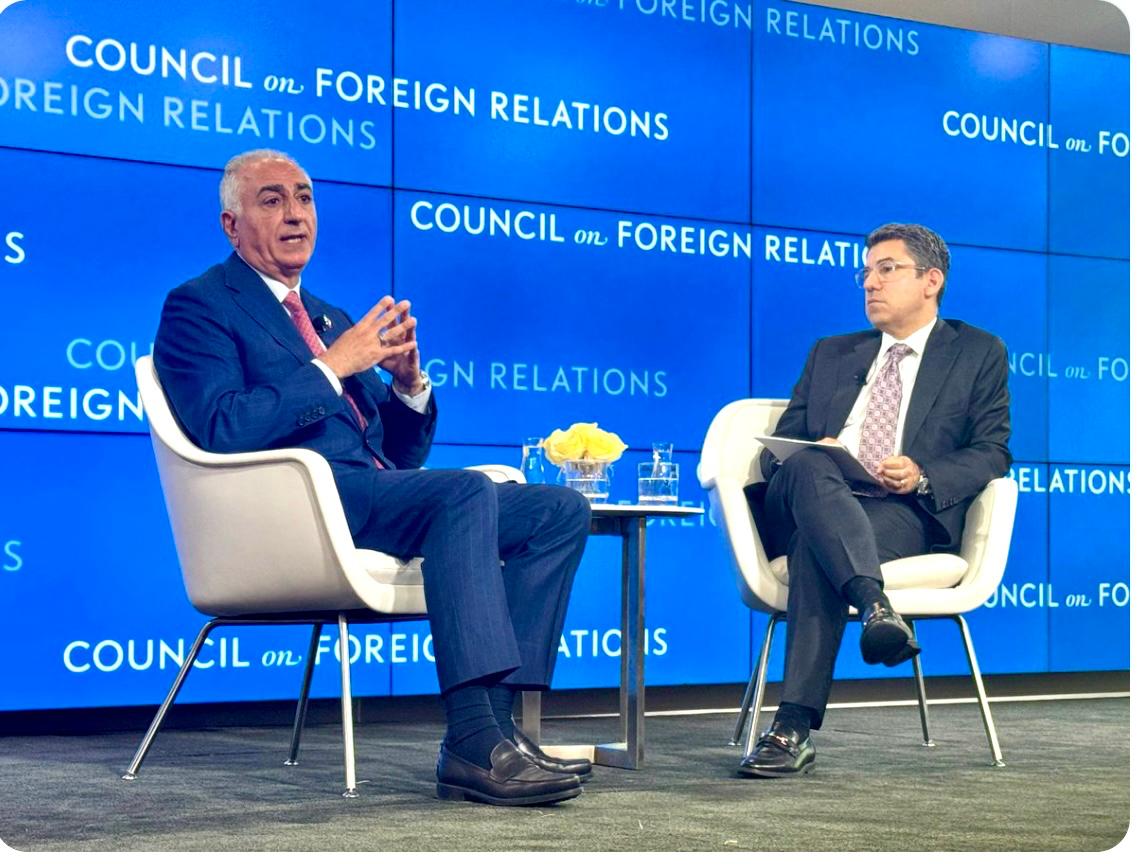
Speaking at the Council on Foreign Relations on Oct. 3, Reza Pahlavi said his campaign was not aimed at restoring the monarchy that was overthrown in 1979, but rather at supporting civil disobedience and developing a roadmap for democratic transition.
“This is about self-determination and freedom,” he said. “The Islamic Republic is not reformable.”
In the question-and-answer session, the Prince outlined his vision for a secular, democratic Iran achieved through nonviolent resistance and civic mobilization. The fall of the Islamic Republic, he said, must come from within, not through foreign intervention.
“My role is not to seek office,” he said. “It is to help my compatriots free themselves so that, through elections and a referendum, they can decide their own future.”
He argued that despite decades of repression, Iran’s civil society remains capable of self-governance. “Iran is neither Iraq nor Afghanistan,” he said. “Its civil society — though suppressed — is alive and capable of governing.”
The Prince emphasized that his movement was not contingent on the ill health or death of Ayatollah Ali Khamenei, the Islamic Republic’s supreme leader, but on the need for systemic change. He pointed to the role of civil disobedience and nationwide labor strikes in “paralyzing the regime from within.”
To demonstrate growing engagement, Pahlavi cited a QR-code campaign that he said had received more than 60,000 messages from inside Iran within its first few days from people willing to cooperate with or defect from the regime.
He also noted that his new website, IranoPasMigirim.com “We Will Reclaim Iran,” had drawn more than 1.5 million visits in its first 24 hours — a sign, he said, of “a rising unity among opponents of the Islamic Republic.” [As of this writing, the website has attracted more than 2.5 million visits, despite being blocked inside Iran and targeted by failed cyberattacks from the regime, according to the Reza Pahlavi Communications account on X, formerly known as Twitter.]
The Prince outlined a five-point strategy aimed at weakening the regime and guiding Iran toward a democratic transition — by mobilizing domestic networks, uniting the diaspora, increasing international pressure, fostering defections within the regime, and preparing for a stable, democratic post-transition future.
He said the success of that final phase would depend on careful planning and coordination, pointing to the Iran Prosperity Project (IPP) — a reconstruction plan his team has been developing for the past two years — as the framework for ensuring political and economic stability once the regime falls.
“The IPP is focused on the first 100 days after the regime collapses,” he said. “It defines how an interim government should be composed, how a constitutional assembly should be elected, and how a new secular constitution would be drafted and submitted to the people for ratification.”
The Prince emphasized transparency and inclusivity in the transition process, calling for broad participation from political parties and civic groups in shaping Iran’s next government.
Addressing Iran’s economic crisis, Pahlavi dismissed claims that U.S. sanctions were to blame.
“Only the regime’s apologists say sanctions cause poverty,” he said. “Iranians don’t blame the West for their poverty. They blame the regime and what it has done to bring us here.”
The Prince accused the government of draining national wealth through corruption and costly nuclear ambitions.
“The regime’s nuclear program has cost the nation more than one trillion dollars,” he said.
He faulted Western powers for what he called “decades of appeasement,” arguing that repeated efforts to engage Tehran had only helped the regime survive.
“Appeasement has never changed the regime’s behavior,” he said. “It has only given it time to expand repression and export instability.”
The goal of regime change, Pahlavi said, was not merely to alter the government’s behavior but to “liberate a nation” seeking to reconnect with the free world. He argued that a democratic Iran could become a stabilizing force in the Middle East, rather than a source of conflict.
Referring to the Abraham Accords between Israel and several Arab nations, the Prince suggested that a future democratic Iran could help turn that framework into what he called a “Cyrus Pact” — a regional partnership rooted in peace and mutual respect.
“If those agreements evolve into a ‘Cyrus Pact,’ a different Iran could become a bridge of peace in the region,” he said.
The Prince urged Western governments to align their policies with the interests of the Iranian people rather than with those of their rulers. “The world has spent four decades negotiating with a regime that cannot change,” he said. “It’s time to stand with the people who can.”
Video:
Prince Reza Pahlavi : ‘The Alternative to the Islamic Republic is the Iranian nation’
OPINION: Reza Pahlavi’s Transition Plan Is Roadmap for Regime Change
OPINION: What Iran Nuclear Deal Reveals About Talking to Theocrats