By Kambiz Zare
(Kambiz Zare is Professor of International Business and Geostrategy at KEDGE Business School and a member of the Scientific Committee of the Spirales Institute, a France-based think tank. The views expressed are his own.)
The U.S.-Iran talks—framed as a renewed push for diplomacy—were back on, at least for the moment. But the bigger problem remains: even if the process resumes, it is unlikely to change the underlying reality of deep mistrust and sharply conflicting demands.
Washington wants a quick, wide-ranging resolution that reaches beyond centrifuges and timelines. U.S. officials are urging the Islamic Republic to address its missile program, its support for proxy groups across the Middle East, and human-rights violations linked to a violent crackdown on protesters.
Tehran wants the opposite: to narrow the agenda to the nuclear issue, keep the talks strictly bilateral, and treat everything else as either non-negotiable or out of bounds.
That gap is not a mere footnote. It is the crux of the story.
Negotiating with a theocratic regime is rarely about technical clauses. It is about whether the system can make—and execute—binding commitments despite its ideological and factional constraints, while preserving the theological power that keeps it alive. In Iran’s case, the leadership has spent decades defining the United States as the ‘Great Satan.’ Based on that worldview, agreements are often treated less as promises and more as tools: something to resort to when it helps, and to discard when it doesn’t.

The mismatch in the opening positions is clear to all. Iran treats its ballistic missiles as a red line, and rejects any effort to tie the negotiations to the armed groups it backs in the Middle East. The United States, by contrast, is reportedly pushing for significant limits — no enrichment, restrictions on missiles, and an end to support for those regional partners — as well as accountability for human-rights abuses. Those are not minor differences. They are competing definitions of the talks’ purpose.
The likely outcome will be a case of déjà vu: we will either see a deal that buys time, the start of a process that produces headlines but no real change, or a collapse in the talks followed by another round of tension. None of those outcomes requires Iran’s leadership to change how it governs or to continue its claims that it pursues “resistance” at home and “engagement” abroad.
Donald Trump is pairing the diplomatic negotiations with explicit threats, warning that “bad things” would likely happen if no deal was to be reached. A U.S. naval buildup in the region is coercive diplomacy, not a friendly reset.

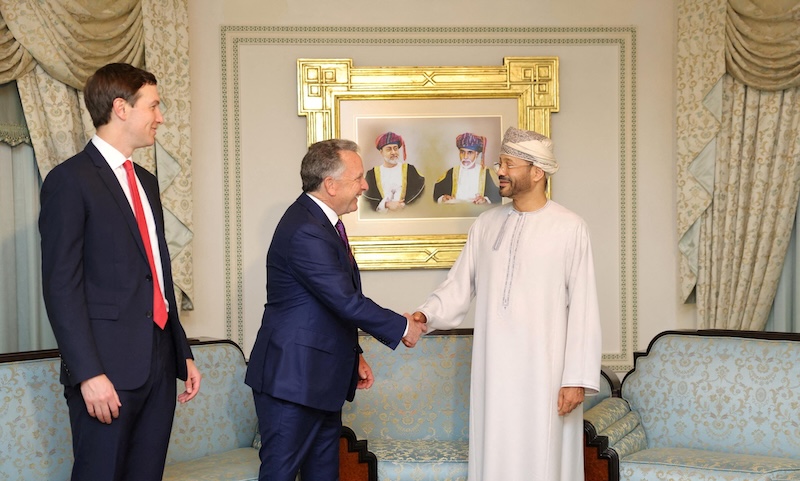
Oman — on the southeastern tip of the Arabian Peninsula, across the water from Iran — has long been a place where quiet, behind-the-scenes diplomacy can happen. It is close to the action and known for its discretion. But quiet venues can also produce stalemates that masquerade as progress.
The talks are shadowed by real-world friction at sea.
The United States says it shot down an Iranian drone that “aggressively” approached the USS Abraham Lincoln in the Arabian Sea. U.S. Central Command said Islamic Revolutionary Guard Corps forces harassed a U.S.-flagged tanker (M/V Stena Imperative) in the Strait of Hormuz — the narrow waterway between Iran and Oman and the United Arab Emirates that is one of the most important oil chokepoints on Earth.
These are precisely the kinds of incidents that can hijack the agenda, turning negotiations into crisis management — and buying time for Tehran.
Yet the biggest reason that these talks are unlikely to succeed is neither their geographical location nor the naval theatrics. It is what is happening inside Iran.
News coming out of the country has been terribly grim. Tehran’s response to the January uprising of unarmed, ordinary Iranians in all 31 provinces — citizens of all ages, genders, and professions, reflecting the diversity of the country — has been described as repression on an industrial scale.
A nationwide digital blackout, enforced as of Jan. 8, degraded real-time accountability and evidence preservation at the exact moment that lethal force started to be used.
According to figures gathered by medical networks and news outlets with access to state entities and officials, between 16,000 and 40,000 Iranian citizens have been killed in the January uprising. Tens of thousands have been injured, and tens of thousands more have been detained — numbers that suggest an extensive, coordinated repression campaign carried out in a matter of days.
If those figures are investigated promptly and independently, the clerical state will likely go down as having carried out the bloodiest crackdown of a peaceful protest movement in the 21st century.
One of the most disturbing allegations coming out of Iran is that the crackdown did not stop on the streets: It reportedly followed the wounded into hospitals. Mai Sato, the United Nations Special Rapporteur on the situation of human rights in the Islamic Republic of Iran, has referred to allegations that injured protesters were removed from hospitals and detained, and that families were pressured to pay $5,000 to $7,000 to retrieve bodies. Medical staff have been intimidated and imprisoned. Many of the injured avoided treatment in clinics and hospitals to reduce their risk of arrest. This points to an explicit breach of medical neutrality and basic human rights.
Hospitals are supposed to be the one place where politics stops. When people avoid emergency care because they fear arrest, a country is no longer operating by anything resembling standard rules. And when a government is accused of including hospitals in its crackdown, the meaning of “engagement” changes.
A “nuclear-only” process is unlikely to hold. Iran’s leadership wants relief from sanctions and a calmer relationship with the outside world. Yet it also wants to keep its domestic control system intact: maximum coercion, minimum scrutiny. Those goals collide. The harsher the crackdown, the harder it becomes for any Western government to justify making concessions to the Islamic Republic, loosening pressure on it, or calling an agreement a breakthrough.
And yet negotiators often act as if the nuclear issue can be separated from everything else — as if you can talk about enrichment levels in one room while ignoring what is happening in the streets and hospitals.
Tehran has long benefited from that separation. It forces outsiders to choose between, on the one hand, focusing on nuclear risk and ignoring other issues, and on the other hand, pressing on with human rights and risking escalation. Either way, the regime buys time.
Inside Iran, meanwhile, protesters have been sending signals that go beyond day-to-day anger. People have hoisted the Lion and Sun flag as an alternative to the Islamic Republic’s banner. They have chanted the name of Crown Prince Reza Pahlavi across cities — gestures that point to identity, continuity, and a different political future.
EXCLUSIVE: Isfahan Residents Describe the Deadly Crackdown on Protesters
“One Murder Every 14 Seconds”: Pahlavi Urges World to Confront Mass Atrocities in Iran
Iranians abroad have amplified that message, mobilizing daily in major cities across North America, Europe, and elsewhere. They have rallied around the same symbol — the Lion and Sun flag — and the same demand: an end to the regime’s rule.

All of this leads to a tricky question that is impossible to avoid: What does it mean to negotiate with a government accused of carrying out mass violence against its own people, while the violence is still fresh, and while the basic safeguards of a functioning society, such as the neutrality of hospitals, are being called into question?
The West should stop pretending that this is a typical negotiation with an ordinary partner. Long, inconclusive talks will not only drain momentum from a protest movement but also give the authorities time to tighten their grip. Every cycle that ends in delay rather than enforceable outcomes risks raising the costs paid by ordinary Iranians seeking freedom.
A deal can sometimes buy time. Yet in Iran right now, time looks like the one thing the authorities are trying to take — from their own people, and from the rest of the world that is watching on.
Prince Reza Pahlavi : ‘The Alternative to the Islamic Republic is the Iranian nation’