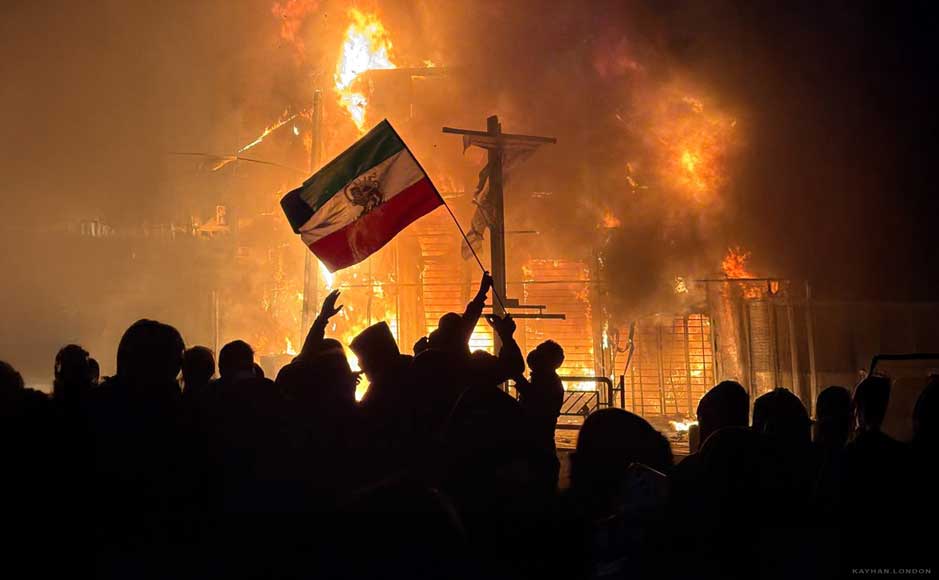
Iran began the year 2026 amid intense political unrest, economic collapse, and widespread mistrust of the Islamic Republic. On Jan. 8 and 9, the country erupted into mass demonstrations that were met with the deadliest crackdown in contemporary Iranian history.
A nationwide internet blackout is currently in its fourth week, making it extremely difficult for Iranians to communicate with the outside world. Testimonies emerging from cities such as Isfahan describe streets filled with gunfire and resembling a war zone.
According to figures gathered by medical networks and news outlets with access to state entities and officials, between 16,000 and 40,000 Iranian citizens have been killed. Tens of thousands have been injured, and tens of thousands more have been detained. If the crackdown were to be investigated promptly and independently, the Islamic Republic would go down as having committed the bloodiest crackdown of a peaceful protest in the 21st century.
EXCLUSIVE: Six Protesters Speak Out After Deadly Crackdown in Iran
Kayhan Life is compiling an oral history of the Iranian people’s uprising against the Islamic Republic, and speaking to residents who witnessed and participated in the protests across multiple cities. For their safety, all witnesses have been identified by pseudonyms.
This account focuses on Sepahan-Shahr, an affluent district on the southern edge of Isfahan, near a base of the Islamic Revolutionary Guard Corps. Although the area had rarely been a protest hub, thousands of residents took to the streets on Jan. 8 and 9, only to face a sudden and severe armed response.
Sasan, a young resident, said crowds began gathering around 8 p.m. on Jan. 8, and swelling so rapidly that, within hours, “the streets were effectively controlled by protesters.”
Parand, 39, joined the crowd with her 10-year-old son. She said she spent two days agonizing over whether to participate, mainly because she had no one to watch her child. Her husband worked late into the night, and was often home only after midnight.
A few days earlier, when she had briefly stepped out to buy groceries, several security officers had shouted at her in an aggressive and demeaning tone, ordering her to return home. The episode was, for her, a turning point.
“When they spoke to me like that, so insultingly, I suddenly thought: why should I, as a citizen, not even be free to step out to buy milk and bread without being humiliated?” she said. “Not to mention all of the other economic, social, and political hardships.”
After two days of discussing with her husband whether she should join the protests, she sent him a message that read: “I’m going.” His reply: “Take care of yourself, and take care of Iran and freedom.”
Parand said she never imagined that the demonstrations would be met with an armed response.
“When we left the apartment complex, you could already feel movement in the neighborhood: a lot of people were clearly heading toward the streets,” she said. “But when we reached the main road, I encountered an absolute flood of people. I was holding my son’s hand and moving forward with the crowd. Some were walking in the streets, others on the sidewalks.”
Reports Emerge of Patients Taken and Doctors Detained in Iran: Diaspora Doctors Call for Action
Within minutes, Parand said, she could no longer see where the crowd began or where it ended. Because her son was with her, she tried to walk along the sidewalks.
“People were only chanting. No one was being violent,” she said. “Many were chanting and walking with smiles and open faces. I did not expect an armed crackdown.”
She said she saw two or three friends who had come with their families and who all moved together in a group of about 11 people. At the front of the crowd, she heard warning shots fired into the air. Yet still, the protesters pushed forward.
“A little later, there was a commotion near the front, then gunfire, and suddenly the crowd scattered,” she said. “Everyone started running. Some young people took cover, chanting and throwing stones toward the Basij and the police forces.”
Most of the security forces that night were from the Basij militia and the police. They tried to push back the crowds using batons, tear gas, and pellet guns. Yet the clashes grew worse. As protesters shouted anti-government slogans, officers began firing directly at them.
Parand said that as she fled into an alley, she felt burning in her thigh and hip. Six pellets had struck her son in the shoulder and back. A neighbor, a retired nurse, treated them at her home.
By Jan. 9, the situation changed. IRGC units arrived, and witnesses said the crackdown became much more severe.
Sasan said security forces used live bullets and often aimed at people’s heads. Parand, watching from her window, described the constant sound of gunfire, stun grenades shaking the street, and motorbikes racing through alleys next to Samand sedans that were packed with riot police.
At around 10:20 p.m., a young woman running down an alley was chased by two officers on a motorcycle. They fired at her, she fell screaming, and a white van with tinted windows arrived. The officers dragged her on the ground and forced her inside the van.
“It felt like a nightmare,” she said. “Her screams still echoed in the alley.”
According to Sasan, protesters that first night chanted anti-regime slogans including “Long live the Shah,” “This is the final battle, Pahlavi will return,” and “Death to the dictator.” Someone set fire to the flag of the Islamic Republic.
As the crowd moved forward, the clashes became more intense. “Security forces began firing on unarmed people,” said Sasan. One of his friends was shot in the face, and he was wounded in the leg. He thought a tear-gas canister might have hit him, but in the chaos, he could not be sure.
After Sasan was hit, possibly by a tear-gas canister, he went to a small clinic that was not prepared for serious injuries. The scenes he described were shocking.
He said a 15-year-old boy who had been shot in the groin bled to death before he could be treated. A 34-year-old man arrived with part of his skull missing and brain tissue exposed. Other protesters were shot in the legs. One father, holding his dead son, begged doctors to save him even though he knew it was too late.
“The floor kept turning red with blood,” Sasan said. “They would mop it up, but it would be drenched with blood yet again.”
He said the conditions were so overwhelming that he left without being treated.
Both witnesses said there were many reports of security forces taking bodies from hospitals and detaining some of the wounded. Families hid their injured relatives to protect them from arrest or disappearance.
One neighbor with twin sons recovered the body of one, but was told that the family had to pay 1.5 billion tomans (about $12,000) for the body of the other.
Another family hid an injured man in a stable outside the area. He died there.
On the night of Jan. 9, Sasan said the doors of his apartment building, just off the main street, were left open so that people could hide inside. He was out protesting and later went to a clinic, but his family told him what happened during a sweep by security forces.
“As the units moved through the area, many people ran into the building,” he said. Residents locked the doors. About 40 to 50 Basij militia and riot police tried to break in, firing tear gas into the parking garage and shooting at the entrance. They could not get inside, and left around midnight, after four or five hours.
When it seemed safe, the people who had hidden inside went home. Residents deleted the CCTV footage so no that one who took shelter there could be identified.
On Jan. 10, security agents returned to the complex and seized the surveillance hard drives. All of them, Sasan said, wore masks.
“They had come to intimidate people and to identify defenseless citizens,” he said. “But it seemed that they themselves were even more afraid of being identified.”
Parand said her husband, returning home from work at dawn on Saturday, Jan. 9, saw municipal water trucks washing the streets.
Sasan recounted the same scenes. “They were using water trucks to wash away the places where blood had been spilled,” he said.
“These bloodstains, these horrific scenes of the killing and repression of defenseless people, cannot be washed from our memory,” Parand says through tears.
Parand said she struggled to speak about the trauma. “My whole body ached,” she said. “Not just where the pellets hit. My heart ached. The grief was heavy.”
She said the Islamic Republic lost its legitimacy on Jan. 10, 2026.
“It dug its own grave beside the graves of the tens of thousands it killed down,” she said.