By Kayhan Life Staff
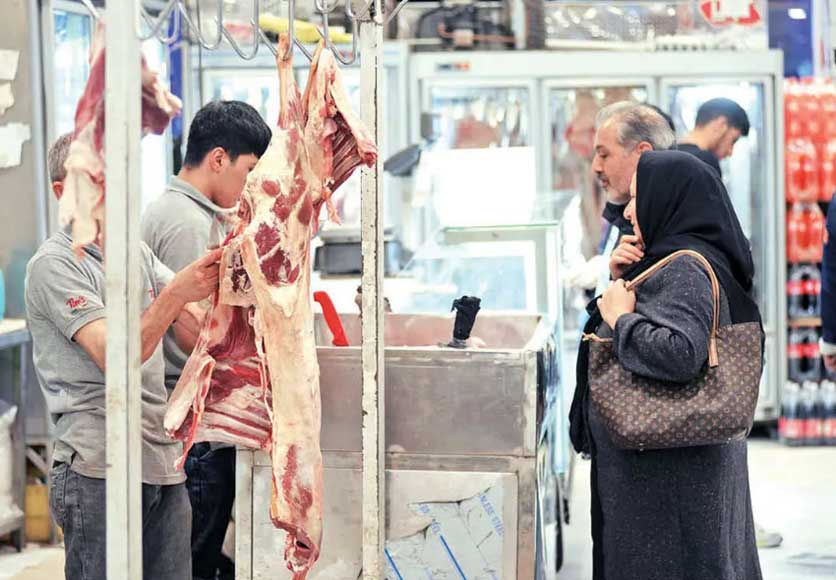
Iranian families squeezed by skyrocketing prices and stagnant wages are drastically reducing their food purchases and cutting back on chicken and dairy products.
Abdollah Ghasemi, a board member of the Gilan Province Poultry Farmers’ Association, pointed to government policies — particularly the removal of the preferential exchange rate system, known as arz-e tarjihi — as a major driver of rising food costs.
“The several-fold increase in chicken prices following the elimination of preferential currency has halved chicken consumption in the country,” he said.
As of January 2026, Iran ended its preferential exchange rate for essential imports to curb corruption, combat inflation, and simplify its complex currency system amid ongoing economic instability and public protests.
Ghasemi highlighted the steep rise in poultry production costs.
“Each kilogram of corn, which previously cost 11,300 tomans (approximately $0.07) under the preferential rate, surged to 42,000 tomans ($0.27) after liberalization and later rose to 55,000 tomans ($0.36) due to currency fluctuations. Similarly, soy increased from 21,300 tomans ($0.13) per kilogram to 85,800 tomans ($0.54) and later 120,000 tomans ($0.75),” Ghasemi noted.
Ghasemi also cited the removal of the preferential rate for vaccines, veterinary medicines, and imported supplements as another factor driving up chicken prices.
“Recent currency policy changes sharply increased the cost of micronutrients, all of which are imported,” Ghasemi explained.
Thousands of Businesses Shut Down In Iran Because of Internet Blackout
The impact on production has been severe. Monthly chicken output has dropped from 140 million pieces to 94 million, creating a supply shortage.
“Demand spikes only when ration cards are announced, which is why we have seen recent price surges coincide with ration card announcements,” Ghasemi noted.
Official statistics reflect this downward trend in meat consumption.
The Statistical Center of Iran (SCI) reports that average monthly household consumption of red meat fell from 2.8 kilograms in 2011 to 1.25 kilograms in 2024.
Similarly, the United Nations Food and Agriculture Organization (FAO) reported that total red meat consumption in Iran in 2025 at 724,000 tons — a 7 percent decline from 2024. By comparison, Turkey, with a similar population, consumes 2.5 times as much red meat and over three times as much dairy as Iran.
Dairy consumption has also plummeted. While the global standard is 180 kilograms per capita per year, Iran’s consumption has dropped below 50 kilograms.
Even though cheese and milk were included in the one-million-toman ($6.5) ration card program launched in December 2025, families prioritize more filling foods such as rice, chicken, and oil, according to the Iranian Students News Agency (ISNA).
Field observations suggest that in inflationary conditions, households minimize purchases of milk, yogurt, and cheese — a trend that could have long-term health implications.
Rising food prices, combined with declining household purchasing power and the erosion of real incomes, have drastically reduced access to nutritious foods.
The SCI reported that monthly food inflation rose to 5.6 percent between March and April 2026, with fruit, chicken, and oil prices rising by double digits in just one month. Year-on-year inflation for many food items has reached triple digits, with some increasing by more than 300 percent.
Examples include:
- Solid oil: up 375 percent, from 80,000 tomans ($0.52) to 380,000 tomans ($2.50)
- Liquid oil: up 308 percent, from 74,000 tomans ($0.48) to over 300,000 tomans ($1.94)
- Top-grade imported rice: up 209 percent
- Chicken: up 191 percent
- Mayonnaise: up 190 percent
- Eggs: up 170 percent
By early April–May 2026, the price of a single egg exceeded 20,000 tomans ($0.12), second-grade Iranian rice reached 400,000 tomans ($2.60) per kilogram, and red meat topped 2.2 million tomans ($14) per kilogram. Dairy products also saw price increases of 5–10 percent.
Iranian rice, which had already reached 500,000 tomans ($3.2) per kilogram last year, recently climbed to 700,000 tomans ($4.5), with a 10-kilogram bag costing 7 million tomans ($45) — roughly half a new worker’s annual base salary.
Reza Kangari, head of the Tehran Food Wholesalers’ Union, warned that the 700,000-toman price per kilogram is inconsistent with supply and demand and is unrealistic.
Consumption patterns reflect this economic pressure. The average household rice consumption fell from about 12 kilograms per month in 2011 to 6.52 kilograms in 2024.
Considering that a single worker now earns at most 22 million tomans ($142) per month, and a married worker with children just over 24 million tomans ($155), it is evident why essential foods like meat, chicken, dairy, and rice are increasingly excluded from household diets.