
The Islamic Republic of Iran’s Revolutionary Guard Corps, a powerful military unit at the heart of the regime, should be listed as a terrorist organization by the European Union, the Iranian-born Belgian lawmaker Darya Safai has said.
The comments followed an alleged plot to kidnap the lawmaker, after Safai initiated a resolution in the Belgian parliament to proscribe the Islamic Revolutionary Guards Corps (IRGC).
Safai said she received a call from the Belgian police advising her that her life was in danger.
“I was on vacation in California when the police called me. The policeman asked if I was still in Belgium, because in the month of August lots of people travel and go on vacation,” Safai said in an interview with Kayhan Life. “He told me not to travel to countries like Turkey, because there was a plan in place to kidnap me by the Islamic Republic of Iran, and this plan had been shared with the Belgian security service.”
Sweden Urges European Union to Designate IRGC A Terrorist Organization
“Belgium has had several terrorists, the last one being Asadollah Assadi, who was sentenced to 20 years prison in Belgium [for plotting to bomb a 2018 meeting in Paris organized by an exiled opposition group],” Safai added. “Unfortunately, through hostage diplomacy, he was released and sent back to Iran in a prisoner swap with Belgian humanitarian Olivier Vandecasteele. This is what the Revolutionary Guards do.”
“The Revolutionary Guards have all the power and control in Iran,” Safai said. “It is important that they are placed on the European Union’s list of terrorist organizations. The money they earn from oil and gas helps them to finance terrorist attacks. Putting them on the terror list would restrict the group’s funding, which would weaken the regime.”
Her resolution, which was submitted last month, was almost unanimously backed by the parliament. The IRGC, which has been accused by states of orchestrating terror attacks and plots to kidnap and assassinate dissidents in the West, has been proscribed by the U.S., Canada, Bahrain and Saudi Arabia.
The Islamic Republic of Iran was condemned by 14 countries in a joint statement published July 31 for its ongoing attempts to threaten individuals perceived as opponents of the regime in the U.S., the U.K. and Europe.
“We are united in our opposition to the attempts of Iranian intelligence services to kill, kidnap, and harass people in Europe and North America in clear violation of our sovereignty,” the statement said. “These Services are increasingly collaborating with international criminal organizations to target journalists, dissidents, Jewish citizens, and current and former officials in Europe and North America. This is unacceptable.”
A separate investigation by Britain’s domestic intelligence agency MI5 and the Metropolitan Police, the details of which were published in November 2023, found that the Iranian regime had tried to assassinate or kidnap 10 British nationals or UK-based individuals in a 10-month period, including several journalists.
Several cases of individuals being targeted by the regime have also been reported, including the attempted assassination in 2022 in the U.S. of human rights activist and journalist Masih Alinejad; and the kidnap, arrest and execution in 2020 of human rights campaigner and journalist Ruhollah Zam.
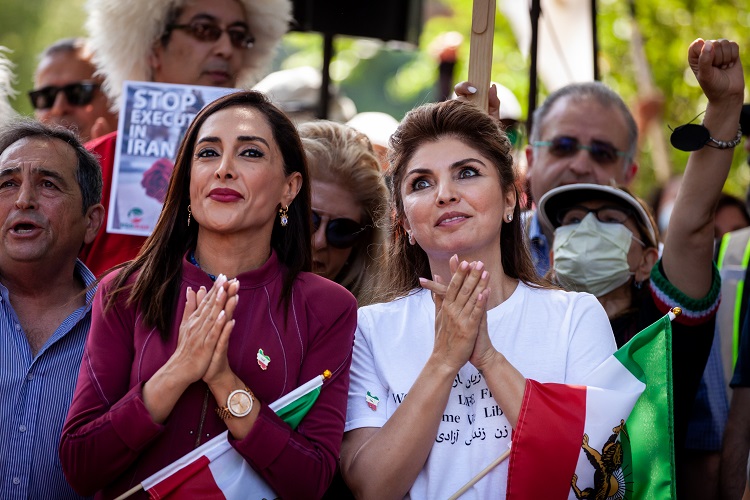
Safia was previously detained in Iran in 1999 for taking part in student protests with her husband Saeed Bashirtash. Bashirtash was one of the organizers of the student protests but escaped detention after fleeing into a crowd. Safia spent 24 days in an illegal detention center, Towhid Prison, in Tehran.
The center was allegedly closed down in 2020 following a global outcry about the use of such centers in Iran at the time. The centers were staffed by intelligence and security officials who reportedly carried out mass-killings and brutal acts of torture. The number of illegal detention centers currently operating in Iran is unknown.
“The only reason that I am still alive is that officials were still out looking for my husband, who was one of the leaders of the student protests in 1999, and so they released me in the hope that I might lead them to him,” Safai said. “I believe that if they had found us we would both have been executed.”
The couple fled to Belgium in 2000. Safia was sentenced in absentia by a court in Iran to two years in prison in the same year.
In 2014, Safia founded the ‘Let Iranian Women Enter Their Stadiums’ campaign, which advocates for Iranian women to attend games at sports stadiums in Iran. In 2016, Safia made global headlines after holding up a campaign banner demanding gender equality for women in Iran, while at an Iranian men’s volleyball team match during the Olympic Games in Rio de Janeiro. She has also campaigned against the forced hijab laws in Iran, which require women to be veiled in public spaces.
“Iranian people were the first victims of this monstrous regime. But it doesn’t end there. Look at the Israeli hostages who have been captured by a regime-aligned Hamas, within a war financed by the regime,” Safia said. “It is not only the people of Palestine and Israel who are victims of the regime, the whole world will become a form of hell if this continues.”