By S.D. Jabbari
(S.D. Jabbari is an international security analyst and an advocate for secular democracy in Iran. He serves on the Executive Committee of the Institute for Voices of Liberty (iVOL). He also advises diaspora groups including the Constitutionalist Party of Iran. The views expressed are his own.)
As the war over the Strait of Hormuz enters its third month, the world is witnessing not only one of the most consequential disruptions in modern energy markets, but an even deeper moral failure in the West. Tehran’s effective closure of the strait, a waterway that normally carries about a fifth of the world’s oil and gas supplies, has shaken global markets and left Persian Gulf shipping exposed to missile, drone, and tanker attacks.
Alongside this crisis, another failure has come into sharper view: the moral bankruptcy of a liberal-progressive world view that has long used political relativism to excuse the inexcusable and rationalize the indefensible. By treating the Islamic Republic’s brutal repression of its own people, and its export of a millenarian revolutionary ideology, as matters of “cultural context,” an influential segment of the Western left has abandoned its own liberal inheritance.
Worse, at the very moment that Iranians are confronting both domestic tyranny and the consequences of the regime’s regional adventurism, that segment of opinion is helping obstruct one of the most important movements for freedom and democracy of the 21st century: the struggle taking shape in Iran.
For decades, many Western activists have viewed the Islamic Republic theocracy not as a domestic oppressor, but as a strategic asset in a global ideological power struggle. This perspective mirrors the historic totalitarian ideology of Marxism-Leninism, Maoism, and Socialist Fascism, where the individual is a mere pawn in a global chess match.
According to this logic, the Iranian people’s demand for dignity is often dismissed as an “imperialist” or “colonialist plot,” and the overwhelming consensus among Iranians for a secular democratic state is ignored.
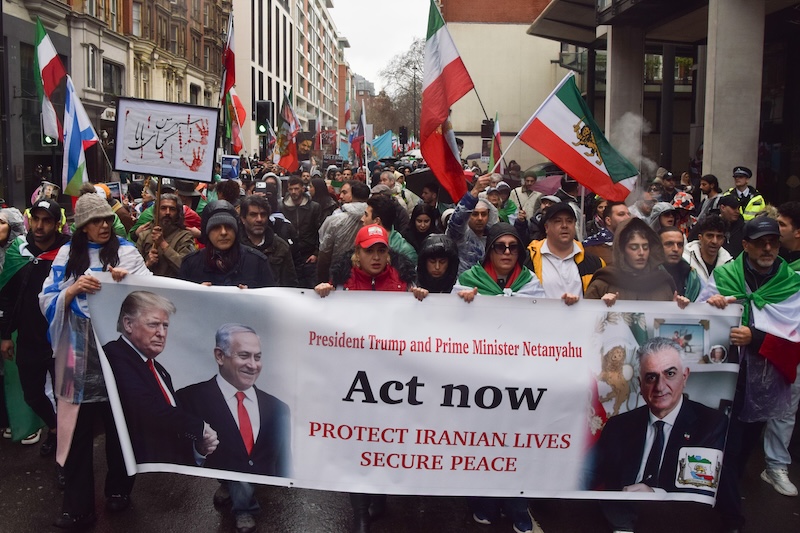
A key part of this transition is the vision of the “Cyrus Accords” championed by Reza Pahlavi. This is not just a slogan for diplomacy, but rather the embodiment of a 2,500-year-old legacy. It adopts its moral compass from Cyrus the Great, who in 539 BCE issued the first charter of human rights and liberated the Jewish people from Babylon. This ancient bond was modernized during the Pahlavi era, and the “Cyrus Accords” seek to return to this regional precedent, replacing manufactured anti-Zionism with a policy of regional peace.
This vision is supported by independent data, which consistently refutes the narrative that Iranians desire theocratic rule, or that they hate Israel and the Jews, and therefore the United States. Surveys by both ERF-I (Education and Research Foundation for Iran) and GAMAAN show that between 70 and 80 percent of Iranians reject the Islamic Republic and support a transition to secular democracy. They also demonstrate that a plurality supports Reza Pahlavi as their transitional leader.
This is in spite of the fact that the regime and its proxies have spent 47 years destroying any and all opposition through terror and outright murder, both internally and externally.
To this end, Reza Pahlavi has outlined six fundamental tasks for both the Iranian diaspora and Western democracies. Chief among them is to substantially degrade and neutralize the regime’s repressive capacity and its machinery of oppression. Other tasks include sustaining maximum economic pressure, breaking the internet blockade, expelling and prosecuting “diplomats” that are simply agents of terror and oppression, pushing for the release of all prisoners of conscience, and, of course, recognizing a transitional framework when it is announced.
It is, of course, the diaspora’s responsibility to create greater cooperation, coordination, and synergy among its many gifted and committed forces and resources.
For the West to be able to assist the Iranian people successfully and meaningfully in this quest, it must abandon its ideological hesitation, born of misplaced relativism and cognitive dissonance. An unconditional surrender of the Islamic Republic and Velayate Faghih is a win-win for both Iran and the Free World.