By Katayoon Halajan
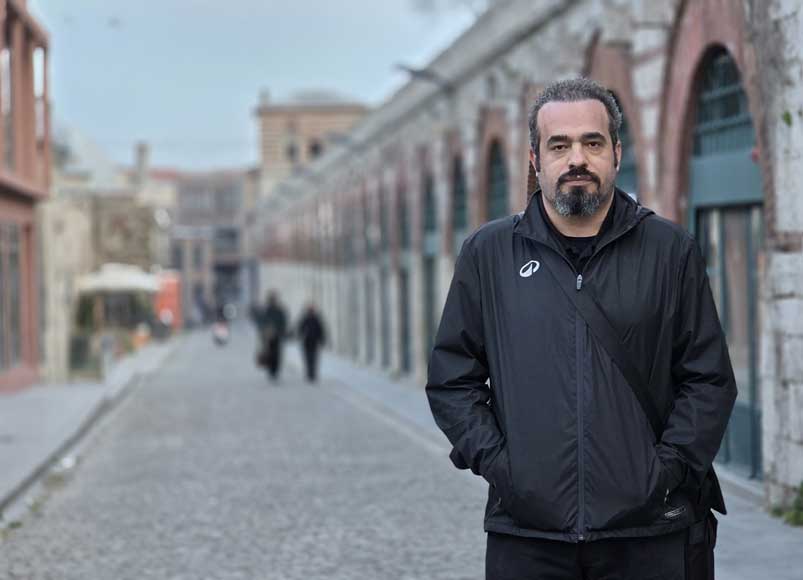
Azad Andalibi, editor-in-chief of Baru Magazine, is an editor, writer, translator, and one of the co-founders and directors of the Library of Babel, an initiative active in book criticism and reviewing in Iran.
Baru, edited by Andalibi, began publishing in 2021. To date, 14 issues have been published. The magazine publishes uncensored articles, short stories, poetry translations, essays, interviews, and reviews of art and books online.
Its print edition also reaches readers in Iran through underground distribution networks. According to its editor, several generations of Iranian writers working across a wide range of fields have contributed to Baru.
Approximately seven months ago, following a raid on his home by agents of the Ministry of Intelligence of the Islamic Republic of Iran — and amid immediate threats to his life and well-being — Andalibi went into exile. He has been living in France for approximately three months.
In an interview with Kayhan Life, Andalibi discussed the Islamic Republic’s censorship apparatus and its security-driven cultural engineering, as well as writers’ resistance to it.
Government censorship in Iran has a long history. What distinguishes the Islamic Republic’s censorship apparatus from those of previous governments?
Comparing censorship before and after the Revolution is like comparing a primitive apparatus with a highly advanced one. Before the Revolution, writers knew where the boundaries were. Certain words and codes were forbidden—for example, “forest” or “blackness,” or words commonly used by left-wing writers which carried radical political meanings and functions within their texts. Writers knew where the red lines were.
The level of censorship before the Revolution was in no way comparable to what exists today. After the 1979 Revolution, the further we progressed, the lower we sank, and censorship became increasingly complex.
Today, a writer does not know whether what they are writing falls within the regime’s vast range of red lines. They do not know what fate awaits their text. This ambiguity exacerbates self-censorship.
Under the current regime, censorship has acquired at least two dimensions: an institutional dimension and an individual one.
The institutional dimension encompasses vast areas in which a writer cannot write. This terrain includes almost every sphere of thought — from religion and politics to evolution and eroticism.
The second dimension is advanced by individuals, one person at a time, according to their own assumptions, complexes, and tastes.
For example, a work may, after undergoing repeated “review,” somehow pass through the censorship barrier, be published, and reach readers. Yet it often happens that someone in some institution reads the book, dislikes it, and reports that the work should have been censored but was not. As a result of these constant reports, the censoring institution says: either make the required revisions, or the book will be withdrawn.
In other words, the censors who have personally pushed the boundaries of censorship are, themselves, also subject to constant surveillance.
This process continually intensifies censorship. It transforms censorship from a temporary stage into a permanent condition, one that is governed not merely by clearly defined rules and limits.
This complex, multilayered process cannot be compared with the period before the Revolution, or even with many totalitarian governments, because it has a political dimension, an erotic dimension, a religious dimension, a scientific dimension, and a lifestyle dimension.
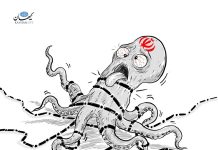
Almost every realm of human thought and imagination is exposed to censorship. It is a form of total censorship. This is the most terrifying form that a censorship apparatus can take — and it has taken this form precisely, continuing to function by whatever means necessary.
It is important not to think of the censorship apparatus as something small or unsophisticated. We should not imagine a group of amateur ideologues with beards and buttoned-up shirts, incapable of distinguishing one thing from another.
Through the money, opportunities, and institutional support it provides, the regime has also succeeded in recruiting many highly educated people. The person censoring your literary work may well hold a PhD in literature and teach at a university.
Your scholarly work may be reviewed — and censored — by people with whom you have shared conference panels or casual conversations in university corridors. The agents of censorship are not distant or invisible; they are all around us.
First, you have to understand this apparatus correctly and precisely if you want to fight it. Slogans and simply saying “No to censorship” will not do.
What do publishers and writers generally do in response to this system?
Several reputable publishers, as well as numerous writers, have refused to simply accept the conditions imposed upon them. They are engaged in a constant struggle with censorship, and it is not the case that they accept everything they are told. This is an important point.
Censorship and resistance to censorship advance side by side.
The further censorship has advanced, the further the methods of resistance, perseverance, and circumvention developed by writers and publishers have as well.
In my view, broadly speaking, the regime’s censorship apparatus, like its apparatus of repression, has expanded, become more multilayered, and acquired better equipment. At the same time, people’s resistance to the regime has also grown and become more seasoned.
Some writers have participated in this expansion of social and political resistance and have managed to stand up to censorship to the fullest extent of their ability. The censorship apparatus is just as capable of creating and expanding suffocation as it is blind.
You know that intelligence agencies like to say, “We know everything and see everything.” That is not true.
Iranian writers have succeeded in writing what they want in such a way that their work can pass through the gaps in this hellish apparatus and reach their readers.Since the development of the internet, the work of writers has also become easier in certain respects.
Before that, if a work failed to receive official permission for publication, it was consigned to oblivion. There was a very pronounced divide between writers inside and outside the country. With rare exceptions, works published outside Iran did not reach readers inside Iran. Communication was almost completely cut off, or extremely weak.
This created an ideal environment for the cultural-security structure and machinery of the reformists, allowing them to publish whatever they wanted in an uncontested field, one largely devoid of other voices — and to call it freedom of expression, or a “press spring.” For at least two decades, they were able to gain relative control over Iran’s cultural sphere.
This staging was a lie.
It was like attaching green leaves across an entire winter-stricken forest. A wide range of writers and thinkers could not write what they wanted unless they also operated within frameworks approved by the reformists and cooperated and coordinated with them.
The inevitable expansion of the internet created a space capable of pushing censorship back. It was miraculous.
Few people imagined that such a world could open up. A wide range of writers, translators, and cultural activists who had been unable to speak for decades were able to establish direct contact with readers, raise their voices, and find and build audiences, while at the same time accepting the costs and risks involved.
This achievement belongs to a nation and to its writers and activists. It was made possible through courage, a sense of timing, and perseverance — not through the benevolence of the reformists, or of someone in a position of authority preaching from a pulpit.
You recently left Iran. How do you predict developments in Iran?
We are currently in a state of suspension between war and a cessation of hostilities. Because of this regime and the infection it has introduced into our world, any form of national social cohesion may, from a distance, appear unlikely or impossible. But the reality is that, socially speaking, we are in the most hopeful circumstances of the past half-century.
This is because society has succeeded, through an everyday struggle — I emphasize: an everyday struggle — in reclaiming, one by one, domains that this totalitarian religious regime had occupied for half a century, and in pushing it back step by step.
A regime that had advanced into people’s bedrooms, intervening and defining boundaries, is now retreating from one domain after another which it never imagined losing. It can only take comfort in showing its claws and teeth, lest its loyal supporters feel that it has lost the game.
In recent years, if you walked through the streets of Iran, you rarely saw signs of the Islamic Republic regime. City after city, domain after domain, took on the colors of the people. This is the result of the people’s will and perseverance — not of the reformists or of movements whose existence depended on funding from one government or another.
The truth is that the reformists have acted in a profoundly deceptive manner against this historic movement. They have sucked the blood from the nation’s demands and dreams and, whenever they have been able, drained it of its strength and breath.
In any case, over these years, the distance between some writers and various layers of the people — a distance that, for a time, had grown wider and approached hostility and confrontation because of the image and history of leftist and ideological writers — has diminished.
As time passed, this group of writers, with nationalist and liberal leanings, strengthened their ties with the people and succeeded, to some extent, in changing the old image of the writer in the public imagination.
These non-ideological writers moved forward alongside the people and managed to reclaim, one by one, the spheres that the reformists had seized.
Did the sum of these developments in different domains ultimately lead to the events of January?
We are speaking of the emergence and rising of a nation in a national uprising in which every layer of society is present and involved: workers, teachers, the unemployed, homemakers, students, journalists, engineers, doctors, nurses, tradespeople, merchants — and, of course, writers.
Look at the bloody events of January 2026, and you will see that every profession has had its own dead, whose names have been immortalized, as well as prisoners. We are speaking of tens of millions of Iranians who have risen to reclaim their country.
With peace of mind and warmth of heart, we can say that we are a nation standing united to revive the national state and reclaim Iran.
Are this desire and determination still alive even during these difficult days?
These days, everything may seem discouraging from afar to those who are outside Iran. There is a gray membrane of fear and doubt between us. But I do not doubt that beneath this membrane, life and resistance continue in every area, without having lost even the slightest of their luster, just as they have continued and flourished throughout this entire half-century.
The events of January 8 and 9 were a dazzling spark of this national-patriotic resistance — one that could be predicted and has a future.
There is, and has been, a powerful current that exists like underground water in the depths of the Iranian spirit and has guaranteed its life and survival.
You may look upon a landscape that appears dry and barren, with only one or two trees visible. But a sharp-eyed and experienced observer knows that these trees have roots somewhere and must inevitably have access to living water. The water flowing through the underground aquifers of Iran’s history, culture, and society is one thing: the constitutionalist aspiration.
According to the precise meaning of the term, the constitutionalist aspiration means the revival of the national state, the continuation of the modernization and national development begun during the first half-century of the constitutional era, prosperity, a valid visa and currency, joining the international community, secularism, material well-being, and, of course, freedom.
Without freedom, all of these are nothing more than dreams and delusions.
It goes without saying that, despite the denials of ill-wishers, the constitutionalist aspiration cannot be separated from the desire for freedom. This fundamental aspiration has existed in the depths of our dreams during the darkest period of our contemporary history, throughout this terrifying half-century, and has now emerged into the open.
From 2016 to the present, we have witnessed a continuous process. These uprisings — from January 2016 to November 2019, from 2022 to 2026 — are chapters in a great national and historical movement. Each emerged at a particular moment and for a particular reason, but all share a common nature and foundation.
One thing connects these uprisings: in a word, the desire to revive the national state in the light of the constitutionalist dream.
The majority of our nation sees itself as stateless. It does not regard this government as belonging to Iran. It considers it the embodiment of rootlessness, destruction, and the devastation of Iran. We are a stateless nation.
You and I, who are outside Iran today, cannot go to our country’s embassy. We do not wish to go. People at various levels do not see themselves as citizens.
All of our demands depend upon the realization and revival of the national state, with a clear horizon: the material well-being and happiness of the Iranian people in their homeland.
Such a demand may appear simple, but it is not. We have paid an extraordinarily high price to understand the importance of this historical aspiration. We have experienced the largest massacre since the Second World War.
The price we have paid for this historical aspiration is not a small one. This aspiration reaches back to the dawn of Iran’s constitutional era.