
By Kayhan Life Staff
Women in the workplace in Iran are suffering mass layoffs because of the prolonged internet shutdown in Iran — now into its third month — and the ongoing war.
Traditional views about women’s role in the workplace, alongside the persistent belief that men are the primary breadwinners, have led many employers to put women first on the list when it comes to dismissals.
In recent weeks, millions of workers across Iran’s industrial, production, and service sectors have lost their jobs. Longstanding structural economic problems, years of stagflation, and severe resource shortages have left many businesses unable to withstand the shock of a 10-week internet blackout combined with the consequences of war.
For thousands of companies, continuing operations has become impossible; as they shut down, their employees are being pushed into unemployment.
Simultaneously, numerous industrial, production, and service entities, already struggling from the economic fallout of the internet disruption and the war, have had to reduce their operations. In an effort to avoid bankruptcy and mounting losses, these businesses have turned to cost-cutting measures.
Layoffs are among the most immediate and commonly used strategies, and in recent weeks, hundreds of thousands of workers have been dismissed or, in the terminology of the Islamic Republic’s labor laws, “downsized.”
Government officials have acknowledged that around two million people have lost their jobs. However, labor activists argue that the true figure is significantly higher, estimating that at least four million individuals across the country have been laid off or rendered unemployed.
When compared to Iran’s total employed population of 24.4 million, this suggests that roughly one in six workers has lost their job — an indication of the severity of the crisis engulfing the labor market and the fragility of the broader economy.
Within this already troubling context, women have been disproportionately impacted.
Across many industrial, manufacturing, and service sectors, women have accounted for the largest share of layoffs. Due to the internet shutdown, accurate, up-to-date data on the number of women who have lost their jobs remains unavailable. Despite this, both expert opinions and official statements repeatedly identify working women as being among the most severely affected by the ongoing labor market crisis.
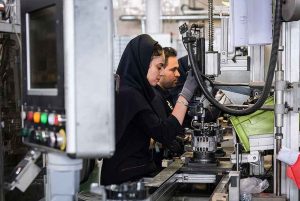
In this context, sociologist Simin Kazemi explained in an interview with the Iranian Labor News Agency (ILNA) that during periods of downsizing, it is typically the most vulnerable segments of the workforce that bear the brunt.
She noted that gender stereotypes and deeply rooted social perceptions play a decisive role in shaping these outcomes, as they often portray women’s employment as less essential than men’s. As a result, women are disproportionately affected and frequently become the primary victims of workforce reductions.
Kazemi further observed that unemployment drives women further down both the social and gender hierarchy, weakening their standing within the family as well as in the broader society.
“Among lower-income groups, women’s unemployment not only exacerbates poverty but also significantly reduces the overall quality of life for them and their families. Many in this segment struggle to meet even their most basic needs, including access to adequate food, healthcare, and housing,” Kazemi said.
“For low-income women in particular, unemployment exposes them to the most severe forms of deprivation, placing them, their families, and their children at heightened risk of homelessness, malnutrition, illness, interrupted education, and a range of social harms.”
She emphasized that unemployment strips women of economic independence and increases their dependence on men, thereby reinforcing male dominance over their lives.
“Under such circumstances, women are far less able to resist or escape situations of domestic violence. However, being out of work often leads to their abilities and qualifications being doubted, which can result in social isolation and increased time spent at home,” she stated.
Kazemi also described women’s unemployment as an “unfortunate catastrophe,” explaining that within Iran’s labor market, women already face significant challenges in securing employment.
“Once they lose their jobs, re-entering the workforce becomes considerably more difficult for them than for men. They encounter numerous structural and cultural barriers, as their work is neither fully recognized nor genuinely supported, and persistent societal obstacles continue to restrict their participation,” she added.
She concluded by noting that women are not only disproportionately affected by workforce reductions but are also compelled to compete with men in an unequal and discriminatory environment in order to obtain and retain employment.
Official statistics clearly reflect this imbalance: while approximately 64 percent of men aged 15 or older are employed, the corresponding figure for women is just 11.5 percent.
Gender discrimination within Iran’s labor market has led many highly educated and skilled women to become discouraged, ultimately withdrawing from the workforce after failing to find suitable employment opportunities.
This disparity is further evident in unemployment rates, with women experiencing joblessness at more than twice the rate of men. In addition, a gender pay gap persists, with discrimination resulting in women earning, on average, 18 percent less than men performing the same jobs with the same responsibilities.
Moreover, women are disproportionately pushed into informal employment and temporary contracts. This trend has recently become visible in unemployment insurance data.
Zahra Behrouz Azar, Iran’s Vice President for Women and Family Affairs in the administration of President Massoud Pezeshkian, highlighted the scale of the issue by noting that nearly one-third of unemployment insurance claims filed over the past 40 days have come from women.
Given women’s comparatively lower participation in formal employment, she described this figure as particularly significant, underscoring the disproportionately high rate at which women are being forced out of the labor market.