(The following piece was written by Elahe Boghrat, Editor-in-Chief of Kayhan London, the Persian-language sister publication of Kayhan Life. The view expressed are her own.)
What follows are recurring reflections on a moment in which both personal and collective ‘opportunities’ still exist—and yet are clearly running out.
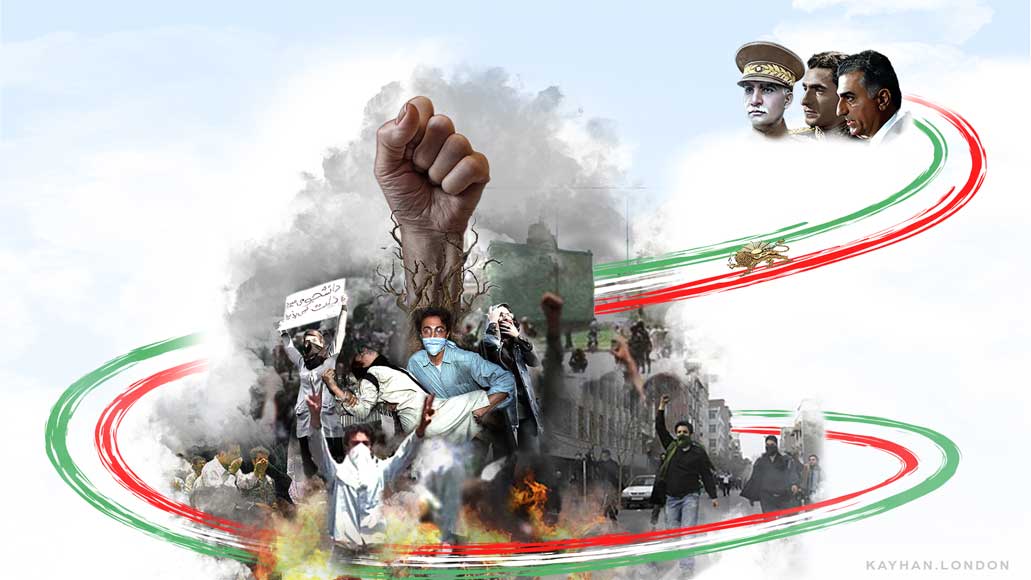
The spark for a new wave of protests in Iran was ignited on Friday, Dec. 12, 2025 (21 Azar on the Iranian calendar), during a memorial ceremony in Mashhad for Khosrow Alikordi, a lawyer and human rights activist who died under suspicious circumstances in his office on Dec. 6. From Dec. 28 onward, beginning in Tehran’s Grand Bazaar, the protests spread on a wide scale to diverse groups of citizens across many regions of the country—and they continue to spread as I write these words.
Despite the admirable determination shown by protesters in recent years against Iran’s religious and mafia-like ruling system, I remain convinced (as I was in past cycles of unrest) that unless Reza Pahlavi decisively assumes the role that the Iranian people see for him and demand of him—as the symbol of the history, civilization, and culture of an ancient nation-state—this opportunity, too, may be lost. It could meet the same fate as the unprecedented protests of 2022: crushed by repression, diluted by deception, undermined by political opportunists, and abandoned by an international community lacking resolve against the Islamic Republic.
This time, however, the regime itself has entered a phase of existential survival. Its so-called reformists—who have consistently stood against the people—are now maneuvering to install one of their own as the successor to Supreme Leader Ali Khamenei. Their most practical model is Russia. Drawing inspiration from Russian President Vladimir Putin’s system, they seek to embed a security-driven figure from within the regime at the helm, ensuring the continued political and economic power of Iran’s ruling families (who are much like Russian oligarchs)—all the while maintaining a working accommodation with the West and the region.
It is not difficult to imagine that, once consolidated, such a regime would again give its old ‘red and black’ ideology a superficial veneer of nationalism and of Iranian nationalism, echoing Putin’s Russia in its renewed belligerence toward democracies and the free world.
The success of this reformist scenario—advanced by regime affiliates and defenders of the 1979 revolution—would mean the failure of what many protesters see as their ‘final battle’: a struggle in which people have risked their lives for the return of the monarchy and who have chosen the Pahlavi legacy as a path toward freedom, prosperity, and national dignity.
That is why, at a moment when all anti-Pahlavi forces are effectively aligned with the Islamic Republic in leader-manufacturing schemes, the figure whom protesters invoke by name in the streets is far more than an ‘advocate,’ a ‘father,’ or even merely a ‘leader.’ He is seen as the heir not to his own throne, but to the sovereignty of the nation itself—the guardian of Iran’s history, civilization, and culture against what many view as the destructive force of the Islamic Republic.
It bears repeating that Iranians have long articulated their path, their demand, and their alternative to the current regime. They have done so in countless slogans, including those invoking Reza Pahlavi by name and the chant “Long live the Shah.” Accepting this historical role does not contradict Reza Pahlavi’s stated commitment to allow the Iranian people to choose their future democratic system through free elections. On the contrary, it is precisely this role that could make such elections possible.
Today, the nation remains captive. To escape a regime widely perceived as anti-Iranian and to reach the stage of free choice, the country needs the historical and cultural role of the ‘Shah’—a role that, in the eyes of many Iranians, only the Pahlavi name, with its record of nation-building, modernity, and relative openness, can embody.
But this opportunity is not eternal. No one can guarantee that conditions will remain favorable long enough for the goal to be achieved. It is no coincidence that the Islamic Republic and all anti-monarchist forces emphasize precisely this point: the passage of time. “What’s the rush?” they ask. “Another ten years means nothing in history.”
And yet it does. Even a single day or hour matters—because in that time, citizens are killed, arrested, tortured, and the country’s resources are plundered ever more ruthlessly through incompetence and corruption.
A Coronation Oath as Historical Foundation
The oath that Reza Pahlavi swore at age 20, on Oct. 31, 1980, as crown prince and heir to the Iranian throne—not merely the Pahlavi throne—constitutes, regardless of debates over the constitutional framework of the monarchy or the regressive role of clerical power within it, a historical foundation upon which many Iranians now stand. Through lived experience, they seek to overcome the rupture of 1979 and the Islamic Republic.
Rather than distancing oneself from that oath, its significance should be reaffirmed as a bridge to the day when Iranians can freely choose their future democratic system. In that oath, the young crown prince committed himself to restoring sovereignty to the Iranian people—a goal he has pursued for more than four decades, including during years when much of the nation was trapped by inexperience, misinformation, and the regime’s propaganda machinery as the country slid rapidly toward collapse.
A Mission for the Nation
Unlike nearly every political movement in modern Iranian history—many of which relied on military or paramilitary organizations, including so-called guerrilla movements—the Pahlavi movement and Reza Pahlavi himself focused instead on political, intellectual, and civic initiatives. He did not seek an armed organization, believing instead that the Iranian people themselves constitute the nation’s true liberation army, joined eventually by patriotic members of the armed forces whose duty is to protect the country and its citizens.
Throughout these years, Reza Pahlavi has consistently positioned himself as a unifying and inclusive figure—an umbrella for the nation and for all political currents committed to democracy and human rights. No other individual possesses this unique capacity, and in nearly half a century, no comparable figure has emerged.
That some political factions—particularly segments of the left and defenders of the current system—refuse to recognize the importance of this role does not diminish its reality or its significance. Repeated attempts by regime-linked networks to manufacture alternative leaders have consistently failed. Reza Pahlavi has worked not for the dominance of one faction, but for the sovereignty of an entire nation—including his critics and ideological opponents.
It is precisely his historical and cultural role that enables him to transcend divisions and to call for political coexistence and reconstruction rather than endless cycles of ideological conflict and militarization.
History at a Crossroads
As January 16 approaches—the anniversary of the day in 1979 when Iran’s second Pahlavi monarch and the Empress left the country—it is worth recalling that less than a month later, the revolutionary coalition of political Islam and radical ideologies did more than topple a government. It fractured the history, civilization, and culture of an ancient nation.
To confront such a rupture, it is that very history and culture that must now stand firmly against the regime. This is the path that many Iranians have chosen.
Political Islam and its left- and right-wing allies did not rise for greater freedom or prosperity, but against the monarchy that symbolized and safeguarded Iran’s civilizational continuity. To defeat the system they created, Iranians must again draw upon that heritage—of which monarchy has long been a unifying institution, and Reza Pahlavi its living symbol.
Iran, many believe, has only one figure capable of assuming this role today.
Since at least the protests of 2017, a significant portion of society has recognized the historical responsibility placed upon him and has insisted upon it in the streets. They must prevail in what they see as their final battle. Otherwise, the Islamic Republic will endure in one form or another, until the opportunity for both nation and monarchy is lost—reducing Iran to a regional state scarcely comparable Turkey or Saudi Arabia, let alone to Iran under the Pahlavis.
What is at stake is nothing less than the fate of a nation and its history. The crown in question is not the crown of a single man, but the crown of Iranian civilization itself—caught between the reactionary revolution of 1979 and the Islamic Republic. That crown, many argue, rests today with the crown prince, to be placed ultimately upon the people themselves, who must then assume responsibility for their democratic choice.
Until then, the barrier of the Islamic Republic must be removed. Citizens risking their lives in the streets understand this clearly. The Shah, in this view, is the authority capable of anchoring a transitional period and guiding the nation toward the ballot box. Without such authority, the outcome remains uncertain—and a people chanting the name of Pahlavi may find themselves unable to impose their will on the world’s powers.
As the 47th anniversary of January 16 is marked, supporters insist on one point: Reza Pahlavi did not seize this crown today, but the moment he swore his oath decades ago—lifting it from between the forces of the 1979 revolution and the Islamic Republic, to return it one day to the Iranian nation.
Iran has entered a new and decisive phase. A clear response to the people’s call—for the role of “Shah”—is no longer symbolic. It is, they believe, a historical necessity.
The outcome of this ‘final battle,’ and the fulfillment of the chant “Pahlavi will return,” rests with both the nation and the man they invoke—when Pahlavi appears in the role that history, civilization, and culture demand: as the Shah.
Prince Reza Pahlavi Issues First Call to Action as Iran’s Winter Protests Escalate