
By Kayhan Life Staff
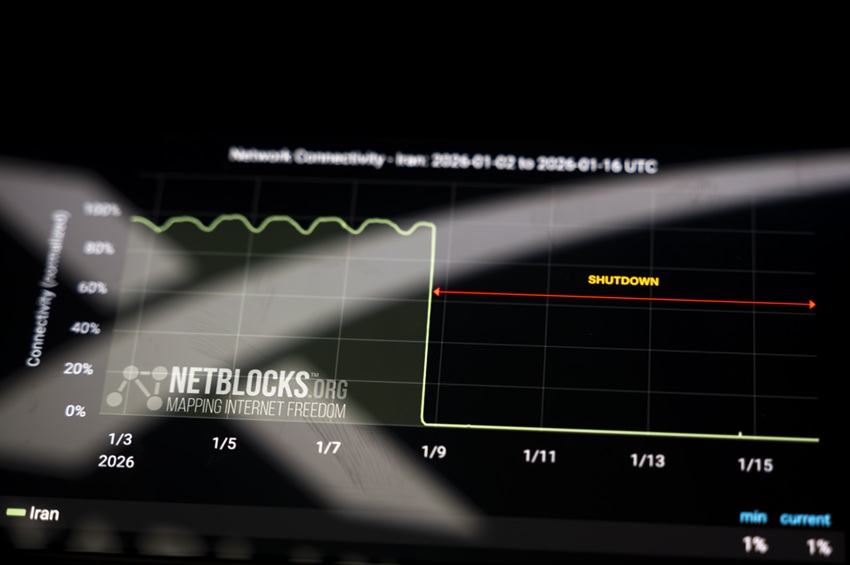
It has now been more than two months since the people of Iran were denied access to the global internet. On Feb. 28, in the aftermath of the U.S.-Israeli war against the Islamic Republic of Iran, the government made the drastic decision to cut off global internet access.
For more than 1,400 hours, Iranians have effectively been silenced as the internet blackout has taken hold.
Estimates indicate that the eight-week shutdown has caused more than $2.5 billion in economic damage to Iran. Government officials have confirmed that two million people have lost their jobs, though economic analysts put the true figure at four million and predict that the number of unemployed will continue to rise in the coming weeks.
Meanwhile, members of the regime’s inner circle have continued to access the internet through a well-known method: the “white SIM card.”
As the Nowruz (Iranian New Year) holidays drew to a close, a new form of internet, referred to as “Internet Pro,” was introduced to specific professional sectors, marking the public rollout of a two-tier system of online access.
The initiative makes the internet a privileged commodity, selectively allocated by the government and monitored by security agencies for use by certain citizens. Those who are less privileged and economically disadvantaged are likely to be excluded from this process.
Despite some professional associations — such as the Semnan Province Bar Association, the Nursing Organization of the Islamic Republic of Iran, and the Iranian Graphic Designers’ Society (IGDS) — rejecting “Internet Pro” due to its discriminatory nature, many other professions have embraced it.
This heightens the social divisions in access to what should be a universal right: internet connectivity.
Iran’s Rial Drops to Record Low as Ceasefire Prompts Rush for Hard Currency
Numerous reports have meanwhile emerged detailing the economic damage caused by this repressive measure by the Islamic Republic.
On the 30th day of the shutdown, Sattar Hashemi, Iran’s Minister of Information and Communications Technology, warned that the incomes of 10 million Iranians were directly or indirectly dependent on the internet, and that the economy could only tolerate a nationwide internet blackout for 20 days. The internet shutdown continued.
One consequence of the internet shutdown that has garnered less attention is its psychological and emotional impact on the citizens.
The abrupt severance of communication, loss of access to social networks, and the disruption of daily life — which heavily depends on the internet — have added additional pressure on citizens already struggling with war, poverty, job insecurity, and widespread government inefficiency and oppression.
Kayhan Life spoke with several people in Iran to explore the emotional and psychological challenges they have faced during this global internet cut in Iran.
One person described their experience as deeply humiliating, adding: “I could not understand why, as an ordinary citizen, I was being punished and denied a perfectly natural — or, as they call it, ‘inalienable’ — right.”
Negar, a 32-year-old accountant from Shiraz (central Iran), described her two-month experience during the global internet shutdown as akin to being in “purgatory.”
She said: “I have experienced internet outages during the 2019 and 2022 protests, the December 2019 events, and the 12-day war in June 2025. However, those interruptions were short-lived, and the excitement of social upheavals made the shutdown feel less severe. This time, however, the fear of war made it much harder.”
“The restoration of the internet became linked to the uncertainty of relations between the Islamic Republic and the U.S. After living through 20 years of unresolved nuclear tensions, the situation became frightening. Since I heard about the distribution of ‘Internet Pro,’ I have felt even more hopeless and miserable. I think the internet will not be restored anytime soon,” she added.
Negar noted that the internet she refers to is a censored, low-quality version that has always been costly to access. She identified the disruption of her relationships with friends as the primary source of her emotional distress: “Virtual connections through Instagram and WhatsApp with friends and family were very important to me. The busy nature of life, and the cost of in-person interactions, pushed much of our social and familial communication online — especially after COVID.”
“Now, the sudden severance of all those connections has been extremely stressful. Additionally, my expenses as an employee striving for financial independence have risen sharply. For a few half-hour internet sessions, I have spent over 7 million tomans (£45). After the intensity of the attacks decreased, I visited friends at cafes a few times, which added several million tomans to my costs,” she said.
For many citizens, disrupted communication has been one of the most tangible consequences of the internet shutdown.
Fereshteh, a 72-year-old woman living alone, described the past two months as “falling to the bottom of a well, where my voice reaches no one, and my world has become silent and dark.”
She explained that, like many people, she did not watch state television programs. Satellite networks, meanwhile, were anxiety-inducing with their news coverage, and she only watched them briefly each day.
“My only comfort was communicating with my children and grandchildren abroad, but this was taken away from me. The disconnection caused extreme anxiety and panic attacks,” she said.
As an older adult living alone, she said, she relied on social gatherings with a group of peers in the local park, but wartime conditions disrupted this routine. During the internet shutdown coinciding with bombings, she was forced to stay home, relying on delivery services for groceries and daily necessities. She only left her home twice in 40 days, both times for medical supplies.
Siamak, a 40-year-old civil engineer, has been suspended from his large-scale construction project since the start of the war.
He shared his frustration with Kayhan Life: “The internet shutdown made me feel deeply humiliated. I do not understand why I, as a citizen, should be punished and deprived of a completely natural, or as they call it, ‘inalienable,’ right. Is it because of the war? Why should I bear the costs of war? Is the government’s security apparatus at fault and now afraid to restore the internet? Why should it affect me? Were Israel’s, Dubai’s, or even Lebanon’s internet connections cut during this war?”
Both Siamak and Negar stated that they have not and will not use the national internet or domestic messaging apps, citing distrust in the Islamic Republic and the poor quality of those networks.
Siamak argued: “Even these programs by the Islamic Republic are a mockery of us citizens. They have trapped us within Iran — not just by depriving us of the internet, but by controlling our work, income, daily life, and relationships like prisoners in a monitored camp.”
The pressure on citizens has been immense.
Reza, 37, a single man, explained that his 39-year-old sister Reyhaneh, who has cancer and has been bedridden for months, relied on the internet for comfort. She spent her days reading, watching YouTube, and browsing Instagram while bedridden.
“Reyhaneh’s mental state has worsened in these two months without internet. She has become so hopeless that she was not as desperate even when she was first diagnosed with leukemia. At her last doctor’s visit with my parents, the doctor reported that her recovery was slowing down,” Reza explained.
Bahar and Amir, a young couple, shared that the internet shutdown, combined with the enforced confinement during the war, nearly pushed them to a psychological breakdown.
Bahar, a graphic designer, and Amir, a cafe manager, could not afford to move to a safer location and were forced to remain in their 50-square-meter apartment in eastern Tehran, which had experienced heavy bombings. A window in their apartment was shattered in the second week of the war due to a nearby explosion.
Bahar said: “We usually had a calm and constructive relationship, and Amir was my safe person, but staying home and the internet cut made me extremely irritable, and we argued multiple times.”
Amir believes the arguments were more due to the internet shutdown than being confined at home: “During COVID, we stayed home much longer and were fine. We watched movies, painted our workspace, and enjoyed our time. However, the internet cut made us strangely angry and impatient.”
Bahar explained that by the third week of the war, she had realized she was depressed. After consulting a psychiatrist friend, she was prescribed Sertraline, which she continues to take.
Bahar and Amir reported that their neighbors had also been affected, with daily arguments now emanating from an apartment that had been silent for three years.
Experts confirm that the lack of internet access — coupled with the humiliation and frustration caused by this repressive measure — significantly increases anxiety, disrupts sleep, and heightens irritability.
Some experts even compare these psychological effects to the experiences of prisoners during incarceration.