By Kayhan London and Kayhan Life Staff
Millions of Iranians poured into the streets across the country on Jan. 10 after a renewed call to protest by Reza Pahlavi, the exiled crown prince and son of Iran’s last monarch, according to videos and accounts circulating despite a nationwide internet shutdown imposed by the authorities.
Demonstrations were reported in Tehran and dozens of other cities, including Ahvaz in the oil-rich southwest, Mashhad in the northeast, Tabriz in the northwest, Shiraz in the south, and Isfahan in central Iran. The protests marked what activists described as the 14th consecutive night of nationwide unrest directed at the Islamic Republic, which is nearing its fifth decade in power.
Iran Cuts Internet Nationwide as People Across the Country Voice Support for the Shah
Reza Pahlavi had urged Iranians to take to the streets on Jan. 10 and Jan. 11 starting at 6 p.m., calling on them to carry national symbols and to reclaim public spaces. Although internet and mobile networks were cut across much of the country, videos transmitted abroad — in some cases via satellite connections such as Starlink — showed large crowds chanting slogans hostile to Supreme Leader Ayatollah Ali Khamenei and openly calling for the return of the Pahlavi monarchy.
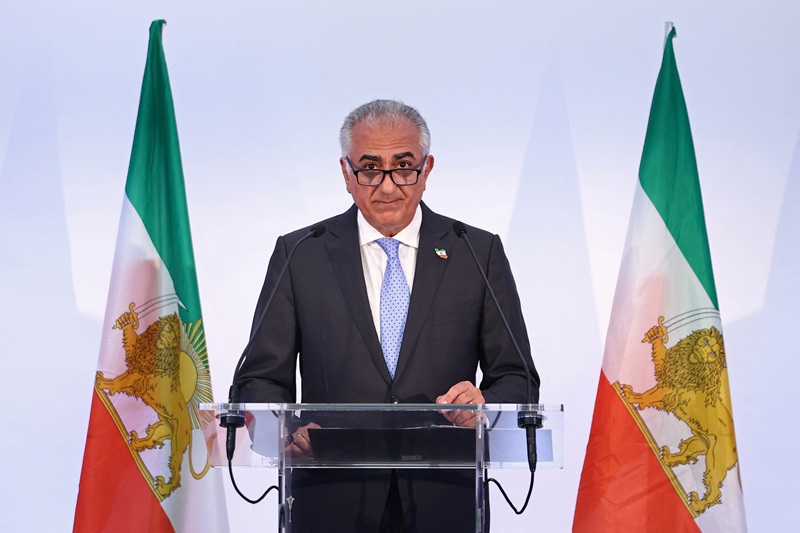
Among the chants heard were “Death to the dictator,” “Khamenei is a killer,” and “We are waiting for Pahlavi; we are not leaving, we are staying right here,” reflecting an increasingly explicit rejection of the Islamic Republic and an embrace by some protesters of prerevolutionary national symbols, including the lion-and-sun flag of the Pahlavi monarchy.
In Tehran, protests erupted in multiple neighborhoods across the north, west, and central districts, including Saadat Abad, Heravi, Narmak, Jannat Abad, Punak, Railway Square, Sadeghieh, Shahrak-e Gharb, Chitgar, Ekbatan, and Tajrish. Witnesses said crowds in Heravi Square and Punak numbered in the thousands. Fireworks were set off in some areas, both as a form of protest and, activists said, a means of disrupting the security forces.
Heravi, a neighborhood known to house residences linked to security and intelligence personnel, was reported to be under particularly heavy surveillance. Even so, videos showed hundreds of demonstrators gathering there, underscoring the scale and persistence of the unrest.
Elsewhere, footage suggested that protesters in several cities waved portraits of Reza Pahlavi, his late father Mohammad Reza Shah, and former Empress Farah Pahlavi. Other videos showed security forces deploying drones to identify demonstrators; protesters responded by jeering at the aircraft or flashing V-for-victory signs.
Reports from Tehran and other cities also described clashes between demonstrators and security forces, including gunfire. In parts of eastern and southern Tehran, witnesses alleged that non-Iranian troops were involved in crowd control, chanting religious slogans as they confronted protesters — claims that could not be independently verified.
In the northern city of Babol, videos circulated alongside unconfirmed reports that demonstrators attacked a police investigation building, freed detained youths despite gunfire, and set the building ablaze. Independent verification of these accounts was not possible.
In Ahvaz, the capital of Khuzestan Province and a center of Iran’s energy industry, protests turned violent after security forces intervened. Witnesses reported intense clashes and gunfire near the local intelligence office in the Golestan neighborhood, as well as large gatherings in other parts of the city, including the central bazaar.
Despite the communications blackout, protesters said they continued to receive calls to demonstrate through satellite television channels broadcasting from abroad. Reza Pahlavi’s earlier appeal, issued on Jan. 8 and Jan. 9, had initially urged nighttime chants from inside homes. Instead, large crowds flooded the streets in cities such as Tehran and Mashhad, with some gatherings swelling into the tens of thousands.
In his latest statement, Reza Pahlavi said he was preparing to return to Iran, adding that he believed the victory of what he called a “national revolution” was near. He urged protesters to move toward the central areas of their cities, link up with dispersed crowds, and prepare to remain in the streets. He also called on workers in key sectors, particularly transportation, oil, gas, and energy, to begin a nationwide strike.
The government, meanwhile, has intensified its crackdown. According to the Human Rights Activists News Agency (HRANA), at least 65 people have been killed during the first 13 days of protests, 2,311 have been arrested, and demonstrations have been recorded in 512 locations across 180 cities in all 31 of Iran’s provinces.
Even so, the authorities’ sweeping internet shutdown and expanded security presence have so far failed to stem the momentum of the protests, which continue to pose one of the most sustained challenges to the Islamic Republic in its 47-year history.