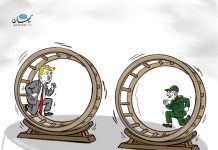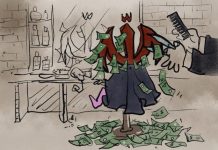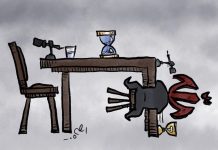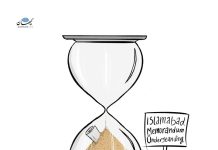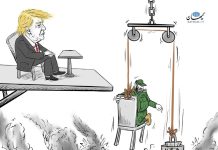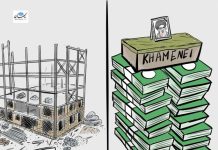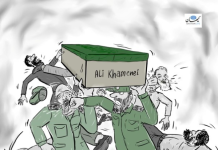

Artist: Behnam Mohammadi
By: Kayhan Life Staff
Tehran’s latest nuclear “understanding” with the International Atomic Energy Agency was signed with a flourish in Cairo and greeted at home with fury. To some, it’s capitulation to Europe’s “E3.” To others, it’s just another attempt to stall until the nuclear deal’s sunset clause kicks in next month.
Kayhan, the conservative daily, wasted no adjectives, branding the IAEA chief “a pawn, a spy, and probably both.” The paper insisted the deal bypassed parliament’s law suspending cooperation, without explaining how Iran’s foreign minister could sign anything without the Supreme Leader’s nod.
Parliament, conveniently on vacation, offered little resistance. Critics accused Speaker Mohammad Bagher Ghalibaf of scheduling recess to avoid debate.
Mohammad Reza Mohseni Sani, a national security committee member, offered a conditional stance on inspections. First, he said, America and Israel must compensate Iran for damage from the recent 12-day conflict. Only after nuclear sites are rebuilt and switched back on will inspectors be allowed to visit.
Meanwhile, the deal seems to exist in two parallel universes: the IAEA’s Rafael Grossi boasts of “full access,” while Iran’s Abbas Araqchi insists no such access was granted.
Europe waits. If inspectors are barred, the Snapback Mechanism is triggered—restoring the full suite of U.N. sanctions without a fresh vote. These are not symbolic. Chapter VII sanctions are binding, enforced even by America’s rivals, and strip the regime of vital economic oxygen.
The result would return Iran to its pre-JCPOA status, but this time the Islamic Republic faces something worse: a regime at its weakest point in four decades, unable to provide basic needs like water, electricity, and fuel, and most vulnerable to an increasingly restless population.
The regime, frailer than at any point in four decades, appears to be wagering that international diplomacy can stretch the intermission before its final curtain call.