
By Kayhan Life Staff
Iran’s educational system is on the verge of collapse as it faces challenges including a severe shortage of teachers, the Coordinating Council of Iranian Teachers has said, citing a report compiled by the Eslamshahr Teachers’ Association in Tehran Province.
According to the report, the Ministry of Education of the Islamic Republic of Iran faces a shortfall of between 100,000 and 130,000 teachers — roughly 10 percent of its current workforce. The shortage is affecting all levels and fields of education.
Overcrowded classrooms are another major challenge. The problem has become more acute this year, as financial difficulties have forced many families to move their children from private to public schools. Even in the capital, some classrooms now have as many as 40 students, a situation that is likely to undermine the quality of both teaching and learning.
Iran Overhauls Educational System, Purges Academia in ‘Cultural Revolution’
The Coordinating Council of Iranian Teachers noted that, despite the standards set out in the Fundamental Transformation Document — the governing framework for Iran’s education system — class sizes in many urban and rural areas, especially in disadvantaged and remote regions, are well above the recommended average.
It said many teachers are facing classrooms of up to 45 students, “which not only lowers the quality of education but also places additional psychological pressure on both teachers and students.”
The report also highlighted Iran’s poor performance in international educational rankings.
In the 2021 Progress in International Reading Literacy Study (PIRLS), Iran was among the lowest-performing countries with a score of 413. One in three Iranian students failed to reach the basic level of reading literacy. The country’s performance also deteriorated compared with the previous assessment in 2016, when Iran scored 428.
School textbook contents were another concern highlighted in the report. It pointed to “a gap between the content of some textbooks and the needs, interests, and lived experiences of students,” suggesting that educational materials were increasingly disconnected from students’ realities.
Another widespread issue is the compulsory and unlawful collection of fees from families. The report described the practice as a crisis threatening the education system, stating: “The collection of money from families during student registration has become a phenomenon which, through sheer repetition and denial, has become so commonplace that its seriousness has been diminished.”
Rising educational costs are leading to an increase in the number of children who are out of school. According to the Coordinating Council of Iranian Teachers, the number of students who either dropped out or stayed out of school soared from around 780,000 in the 2015–16 academic year to more than 993,000 in 2025–26.
The council said authorities had conducted no comprehensive assessment of the causes nor taken steps to address them.
The Coordinating Council of Iranian Teachers described the funding crisis affecting special-education schools as a “silent catastrophe.”
While ordinary schools were struggling with shortages of personnel, paper, and desks, special-education schools faced the same systemic problems, in addition to dealing with what the report called a “crisis in the survival of rehabilitation services” and “structural deterioration.”
The Coordinating Council further warned that students are struggling not only with the absence of classmates and empty desks but also with a complex psychological crisis triggered by the December and January protests, as well as by war, violence and continued uncertainty.
“Looking at the current state of the education system,” the council wrote, “the country is facing a multitude of serious problems.” It listed young people’s declining motivation and hope for the future; the recruitment of unqualified individuals in specialized fields; the declining status of teachers; the devaluation of education and the pursuit of knowledge; the relatively high income and social status associated with informal employment, particularly jobs that did not require specialized knowledge or university education; and insecurity in schools.
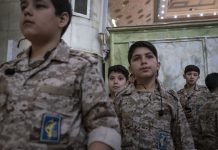
The report also linked teachers’ deteriorating status to low salaries, which it said had pushed many educators into low-paying jobs or into multiple jobs. It further condemned the use of schools for military purposes, describing how they had been turned into “military bases and barracks” and “firing positions from which bullets are shot at innocent people.”
Another major concern was the lack of funding for basic school operations. The report cited shortages of money to cover routine expenses such as water, electricity, gas, and telephone bills, as well as to pay the salaries of part-time and contract teachers. It also criticized attempts to compensate for these shortages by unnecessarily closing schools under what it describes as baseless pretexts.
The report identified several additional weaknesses, including “the ineffectiveness of education at the level of rote memorization; overcrowded classrooms; ineffective instruction in academic/theoretical fields; and, in vocational and technical fields, overcrowding combined with a lack of educational and laboratory equipment.”
The report concluded with a stark warning about the long-term consequences of the education crisis.
“What is happening in schools today is not a marginal issue,” it wrote, “but the front line of this country’s future. The hidden crises beneath the surface of the education system — from the deterioration of its structure to the mismatch and inconsistency of educational content — will, if no solutions are devised, leave behind a society with no place in the competition for knowledge and creativity. Addressing these shortcomings in this worn-out structure is no longer a choice; it is a national imperative for survival.”