By Kayhan Life & Kayhan London Staff
Shopkeepers and bazaar merchants in Iran’s major cities staged coordinated protests this week as the currency plunged to a new record low of 144,000 tomans per US dollar and as the governor of the Central Bank of Iran, Mohammad Reza Farzin, resigned.

According to the Statistical Center of Iran, inflation in December rose to 42.2 percent from the year-earlier period, and was up 1.8 percent from November. The price of foodstuffs was up 72 percent compared to a year earlier, while health and medical items were up 50 percent over the same period.
The protests began on Sunday evening in Tehran, immediately after President Masoud Pezeshkian’s address to the Majles, in which he challenged lawmakers, asking, “They say raise wages; someone tell me where I should get the money from?”
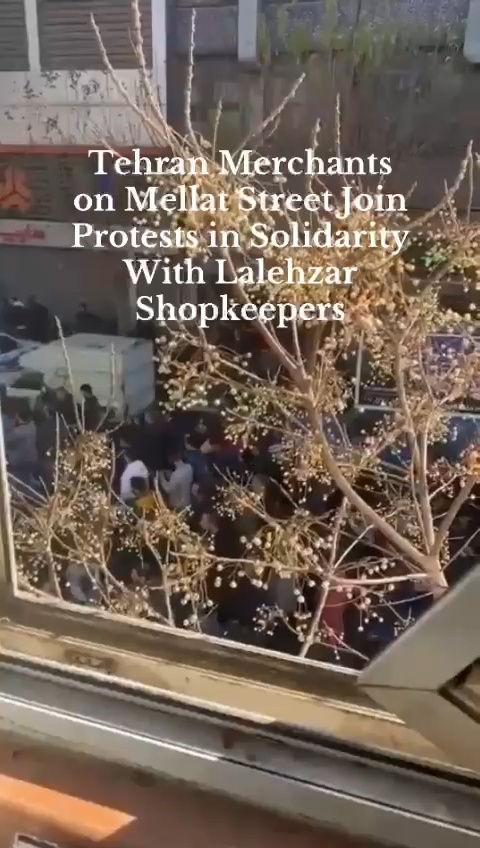
The unrest quickly spread from the city’s central commercial districts — including the Alaeddin and Charsu shopping centers, key hubs for the mobile phone trade on Jomhouri Street — and reached Lalehzar, the traditional electrical appliance market, the following day. Merchants reported that the extreme volatility in the rial’s exchange rate against the dollar had made routine business transactions nearly impossible.
On Dec. 29, merchants in Tehran and Isfahan closed their businesses to protest the sharp rise in the dollar exchange rate, a persistent recession, soaring prices, tax hikes, and punitive commercial rents, according to local reports and eyewitness accounts.
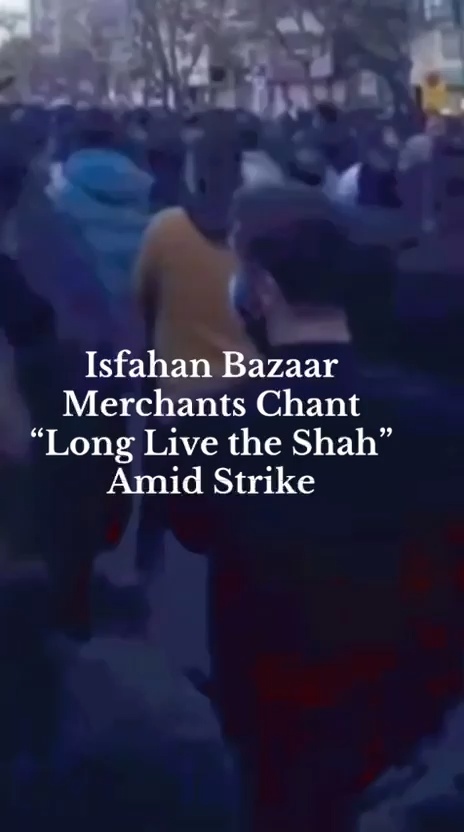
During the demonstrations, some crowds moved beyond economic grievances, chanting slogans that openly challenged the Islamic Republic, and invoking Iran’s former monarchy in an unusual use of language by the country’s traditionally cautious bazaar class.
Merchants in Tehran began lowering the shutters on Dec. 28. The strike began at the Alaeddin mobile phone market and quickly spread to Shoosh Square (Iranian Passage). By the next day, the shutdown spread across several key commercial hubs, including Tehran’s Grand Bazaar, parts of Lalehzar, Saadi, and Mellat streets, as well as Beyn-ol-Harameyn market and Kashani Passage. In Isfahan, bazaar merchants joined the walkout on the same day.
As the strike expanded, groups of merchants and supporters reportedly gathered and marched through market areas and nearby streets, chanting slogans such as:
“They used faith to rule and ruin everyone.” “Reza, Reza Pahlavi — the people’s cry,”
“This is the last and final fight — Pahlavi’s return is now in sight,”
“Reza Shah, your spirit lives.”
Security forces, including police units and special units, moved to disperse demonstrators in multiple cities. In some areas, including Tehran and Malard, officers fired tear gas at protesters.
In Tehran, security forces reportedly attempted to disperse demonstrators as strikers responded with cries of: “Don’t be afraid — we stand as one,” and continued their protest.
Prince Reza Pahlavi issued a message addressed to Iran’s armed forces. Declaring that the ruling system was “in the process of collapse,” he urged security personnel not to stand against the population.
Meanwhile, student activist groups at the University of Tehran and Amirkabir University of Technology issued separate statements supporting a strike by merchants and calling on citizens and students to join the protests.
The Islamic Republic’s official response to the protests is two-pronged. The government is introducing emergency economic measures to manage currency and cost-of-living pressures, while a security-driven narrative is linking the economic protests to “enemy” operations.
Following the bazaar strikes in Tehran and Isfahan on Dec. 29, the IRGC-linked Fars News Agency claimed that the shutdowns were part of an “enemy scenario” aimed at “undermining security.” The head of Iran’s judiciary, meanwhile, said he had issued a “firm directive” to confront what he called “disruptors of the economic order.”
Separately, the Central Bank’s public relations chief said that, on President Masoud Pezeshkian’s instructions, the government’s economic team had convened an emergency meeting at the Central Bank to review currency and livelihood policies.
Hours after Farzin’s reported resignation as governor of Iran’s central bank, President Masoud Pezeshkian’s office announced that Abdolnasser Hemmati would replace him.
Farzin had faced mounting criticism over the central bank’s inability to contain a plunging currency, a failure that paved the way for reformists to return Hemmati—a key economic figure—to the cabinet, despite his impeachment and dismissal as economy minister just months ago over rising inflation.
The change came as bazaar strikes spread from Tehran to cities including Isfahan, Karaj, Kerman, Hamedan, and Qeshm, highlighting the growing link between Iran’s economic crisis and widening unrest.
With officials appearing concerned that the strike could spread further—and that other sections of society might join—state-linked messaging moved quickly to frame the walkout in security terms.
On Dec. 29, Fars News quoted an unnamed security source as saying that “agents” of the enemies of the Islamic Republic were steering the protests in a radical direction by turning economic grievances into political instability.
Fars News reported that dissatisfaction was expected to spread and that protests were likely to be echoed by other groups. The report cited recent demonstrations by nurses, workers, and retirees in multiple cities and argued that authorities feared that scattered sectoral protests could merge into a broader national movement. It added that, following a 12-day war with Israel, the Islamic Republic had been weakened, and that videos circulating in recent weeks—showing some military personnel criticizing economic conditions—suggested accelerating demoralization and internal erosion within security and military institutions.
Prince Reza Pahlavi : ‘The Alternative to the Islamic Republic is the Iranian nation’
OPINION: Reza Pahlavi’s Transition Plan Is Roadmap for Regime Change