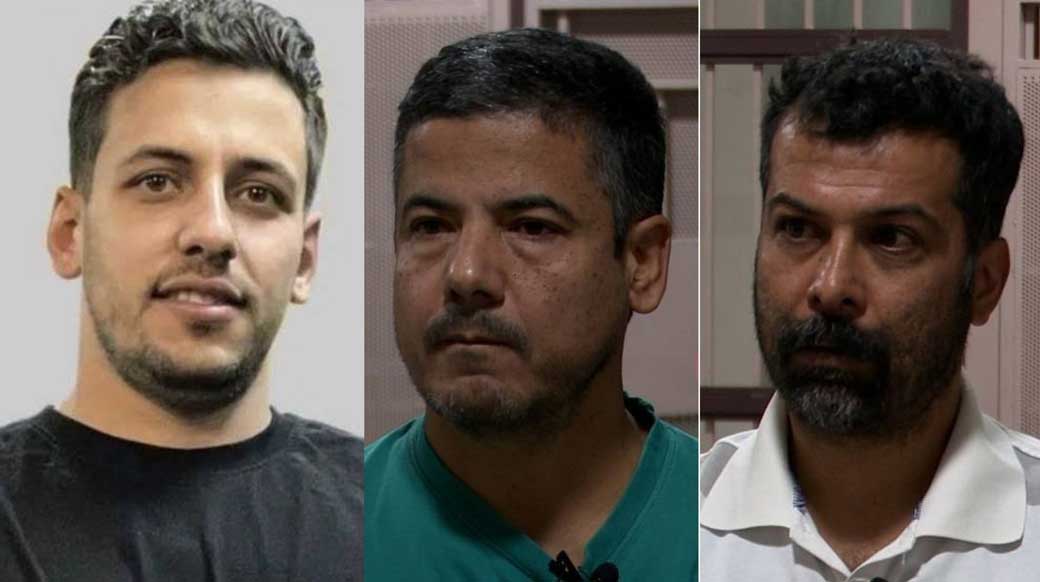
By Kayhan Life Staff
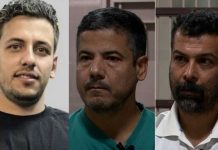
The Islamic Republic of Iran’s judiciary has announced the simultaneous execution of Hassan Divband, Hamid Kazemi, and Reza Zanganeh, three men who were among the many detained during the December-January protests. They were executed on charges that included using Molotov cocktails, grenades and firearms, and setting fire to public facilities.
The three men were sentenced to death and had their property seized on charges of “taking part in an operational act for Israel, the United States, and hostile groups against national security and national interests,” the judiciary said.

Mizan, the judiciary-affiliated news agency, reported that the sentences were carried out at dawn on Nov. 8 at Ghezel Hesar Prison in Karaj, west of Tehran.
According to Mizan, the indictment cited “preparing and making Molotov cocktails and grenades and using them,” “carrying and using cold weapons and firearms during the riots,” “destroying and setting fire to public places, facilities, and equipment,” “destroying an electricity substation and cutting power to some areas of Karaj,” and “encouraging others to riot.”
The judiciary described the three men as “trained” individuals and added: “These individuals took part in the riots with knives, machetes, and two hunting rifles, along with 150 birdshot cartridges that were later discovered. They also made and used Molotov cocktails and homemade grenades.”
Ten other defendants were arrested in the same case on charges of taking part in the protests and cooperating with Divband. The judiciary said the Karaj Revolutionary Court sentenced eight of them to between five and 10 years in prison.
Human rights sources earlier reported that the death sentences were issued by Branch 2 of the Karaj Revolutionary Court, presided over by Judge Sabzevari, with Judge Narimani serving as an advisory judge.
The trial was conducted under the “Law on Intensifying Punishment for Espionage and Cooperation with the Zionist Regime and Hostile Countries against National Security and Interests.” The law — which contains nine articles and seven clauses — was drafted after Israel’s 12-day war with the Islamic Republic in June 2025. The Majlis (Iranian Parliament) passed it on Sept. 28, 2025. The Guardian Council deliberated for only three days before approving it, and it took effect on Oct. 31, 2025.
Covering a wide range of citizens’ actions, the law allows for broad charges of “corruption on earth” (fasad-fel-arz) and “waging war against God” (Moharebeh), giving judges discretion to issue death sentences. Illegal gatherings during wartime and sending photos and videos to media outlets outside Iran are among acts that can carry the death penalty.
Mai Sato, the UN Special Rapporteur on human rights in Iran, reported in a late-October document that between December 2025 (when the nationwide protests started) and late August, at least 25 individuals had been executed in connection with the demonstrations, and at least five of those executions were carried out publicly.
Iran Detaining Protesters Being Treated in Hospitals as Part of Crackdown, Says UN Expert
Zanganeh, 27, was originally from Kalilabad (also spelled Khalilabad), a small village in Malayer, in the western province of Hamadan. He lived in Malard, in Tehran Province. Security agents arrested him in Karaj in the early hours of April 3, in front of local shopkeepers, as he was opening his car repair garage.
After the Supreme Court upheld Zanganeh’s death sentence, Kayhan London reported that his family and relatives cited “cooperation with Mossad” as being among the charges against him. They rejected the accusation as baseless, saying it was made against him because of his work repairing luxury cars, and because of his travel abroad.
In recent days, some human rights sources had reported that Zanganeh and Kazemi had been transferred to solitary confinement and that their executions could be imminent.
UN Rapporteur Sato said in her October report that the law had become a tool for issuing and carrying out several of these executions.
“Protest-related executions constituted only a fraction of total executions. The number of known executions remains extremely high, and the telecommunications shutdown deepened an opacity that long preceded it,” she said. “Over 80 percent of the executions carried out in the Islamic Republic of Iran are linked either to drug-related offenses or to the principle of qisas (retribution in kind).”
Since the start of the war with the U.S. in late February, the Islamic Republic has escalated its repression of citizens, including by issuing and enforcing death sentences on political activists and those arrested at protests.
Norway-based Iran Human Rights (IHRNGO) recently reported that it had recorded at least 691 executions between Jan. 1 and Oct. 31, 2026, including three people who were under 18 at the time of their offenses.
During this period, 353 people were executed under qisas for premeditated murder, including four who had been arrested during the protests. A further 244 were executed on drug-related charges, 81 on security charges, and 12 on charges of rape. The charge against one executed woman remains unclear.
Among those executed on security charges, 32 had been arrested during the protests, 15 were political prisoners affiliated with groups opposed to the government, 17 were accused of espionage or cooperation with foreign governments, and nine were convicted of armed robbery. Four were accused of links to ISIS, while the charges against four others remain unknown.
In late summer, human rights sources reported that at least 100 individuals arrested during the December-January protests across 13 provinces are facing death sentences. The greatest number, 46, is found in the central province of Isfahan.