By Enas Alashray and Nayera Abdallah
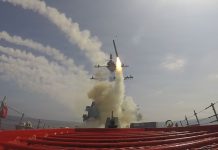
DUBAI, Nov 18 (Reuters) – Iran said it targeted US drone and missile sites in Kuwait overnight after the United States struck Qeshm Island in the Strait of Hormuz, marking Tehran’s first attack on the US-allied Persian Gulf state since September.
Underlining a broader uptick in hostilities in recent days, Bahrain said it intercepted Iranian aerial attacks on Wednesday for a third time in a week, accusing Tehran of a “systematic hostile approach” towards the Persian Gulf kingdom, where the US Navy’s Fifth Fleet is headquartered.
The latest attacks highlighted the obstacles facing diplomatic efforts to end a conflict that has destabilised the Middle East, disrupted shipping, driven up global energy prices and drawn in countries across the region.
IRAN ISSUES FRESH WARNING TO ‘THE ENEMY’
The Iranian army said it had targeted US drone and missile installations at Kuwait’s Ali Al Salem base after Kuwait said its air defences were countering hostile drone attacks.
It followed US airstrikes on Tuesday evening, when American fighter aircraft targeted a missile launch site on Qeshm in retaliation for Iranian attacks on US personnel and assets, a US military official told Reuters. Iranian media, citing an Iranian official, said the US attack caused no damage to infrastructure.
The US military said on Wednesday that no US personnel had been injured in any attempted Iranian attacks this week and that all its service members were safe and accounted for.
Kuwait said it reserved the right to take all necessary measures to safeguard its sovereignty and protect its territory and vital facilities against any aggression or threat.
In videos published by state media on Wednesday, Iranian Army Commander-in-Chief Amir Hatami issued a fresh warning to the United States.
“If the enemy repeats its mistake… we have the readiness and the plans to confront it and its supporters in a stronger, more crushing way and without geographic limitations,” he said.
Hasan Al Hasan, a senior fellow for Middle East Policy at the International Institute for Strategic Studies, said Iran was undertaking a “cautious” escalation.
“But there is no ruling out further escalation, especially if the US begins to widen military operations, begins to widen its target set to include not just Iranian military coastal infrastructure, but also more deeply within Iran,” he said.
Trump Says US Taking Seriously Report of Possible Iranian Dirty Bomb Plot in Washington
MEDIATOR QATAR AIMS TO NARROW GAPS
The United States and Israel attacked Iran on February 28 and Tehran responded with strikes on Israel and Persian Gulf states hosting US military bases.
The conflict later spread to Lebanon, where fighting erupted between Israel and Iran-backed Hezbollah, and to Yemen, from where the Iran-aligned Houthis have launched attacks on Saudi energy facilities, airports and other targets.
Iran has also fired at US forces in Jordan.
Global oil and gas prices have shot up, with shipping through the Strait of Hormuz severely disrupted after Tehran declared it closed, while the US has imposed a naval blockade on Iran, hitting Iran‘s economy hard.
Qatari and Iranian officials met on Tuesday for talks aimed at “bridging perspectives and narrowing the gap between proposals presented on the ground,” Qatari spokesperson Majed Al Ansari said.
A Saudi-led coalition said on Wednesday it had intercepted a cruise missile launched by the Houthis towards the Saudi capital Riyadh. There was no immediate confirmation from the Houthis.
A surge in attacks on shipping since October has threatened to further strain global oil supplies. On Tuesday, a crew abandoned a liquefied petroleum gas tanker off Oman’s Khasab.
The United Arab Emirates’ ADNOC Logistics & Services said on Wednesday that 1 crew member was missing and 11 injured after one of its vessels was attacked in the Strait of Hormuz on Tuesday.
Saudi Arabia condemned Iran‘s latest attacks.
“The Kingdom renews its demand for an end to all acts of aggression, respect for international law and the principles of good neighborliness, and an opportunity for diplomatic efforts to achieve peace and resolve the crisis through negotiations,” the Saudi Foreign Ministry said.
RUBIO SEES NO IMMINENT THREAT TO WASHINGTON
President Donald Trump said on Tuesday the US was taking seriously the possibility that Iran could be planning an attack on Washington, when asked about a CNN report that cited US intelligence assessments on a potential Iranian plot involving a so-called dirty bomb.
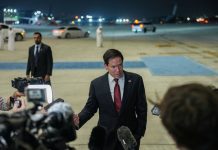
On Wednesday, US Secretary of State Marco Rubio said he did not think there was any imminent threat to the US capital.
Iran called the allegations “baseless”.
(Reporting by Enas Alashray in Cairo; Jana Choukeir and Elwely Elwelly in Dubai, additional reporting by Dubai newsroom and Bhargav Acharya in Toronto; Writing by Nayera Abdallah and Tom Perry, Editing by Stephen Coates, John Mair, Ros Russell and Gareth Jones)
#Iran, #Kuwait, #USStrikes, #IranianIsland, #MilitaryConflict, #MiddleEast