By Kayhan Life Staff
Iran’s agricultural and food sectors are facing an excruciating set of pressures — war disruptions, rising costs, water shortages, and weak economic policies — that are threatening the country’s food security.
Despite President Massoud Pezeshkian’s calls for increased production and sustainable resource use, farmers and food manufacturers struggle with government debts, high input costs, and falling purchasing power — highlighting the gap between government directives and economic realities.
ANALYSIS: Much of Iran Is Threatened By Drought and Water Scarcity
The government has no apparent plan to support food production, control prices, or protect citizens’ purchasing power and household food budgets. Statistics show that a substantial part of the increase in food prices results from the Pezeshkian government’s economic policies, including the ill-timed elimination of the preferential exchange rate last winter.
In a meeting with a group of agricultural sector economic stakeholders on Aug. 18, President Pezeshkian said: “In addition to the problems and consequences arising from the war, the country is facing a range of imbalances and climate-related challenges, including limited water resources. Production and development policies must be designed and implemented in accordance with these realities.”
He also called for greater attention to food production and supply.
“We must move toward producing less water-intensive crops, improving the productivity of existing resources and facilities, reforming cropping patterns, and activating the country’s neglected capacities. We must organize development plans based on the country’s actual territorial advantages and constraints,” Pezeshkian added.
Meanwhile, Iran faces increasingly severe issues in terms of its agriculture and food production, raising concerns about the departure of many who are working in the sector.
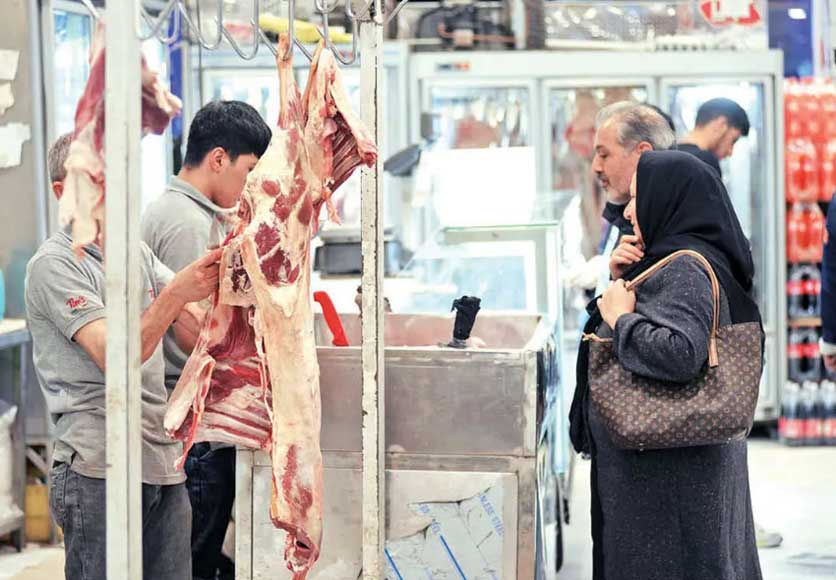
Reports indicate that across many areas of food production, rising production costs have, on the one hand, driven up the final prices of food products and, on the other, deprived producers of the ability to continue operating.
Trump Warns of Economic Consequences for Any Country That Supports Iran
For example, Pezeshkian has emphasized the importance of agricultural production at a time when, amid the war and the crisis facing the government because a naval blockade is restricting imports of essential goods, the state has failed to pay wheat farmers for the wheat it purchased. Large numbers of farmers, already struggling with a livelihood crisis, have been left without the resources needed to cover the costs of fall planting.
According to reports, although the government had previously promised wheat farmers that it would settle payments for their wheat within 48 hours, it has so far paid only a quarter of the farmers’ estimated total claims of approximately 4,000 trillion rials ($2.1 million), and even those payments have been made only on a drip-feed basis.
According to the report, the failure to settle payments owed to wheat farmers, combined with the elimination of the preferential exchange rate, sharp and manifold increases in the prices of fertilizer, pesticides and seeds, and reductions in fuel quotas, have left farmers facing an acute livelihood crisis, an inability to repay bank loans, and an inability to cover the costs of fall planting.
The preferential exchange rate (Arz-e Tarjihi) stood at 42,000 rials per U.S. dollar until December 2025, when Iran abolished the heavily subsidized rate provided to importers of essential goods such as food and medicine. At the time, the preferential rate was far below the open-market rate, which had reached roughly 1.4 million rials per U.S. dollar.
Agricultural trade union activists have warned that the farmers’ liquidity crisis will reduce production and threaten the country’s food security during wartime, when the naval blockade has effectively paralyzed imports.
Meanwhile, Massoud Bakhtiari, chairman of the board of the Iranian Syndicate of Canned Food Industries, told the Tehran-based Didban Iran news website that “production units are currently facing extremely serious challenges in securing raw materials. These problems are putting significant pressure on producers, both in terms of access to raw materials and their prices.”
Emphasizing that producers are currently caught in a lose-lose situation, he said: “If a producer does not adjust the prices of its products in line with rising costs, it will have no choice but to sell them at a loss. If, on the other hand, it moves toward rationalizing prices, given the decline in people’s purchasing power, it will face falling demand and a sharp drop in sales.”
“Production has entered an emergency, and the current circumstances are extremely worrying because inflation and recession are occurring simultaneously. On the one hand, inflation has increased production costs, while on the other, the recession prevailing in the market has reduced people’s purchasing power,” he warned.
The Tehran-based Shargh newspaper, in a report on the sharp increase in food prices, quoted food producers as saying that “the decline in food consumption in the country due to high prices has been so significant that in some cases it has eliminated the need to import goods, and has temporarily halted plans to increase production at manufacturing units.”
The Shargh report also identified soaring production costs as the main factor behind higher market prices, noting that some production prices have risen by as much as 350 percent. Rising input costs have directly increased the final cost of goods and driven up food prices.
For example, reports say damage to the petrochemical industry during the recent war has reduced production and increased the price of plastics used in food packaging. Meanwhile, the cost of food packaging has risen by between 150 and 300 percent. The cost of a small bottle of cooking oil was 50,000 rials ($0.026) before the war and has now risen to 300,000 rials ($0.156).
A large portion of the cost increase, however, has nothing to do with the war and instead reflects Iran’s turbulent economic conditions.
Food producers say that a 60 percent increase in workers’ wages, increases of between 40 and 400 percent in energy costs, and a 90 percent rise in transportation costs over the past year are among the factors that have driven up production costs and final product prices.
Agricultural production, the sector highlighted by Pezeshkian, has also been severely affected. The elimination of the preferential exchange rate last winter caused chemical fertilizer prices to rise sharply.
For example, the prices of phosphate and potash fertilizers have increased by around 300 percent, while the price of urea fertilizer has risen by 150 percent. The price of agricultural pesticides is also estimated to have increased by around 150 percent following the elimination of the preferential exchange rate.
In the protein-production sector, removing the preferential exchange rate has increased the price of livestock and poultry feed by about 350 percent. In this sector, the price of corn rose from 110,300 rials ($0.059) per kilogram to 430,000 rials ($0.23), while the price of soybean meal rose from 20,300 rials ($0.11) to 85,000 rials ($0.47) per kilogram.
The removal of the preferential exchange rate has also pushed the price of each kilogram of crude cooking oil from 550,000 rials ($0.29) to 2,805,000 rials ($1.50).