By Costantino Pistilli
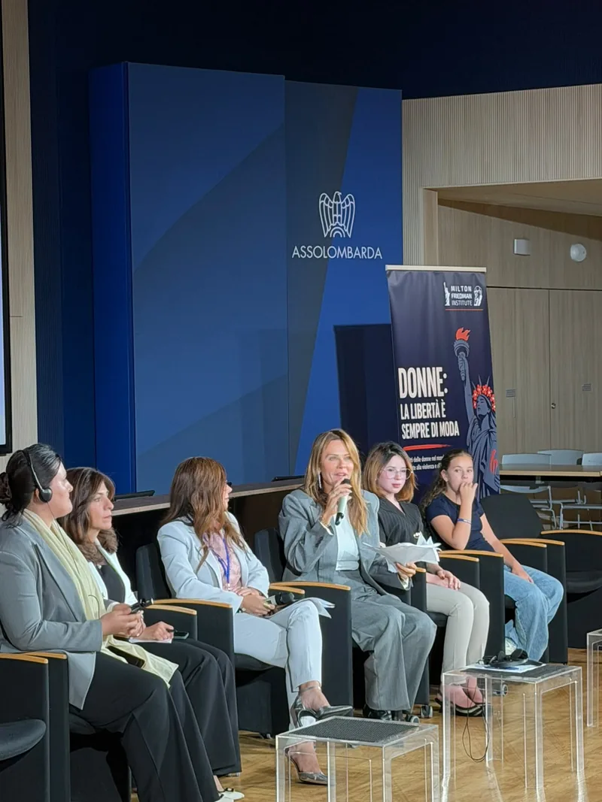
At this year’s Milan Fashion Week, women from Iran, Afghanistan, Iraq, and young girls from Israel featured prominently in an event titled “Women: Freedom Is Always in Fashion,” organized by the Milton Friedman Institute with the Italy-Iran Association for Democracy and Freedom of the Iranian Nation. The event was held at the Assolombarda Congress Center in Milan.
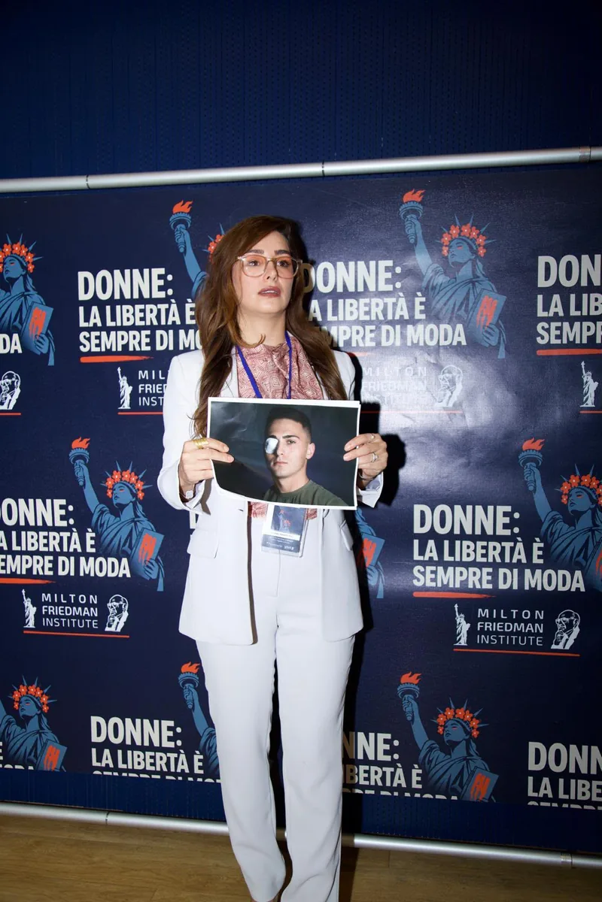
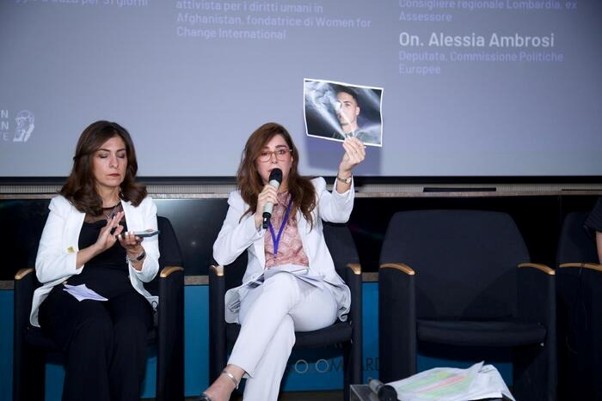
Elaheh Tavakolyan, who lost an eye during the ‘Woman, Life, Freedom’ protests of 2022, gave a powerful presentation. She recalled that one day during the protests, as she was taking to the streets, her daughter asked why she wanted to demonstrate. “For freedom,” she replied: “so that you do not become like our generation, repressed and forced into silence.”
Tavakolyan said if she had to do it all over again, she would make the exact same choice. “If I could go back, I would do the same. I have no regrets.”
She spoke on 25 September at the Assolombarda Congress Center in Milan during “Women: Freedom Is Always in Fashion”, an event held during Milan Fashion Week, organized by the Milton Friedman Institute, the Italy-Iran Association for Democracy and Freedom of the Iranian Nation.
Her testimony was not simply about what had happened to her. It warned of what is still happening inside Iran.
“The story of Iran and Iran’s freedom is continuing. It is not over.”
Tavakolyan then held up a photograph of Ali Zarei, blinded in his right eye on 7 October 2022 during the crackdown on the Woman, Life, Freedom protests. He left Iran for Germany and joined protests against the Islamic Republic and in support of Reza Pahlavi. After returning to Iran, he was arrested on April 28 and sentenced to death by the Revolutionary Court.
The protests have disappeared from the front pages, but men and women remain in Iranian prisons awaiting sentences to be carried out, she said, and some of them are “only a step away from the gallows.” She appealed to international organizations and human-rights groups to keep up the pressure on the Islamic Republic.
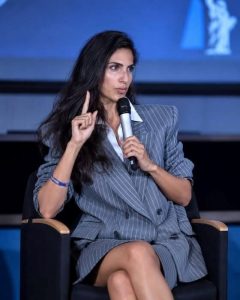 “I hope the day comes when people are no longer forced to lose their lives for freedom, when they are no longer forced to take to the streets and lose an eye,” said Tavakolyan.
Farnoush Hamidian, an Iranian model and actress, said she started working as a model in Iran secretly, at the age of 16: “We risked going to prison for it.”
“Whatever I do, my job in my country is illegal,” she explained. Ultimately, she added, “there is nothing more precious for a woman than freedom.”
Other Iranians at the gathering included Parvaneh Hassibi, a doctor; Melika Kiyan, an anaesthetist with the Italy-Iran Association; Mona Jafarian, a Franco-Iranian activist and author; and Eli Borhan, an activist, witness, and victim of violence in Iran.
The Italy-Iran Association for Democracy and Freedom of the Iranian Nation also communicated to all those present that the protests were not over in 2022, and that repression did not end when the images that travelled the world disappeared from the television screens.
Women from Afghanistan, Iraq, and young girls from Israel also offered striking testimonies at the event.
Husna Jalal, an Afghan woman now living in the Netherlands, described life under Taliban rule. Girls are barred from school after the sixth grade, and women are excluded from large parts of public and professional life.
Jalal warned against the idea that Islamist extremism could be geographically contained: She said its doctrines and ideas were very much present in Europe. She recalled a Dutch friend asking her where women who fled extremism back home were supposed to go, if the same ideas followed them into Europe.
Extremism “is already here” on the European continent, she said.
Ela Elyakim of Israel, meanwhile, told a dark tale of captivity in Gaza. She was 8 when Hamas gunmen entered her father’s home in Kibbutz Nahal Oz on October 7, 2023. Ela hid under a bed with her sister Dafna and another boy.
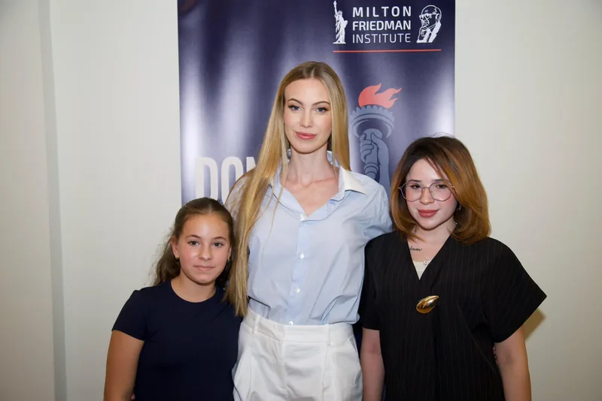
The two sisters were found and taken to Gaza. Meanwhile, their father, his partner Dikla and her son Tomer were all killed. The sisters spent 51 days in captivity, moving between houses and tunnels.
Ela remembered one place in particular: “A kind of cage. Like for dogs, only a little bigger.”
The girls were told by their captors that Israel did not want them back, and that they would remain in Gaza and grow up there.
Asked what had given her the strength to endure her ordeal, Ela replied with one word: “My sister.”
Aviva Siegel, also kidnapped on October 7 and held by Hamas, spoke of hunger, fear and the absolute power of captors who controlled every movement, every mouthful of food and every hour spent underground.
For hostages, political concerns quickly give way to simpler details: doors, footsteps, injuries, hunger and the person sitting beside you.
Fawzia Amin Sido experienced another form of the same brutality years earlier.
She was 10 when the Islamic State abducted her in Sinjar, northwestern Iraq, in 2014. She was sold, beaten and held in captivity for years before eventually being taken to Gaza. The little child was turned into property, into merchandise. child was turned into property, into merchandise.
Yet Fawzia did not ask the room for pity. “I am not here to ask for your compassion,” she said. “I am asking for humanity.”
Costantino Pistilli is an author and journalist based in Italy. He contributed this article to Kayhan Life.