By Kayhan Life Staff
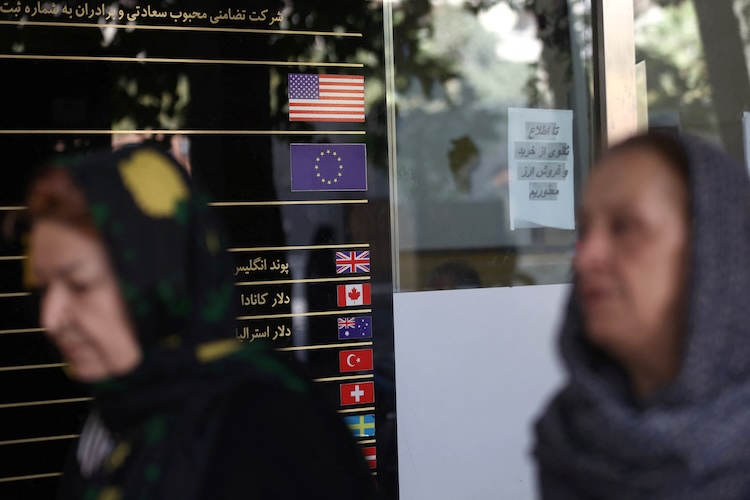
The Islamic Republic of Iran’s security forces have launched a widespread crackdown on dozens of individuals involved in the country’s currency exchange network, informed sources have told Kayhan Life.
According to these sources, the bank accounts of these individuals have been frozen because they refused to cooperate with authorities in transferring large sums of foreign currency to Europe through the Central Bank of the Islamic Republic of Iran.
A journalist and Tehran resident told Kayhan Life that, during the U.S. and Israeli attacks on Iran and before the end of the Nowruz holidays — the Iranian New Year, which this year began on March 20 — the Central Bank froze the accounts of dozens of active currency exchangers in Tehran due to their refusal to cooperate with the regime.
A resident of northern Tehran told Kayhan Life: “A currency exchanger who is a relative of mine and whose office I had visited several times in the past to transfer foreign currency told me a few days ago that various individuals had repeatedly come to his office asking whether he could transfer large sums of money to Europe. He refused. Then, just before the end of the Nowruz holidays, all of his bank accounts were blocked without warning or notification.”
A few days after this exchanger’s accounts were frozen, someone visited his office, addressed an employee, and said: “I came to see if you are okay?” laughed, and left. It was only then that the exchanger understood why his accounts had been blocked.
A Tehran-based journalist confirmed the report to Kayhan Life, stating that multiple currency exchangers had faced similar account freezes, with several of their bank accounts blocked by the Central Bank.
The journalist added: “On Saturday (April 11), I went to Ferdowsi Street, which is the center of Tehran’s currency exchange shops, and I saw that most of the shops were closed, with only a few still open.”
The journalist explained: “Over the years of sanctions, institutions and individuals affiliated with the Iranian regime — particularly the Islamic Revolutionary Guard Corps (IRGC) — have used a variety of resources and methods to circumvent sanctions, launder money, finance operations, and smuggle goods. After the recent widespread crackdown by the United Arab Emirates (UAE) government on financial networks linked to the IRGC, and facing this financial deadlock, they were forced to rely on domestic currency exchangers as a last resort to move funds abroad.”
According to the Iran International network, which cited informed sources, rising tensions sparked by the Islamic Republic’s attacks on the UAE led to a broad crackdown on financial networks tied to the IRGC, and dozens of individuals active in Iran’s government-linked exchange network were arrested.
Three Arrested After Attempted Arson on Iran International TV in London
The sources, who requested anonymity, told Iran International that dozens of exchangers active in the UAE — who collaborated with Iranian financial institutions, including companies affiliated with the IRGC, and played a role in transferring funds for them — had been detained.
Earlier, the U.S. Treasury Department issued a statement highlighting that Hezbollah posed a threat to peace and stability in the Middle East, and that steps would be taken to isolate it from the global financial system. The statement also noted that sanctions had been imposed on a currency exchange company associated with a charitable lending institution operating under Hezbollah.
EXCLUSIVE- Binance Served Crypto Traders in Iran for Years Despite U.S. Sanctions, Clients Say
EXCLUSIVE – Iran’s Surging Crypto Activity Draws US Scrutiny
Israel Orders Seizure of 187 Crypto Wallets It Links to Iran’s Revolutionary Guards