By Sinéad Carew and Niket Nishant
April 17 (Reuters) – The benchmark S&P 500 and the tech-heavy Nasdaq traded at record highs on Friday, while the blue-chip Dow hit its highest level in over two months, as investors cheered Iran‘s decision to open the Strait of Hormuz and were optimistic it could reach an agreement with the United States.
Iranian Foreign Minister Abbas Araqchi said in a post on X that passage for all commercial vessels through the Strait of Hormuz was “completely open” for the remainder of the 10-day truce between Israeli forces and Iran-backed Hezbollah agreed to in Lebanon.
This followed U.S. President Donald Trump’s announcement that talks could take place this weekend between Tehran and Washington and that they could soon secure a peace agreement to end the Iran war, which has left thousands dead since the U.S. and Israel launched joint strikes on Iran on February 28.
Ships Crossing Hormuz Need IRGC Ok, Unfreezing Of Assets Part Of Deal, Iran Official Says
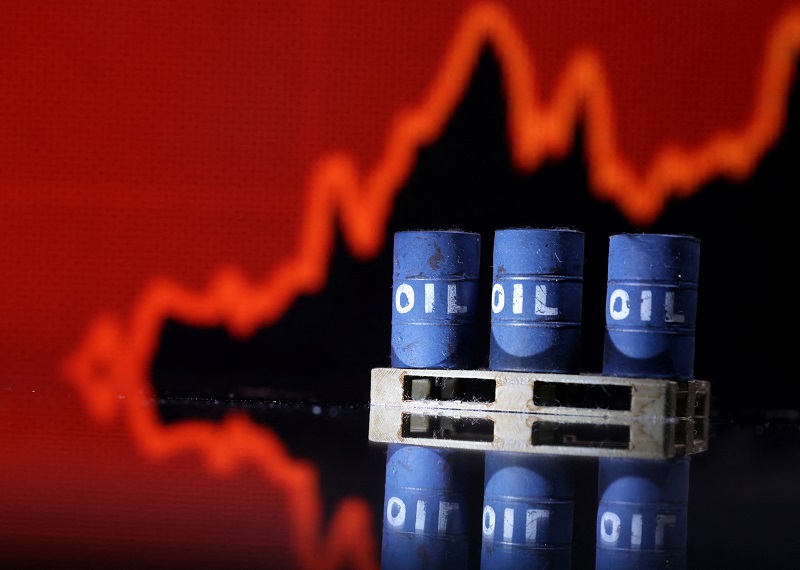
With traders increasingly confident that an end to the war is near, U.S. crude oil prices tumbled more than 11%, alleviating inflation concerns. The Strait of Hormuz is a vital waterway for global energy transportation.
“The concern about oil putting the world into a slowdown diminishes as it’s onward and upward for a possible final deal,” said Bob Doll, CEO of Crossmark, who noted that while there is still no signed U.S.-Iran deal, “it looks like it’s heading in a direction that’s enough for the market to go up.”
At 2:13 p.m. EDT the Dow Jones Industrial Average .DJI rose 914.48 points, or 1.88%, to 49,493.20, the S&P 500 .SPX gained 79.81 points, or 1.13%, to 7,121.09 and the Nasdaq Composite .IXIC gained 322.20 points, or 1.34%, to 24,424.91.
All three indexes were cruising toward their third consecutive week of gains. The Nasdaq Composite .IXIC was on course to extend its winning run to 13 days, its longest since January 1992. The small-cap Russell 2000 hit its first intraday record high since the U.S.-Iran conflict erupted.
ENERGY STOCKS SLIDE AS OIL TUMBLES
Among the S&P 500’s 11 major industry sectors, energy .SPNY was the biggest loser, with Exxon Mobil XOM.N and Chevron CVX.N among the benchmark’s top drags, down 3.9% and 2.5%, respectively.
The biggest gainer was consumer discretionary .SPLRCD, with cruise operators Carnival CCL.N and Norwegian Cruise Line NCLH.N leading gains, up more than 8% and 7%, respectively. Industrials .SPLRCI was also a top gainer, with airline stocks among its lead advancers. United Airlines UAL.O was up nearly 7%.
The CBOE volatility index .VIX hit a more than two-month low before paring losses but was still down 0.38 point at 17.57.
CAUTION PERSISTS ON STRAIT PASSAGE
Still, some analysts cautioned that logistical challenges remain for shippers.
“Ship operators still face astronomical war-risk insurance premiums, potential mine hazards, and uncertainty about enforcement,” said Erik Bethel, general partner at maritime-focused investment firm Mare Liberum.
The S&P’s biggest drag was from Netflix NFLX.O, which dropped 10% after forecasting current-quarter earnings below expectations. The company also announced the exit of co-founder and longtime Chairman Reed Hastings, ending a 29-year tenure.
Alcoa AA.N fell 6.9% after the aluminum producer reported first-quarter profit and revenue below analysts’ estimates, citing elevated costs and softening demand.
Markets are currently pricing in a 50% chance that the U.S. Federal Reserve will cut interest rates in December, based on fed-funds futures prices. This marks a drastic change from a 20% chance earlier in the session, according to LSEG-compiled data.
Advancing issues outnumbered decliners by a 4.14-to-1 ratio on the New York Stock Exchange, where there were 563 new highs and 39 new lows. On the Nasdaq, 3,566 stocks rose and 1,170 fell as advancing issues outnumbered decliners by a 3.05-to-1 ratio. The S&P 500 posted 48 new 52-week highs and no new lows.
(Reporting by Sinead Carew in New York; Additional reporting by Niket Nishant and Avinash P in Bengaluru; Editing by Tasim Zahid and Matthew Lewis)