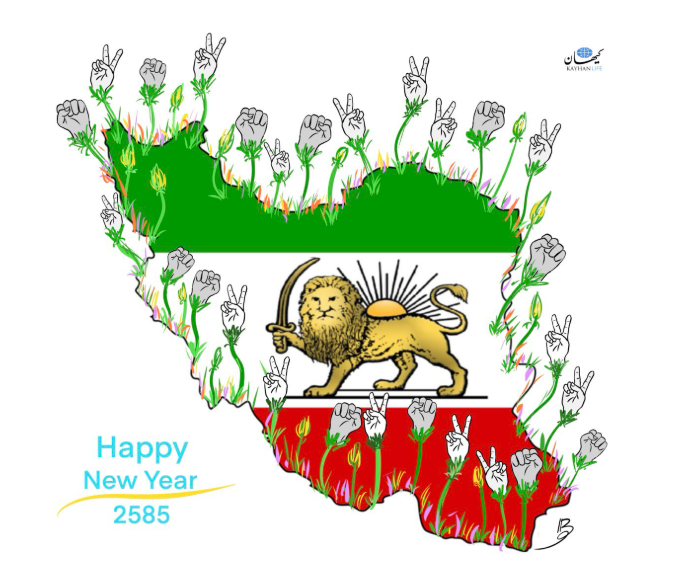
Artist: Behnam Mohammadi
By Kayhan Life Staff
On March 20, Iranians celebrate Nowruz, the Persian New Year. It arrives with the spring equinox and has roots in ancient traditions of renewal that predate Islam. For many, it is a season of rebirth and dignity, a time to heal divisions, reconnect with others, and greet spring with hope.
This heritage has become even more meaningful forty-seven years after the 1979 Revolution, amid lasting traditions and the hope for national renewal.
Nowruz 2585 carries added force for many Iranians. The year 2585 is counted from the time of Cyrus the Great and ancient Iran, rather than from the Hijra, which marks the start of the Islamic calendar. This is not simply a different way to mark the year; it declares that Iranian identity goes back further and is richer than the ideology of the Islamic Republic.
This deeper sense of identity is evident in the return of the Lion and Sun symbol, which now stands for national pride, dignity, courage, and resistance to religious rule. In recent months, both protesters and people in the diaspora have embraced this symbol so strongly that some now call their movement the “Sun and Lion Revolution” of 2026.
As Iranians celebrate Nowruz 2585, they are asserting that Iran’s future will not be decided just by violence, military actions, or changes in religious leadership. Instead, it will be formed by the people themselves, by their ability to turn loss into courage, tradition into a push for democracy, and resistance into a united future.
“Happy New Year 2585” is more than a greeting. It is a declaration that Iran is alive, belongs to its people rather than an ideology, and hopes to find peace within itself and with the world.