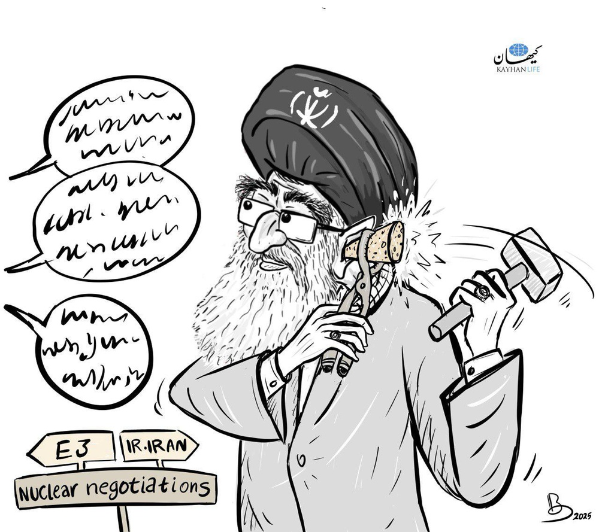
Artist: Behnam Mohammadi
Ears Plugged, Nukes Primed
Ayatollah Khamenei has perfected the art of strategic deafness. It’s his preferred method of tuning out the global chorus calling for compliance, cooperation, or even mild compromise.
For years, he has portrayed the IAEA and Europe’s “E3” (France, Germany, and the UK) as marionettes of Washington and Tel Aviv. The Supreme Leader’s doctrine remains unchanged: foreign pressure isn’t negotiation — it’s coercion.
In his worldview, Iran’s nuclear threshold isn’t a bargaining chip on the diplomatic table; it is the table. Khamenei’s project is one of self-insulation. Hammer in hand, he seals his regime from the hum of international reason. Each strike echoes his proclamation: that his regime will never yield to “imposed outcomes” or “dictated restrictions.”
The West may talk, the IAEA may warn, but Khamenei’s hearing-protection policy remains firmly in place. And so the negotiations persist: one side speaking, the other hammering.
Welcome to the Kayhan Life Week in Review
►The Islamic Republic’s economic and diplomatic fortunes took another turn for the worse this week, as one of its largest private banks collapsed, a global watchdog reaffirmed its corruption blacklist, and its shadowy foreign operations came under renewed scrutiny. At home, citizens faced fresh evidence of official neglect in the prison system. Abroad, the regime’s long arm was exposed once again in a New York courtroom.
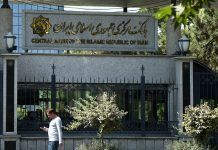
Ayandeh Bank, one of Iran’s largest private lenders, declared bankruptcy after amassing around $5.2 billion in losses and $2.9 billion in liabilities. The bank’s 270 branches — including 150 in Tehran — drew deposits from more than seven million Iranians. Much of that money was lost to bad loans and speculative real estate deals. Ayandeh relied on new deposits to pay earlier investors, many of whom were its own executives who had effectively lent billions to themselves. The British government this week sanctioned Aliakbar Ansari, Ayandeh’s principal stakeholder, for financing the Islamic Revolutionary Guard Corps.
►The Islamic Republic has been on the Financial Action Task Force (FATF) blacklist since 2020. Although the Paris-based intergovernmental body which leads global action to tackle money laundering, terrorist financing, and proliferation financing, acknowledged the Islamic Republic’s re-engagement this week, it stated that the clerical state had failed to address the majority of its action plan since 2016.
►Meanwhile, a Reuters investigation detailed how the Islamic Republic has sought to evade sanctions by routing oil sales through a New Zealand-based insurer that employed a “dark fleet” of tankers transporting crude from Iran, Russia, and Venezuela. The report revealed the increasingly elaborate measures the regime has taken to sustain its oil revenues in defiance of international restrictions.
►The Islamic Republic’s regional influence was dealt a further blow. In Lebanon, the army reported that it had destroyed so many Hezbollah weapons caches that it had run out of explosives, as it races to meet a year-end deadline to disarm the Shi’ite militia in the south of the country under a ceasefire agreed with Israel, two sources told Reuters.
►In a cautious gesture toward the West, the Islamic Republic permitted limited inspections of several nuclear facilities. However, it barred access to plants that were targeted in a joint U.S.-Israeli attack in June. The International Atomic Energy Agency reported no unusual activity at the inspected sites but noted signs of industrial-scale operations elsewhere.
►At home, the clerical state faced renewed accusations of cruelty toward its own citizens. Human Rights Watch said this week that prison officials deliberately withheld medical treatment from three female inmates who later died. Michael Page, the group’s deputy Middle East director, said, “For decades, the authorities have used the denial of even the most basic rights, such as access to medical care, as a tool of repression and punishment against prisoners.”
►Finally, in New York, two men were sentenced to 25 years in prison for plotting to assassinate Masih Alinejad, an Iranian-American journalist and human rights advocate, on behalf of the Islamic Republic. Alinejad, who has long campaigned for women’s rights in Iran, called the verdict “a day of reckoning.” Speaking to Kayhan Life, she said the trial exposed “how deeply the Islamic Republic understands and practices deceit, violence, and criminality.” Her only crime, she said, “was standing up for women in Iran who want to be free of an oppressive regime that forces them to cover their bodies.”
Kayhan Life’s Curated News Picks
Updates from Kayhan Life’s Social Media:
Treat of the Week
Eggplant Tahchin

The Kayhan Life Team wishes you a good weekend.